The race to tokenize real-world assets isn’t hype—it’s a numbers game. In a March 2023 Boston Consulting Group report pegged tokenized securities at almost $16 trillion by 2030. Yet most security-token blockchains still trip over regulator-mandated KYC, jurisdiction, and audit checks. Purpose-built networks are filling that gap. One standout is Polymesh, which bakes customer due diligence into its protocol and offers step-by-step tokenization guides. In this comparison, we rank eight platforms—starting with compliance, then adoption and performance—so you can pick the chain that keeps both your lawyers and your users happy.
Why compliance comes first
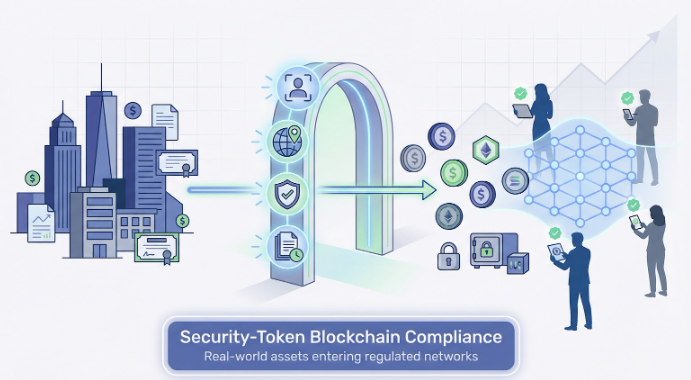
Real-world assets flowing through identity, jurisdiction, and audit checks before becoming security tokens on-chain.
A security token is not only code on a ledger; it is a regulated security. That legal label pulls an entire rulebook onto the blockchain and forces issuers to prove they can follow it.
Regulators usually test three checkpoints:
- Identity – every holder must clear KYC/AML screening.
- Transfer controls – trades must honor jurisdiction, lock-up, and accreditation rules.
- Audit durability – records must stay verifiable even after protocol upgrades.
Most open networks skip those guardrails. On Ethereum, anyone can spin up a wallet in seconds, so compliance lives in bespoke smart contracts or off-chain spreadsheets, which are easy to misconfigure and hard to police. Purpose-built chains solve this by embedding identity checks and permission logic at the protocol layer, trimming both legal risk and developer workload.
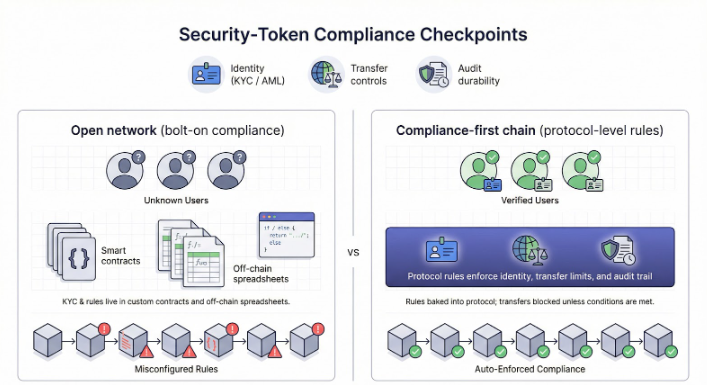
According to Polymesh’s compliance documentation, issuers attach rules that look for specific identity claims such as KYC, jurisdiction, accreditation, and custom tags before a transfer is allowed to settle. Polymesh documentation also describes protocol-level transfer restrictions that can cap the number of investors, limit any single holder’s ownership percentage, or constrain how many non-accredited or particular-jurisdiction investors can hold an asset, so checks that used to live in side spreadsheets are enforced automatically by the network.
Because compliance is non-negotiable, we score it first, then layer in five secondary factors that matter once the regulatory bar is cleared:
- Adoption & asset volume – real dollars on-chain, not white-paper promises.
- Tooling & integrations – SDKs, custodians, and data feeds that work today.
- Performance & cost – fee stability (Ethereum gas spiked to $38 during 2023 meme-coin surges, per Etherscan) and settlement speed.
- Ecosystem support – auditors, forums, and enterprise partners who can unblock you fast.
- Security & governance – how upgrades happen and who can veto a bad one.
These lenses explain why a compliance-first chain like Polymesh tops our list, while high-traffic networks such as Ethereum still rank thanks to their vast ecosystems. Keep them in mind as we compare the eight contenders. You’ll spot trade-offs quickly and choose the platform that satisfies both your lawyers and your users.
1. Polymesh: purpose-built layer-1 for regulated assets
Polymesh emerged after its founders ran into limitations on Ethereum: bolt-on KYC contracts were fragile, slow, and expensive. They responded by rebuilding the stack and placing compliance inside the protocol.
Polymesh positions itself as a purpose-built layer-1 for regulated assets, with compliance baked into the protocol.
Identity by default. Every wallet is tied to a Customer Due Diligence (CDD) check from an approved provider. Until that pass is on-chain, the address cannot receive a single token.
Policy without code. From the Polymesh SDK, an issuer can toggle jurisdiction blocks, lock-up periods, or investor caps. The chain enforces each rule, eliminating “forgot-to-whitelist” bugs. A concise walk-through of those controls lives in Polymesh’s guide on how to tokenize real world assets, covering everything from asset onboarding to secondary-market readiness.
Governance that prevents forks. Upgrades must pass a council vote of regulated entities, so securities cannot be accidentally duplicated on a split chain.
Early but real adoption.
- Tokenise minted its first security token on Polymesh in July 2022 after securing full CSD approval, calling the network “the future of tokenization.”
- AlphaPoint integrated Polymesh’s API in August 2024; its exchange software now serves 150-plus clients across 35 countries.
- As of November 2025, the network runs 97 active validators and secures more than 460 million POLYX in stake.
Trade-offs. Permissioned validators and mandatory identity checks limit anonymity and experimentation, yet they deliver sub-second finality, predictable fees, and regulatory confidence that open networks struggle to match.
For issuers of stock, bonds, or funds, Polymesh shifts compliance from custom code to a built-in feature, turning the legal team’s checklist into the chain’s default behavior.
2. Ethereum: smart-contract mainstay with bolt-on compliance
If Polymesh is a bespoke suit, Ethereum is the off-the-rack classic. Its network effects are hard to match. Electric Capital’s 2024 Developer Report counted about 6,200 monthly active developers, triple the next chain (CoinDesk). Wallets, custodians, auditors, and analytics tools already speak “Ethereum,” so an issuer can plug into talent and infrastructure on day one.
Compliance lives in the contract layer
Because anyone can activate an address, identity and transfer rules live in smart-contract standards such as ERC-1400 and ERC-3643. These frameworks work, but they push responsibility onto the issuer’s code and wallet whitelists, and each rule execution consumes gas.
Cost volatility (and why many hop to L2s)
Gas fees have ranged from less than $0.40 after the 2024 Dencun upgrade to more than $80 during 2023 meme-coin surges (CoinTelegraph). That spread drives security-token issuers to Layer-2 networks like Polygon for routine trading while keeping primary issuance on Layer-1 for its battle-tested security.
Adoption you can’t ignore
- BCAP and SPiCE VC ran two of the first regulated token offerings in 2017.
- Société Générale–FORGE launched the euro-backed stablecoin EURCV on Ethereum in 2023 and extended it to DeFi in 2025 (CoinDesk).
Bottom line
Ethereum stays the default when liquidity, tooling, and developer mind-share top the checklist. You will shoulder more compliance coding, and budget for gas or an L2 plan, than on chains where identity and transfer rules come built in.
3. Stellar: low-cost transfers with built-in authorization
Stellar keeps the offer simple: sub-penny fees, five-second finality, and protocol-level whitelisting that helps regulated assets feel at home.
On Stellar an issuer flips a single require authorization flag, and every holder must be pre-approved before a token can move. No custom contract audits, no guessing at gas prices; the rule sits inside the protocol and costs as little as 100 stroops (0.00001 XLM ≈ $0.000003).
Speed matches price. Ledgers close roughly every five seconds, fast enough for market-making and same-day settlement.
That efficiency persuaded Franklin Templeton to tokenize its U.S. Government Money Market Fund on Stellar; the fund reached $270 million AUM by March 31, 2023.
Stellar’s native order book lets compliant assets list directly against XLM, USDC, or fiat anchors. Liquidity is still modest, with about 40 listed assets averaging under $1 million in daily volume during Q3 2025, but the infrastructure is ready once regulators allow broader trading.
Trade-offs
Protocol whitelisting satisfies basic KYC, yet multifactor accreditation tiers or jurisdiction caps still need custom logic. Simple funds and bonds fit well; complex cap tables may need heavier frameworks.
If you want fast settlement and near-zero fees with straightforward KYC gates, Stellar delivers a practical middle path between compliance-first chains and do-it-yourself smart-contract builds.
4. Tezos: self-amending chain built for institutional comfort
Tezos calls itself the blockchain that upgrades itself. On-chain governance lets bakers vote new features into production, so no contentious forks arise while you safeguard billion-dollar securities.
Why compliance teams care
Developers write contracts in Michelson or Smart Py, languages that support formal verification. You can mathematically prove a transfer rule is watertight, turning a PDF audit into executable math.
Proven by European banks
- Société Générale–FORGE issued a €5 million structured product on Tezos in April 2021, describing the move as a “new step” toward digital capital-markets infrastructure.
- Brazil’s BTG Pactual relaunched its real-estate token ReitBZ on Tezos in 2020, aiming to tokenize $300 million in property through a partnership with Vertalo and tZERO (CoinDesk).
Features that matter
- FA1.2 / FA2 token standards embed whitelists, lock-ups, and multi-sig controls directly in contract logic.
- Layer-1 fees average 0.002 XTZ (≈ $0.015), and block time fell to eight seconds after the January 2025 Quebec upgrade.
- Smart Rollups plus a Data-Availability Layer showed greater than one million TPS in a 2023 public test, giving Tezos room for high-volume trading.
Trade-offs
Identity is not enforced at protocol level, so issuers must add KYC inside contracts. The chain has upgraded 18 times in six years, keeping features fresh but requiring occasional node maintenance.
If you need European precedent, mathematically provable contracts, and a chain that evolves without breaking your tokens, Tezos offers institutional comfort while preserving open participation.
5. Avalanche: speedy subnets tuned for each regulator
Avalanche makes a clear promise: sub-two-second finality and subnets you can configure like private blockchains.
What a subnet does
A subnet is a custom chain anchored to Avalanche’s security layer. You decide
- who validates,
- which token standard applies,
- which asset pays fees.
Need every validator to hold a brokerage licence? Flag it in the subnet config and launch.
Proof in the market
In September 2022, KKR tokenized a slice of its $4 billion Health-Care Strategic Growth Fund on an Avalanche subnet via Securitize, marking a first for U.S. private equity (CoinTelegraph; CoinDesk).
Performance numbers
- C-Chain throughput: about 4,500 TPS in public tests (Ava Labs benchmark, 2024).
- Finality: roughly 1.1 seconds on mainnet; subnets can go faster with smaller validator sets.
- Median fee: less than 0.0005 AVAX (≈ $0.01 at April 2025 prices).
Compliance tooling
The Evergreen Subnet framework, launched in May 2023, ships templates for KYC-gated validator pools, permissioned smart contracts, and audit-ready data exports, so policies drop in faster than building from scratch.
Trade-offs
Closed subnets fragment liquidity; assets need bridges, and often regulatory approval, to reach Avalanche’s public DEXs. For banks that value gated access over open markets, that silo is acceptable. Issuers targeting broad retail flow must weigh the cost.
If your project demands Wall Street speed with custom guardrails, Avalanche offers a direct path to build.
6. Securitize: compliance gateway across multiple chains
Securitize isn’t a blockchain; it is middleware that lets traditional issuers tokenize securities without writing a single smart contract.
Regulatory stack
- SEC-registered transfer agent and broker-dealer in the United States
- MiFID II investment-services licence in Europe
- Top-10 U.S. stock-transfer agent after acquiring Pacific Stock Transfer, serving 1.2 million investor accounts and 3,000 clients.
How it works
Investors complete KYC, accreditation, and e-signature in one dashboard; those verified attributes sync to on-chain tokens through the DS Protocol. Issuers can mint on Ethereum, Polygon, or Avalanche subnets—choosing the chain that fits their cost and speed needs. The same portal handled KKR’s $4 billion Health-Care Strategic Growth Fund tokenization on Avalanche in 2022.
Liquidity out of the box
Securitize Markets, the firm’s FINRA-regulated ATS, lists security tokens once lock-ups expire. Daily volume hovers near $600 k in Q3 2025, yet the venue gives issuers an immediate path to secondary trading. No separate exchange integration is required.
Growing footprint
After buying MG Stover in April 2025, Securitize Fund Services administers $38 billion across 715 funds. A planned SPAC deal aims to list Securitize on Nasdaq at a $1.25 billion valuation in 2026 (CoinDesk).
Trade-offs
Relying on a single vendor means pricing or policy changes cascade to every issuer. For teams that prize speed to market and strict compliance over protocol tinkering, letting Securitize run the process can feel more like an upgrade than outsourcing.
7. Tokeny: European-grade identity wrapped in ERC-3643
Tokeny tackles security-token friction at its source: identity. Instead of juggling per-asset whitelists, each investor receives a reusable ONCHAIN ID, an NFT that stores verified KYC status, jurisdiction, and accreditation.
When a transfer request reaches the chain, the smart contract checks both parties’ ONCHAIN IDs against rules baked into ERC-3643 (formerly T-REX). No valid ID, no transfer. The standard runs on any EVM chain, turning compliance into a drop-in feature.
Proof points
- Euronext bought a 23.5 percent stake for €5 million in July 2019 to streamline private-company listings.
- Enegra, a Malaysian commodities firm valued at $28 billion, moved its EGX equity tokens from Ethereum to Polygon with Tokeny in 2021 to cut gas costs (Polygon).
Why it matters
Because ONCHAIN IDs live on-chain, multiple providers can add attributes over time. A bank might tag an address “accredited,” while a law firm later adds “U.S. investor.” Issuers can then set granular policies like “U.S. accredited investors only until quarter-end” without touching spreadsheets.
Tokeny stays out of the exchange business, so custodians, brokers, and even competing platforms adopt ERC-3643 without lock-in concerns. If your audience spans several EU jurisdictions—or you simply want identity that moves with the investor—Tokeny offers a standards-driven path with no extra chains, just smarter tokens.
8. Provenance Blockchain: permissioned highway moving billions in loans
Provenance flips the public-chain playbook. Only licensed financial institutions can validate blocks, yet every transaction remains visible on a public ledger, giving banks private-club control while auditors view a complete trail.
Built for high-value credit markets
Launched by Figure Technologies in 2019 to securitize home-equity and consumer loans, Provenance logged $18.7 billion in real-world assets by May 2025, including whole-loan pools, asset-backed securities, and the bank-minted USDF stablecoin.
Compliance at the gate
Each participant signs legal agreements, clears KYC, and receives a wallet linked to its legal entity. Unknown addresses cannot transact, removing the anonymity that worries regulators.
Performance and governance
- Consensus: Tendermint BFT (Cosmos SDK)
- Finality: about six seconds per block
- Median fee: 0.002 HASH (≈ $0.0002)
Upgrades and validator additions pass through the Provenance Blockchain Foundation, whose 38 members include Figure, Apollo, Jefferies, and Brex.
Trade-offs
Retail wallets are excluded, DeFi composability is limited, and liquidity stays inside institutional corridors. For banks replacing faxed loan tapes, that control is a benefit; for issuers seeking broad retail reach, it is a constraint.
If you need to move mortgage bonds or consumer-loan pools between known counterparties with audit-ready transparency, Provenance offers capital-markets plumbing ready for production today.
Comparative analysis: where each platform leads
We’ve met the contenders; now let’s stack them against the four variables most teams ask about:
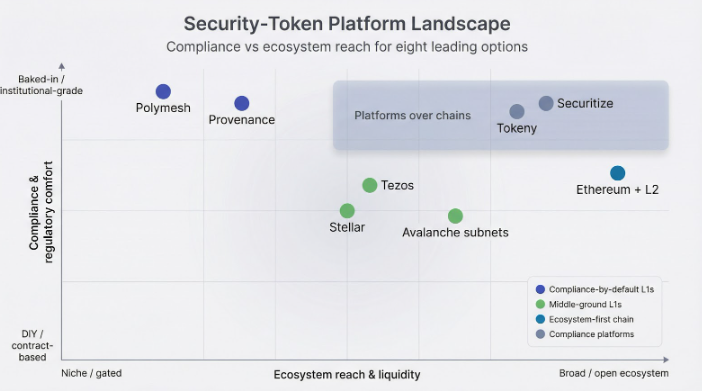
A visual map of where Polymesh, Stellar, Ethereum, Securitize, and others lead on compliance versus ecosystem reach.
- Compliance baked in?
- Real adoption (assets on-chain, as of June 2025)
- Typical throughput and fee
- Upgrade or governance comfort
Use the table as a compass; numbers will shift as networks and deals evolve.
| Platform | Compliance level | Assets tokenized | TPS / Median fee* | Governance model |
| Polymesh (2021) | Protocol-level KYC and transfer rules | 42 security tokens; Tokenise runs CSD node | ~1,000 TPS / <$0.01 | Council of regulated entities |
| Ethereum + L2 (2015) | Contract-based (ERC-1400/3643) | 300+ STOs; EURCV stablecoin by SG-Forge | 15 TPS L1 / $0.40–$5; 6,000 TPS and <$0.02 on Polygon | Community EIPs; social consensus |
| Stellar (2014) | require_authorization flag, SEP-8 | $270 M Franklin Templeton fund | ~1,000 TPS / $0.000003 | SDF proposal and validator vote |
| Tezos (2018) | Formal-verified contracts, FA2 | €5 M SocGen bond; ReitBZ real estate | ~200 TPS / <$0.02 | On-chain amendment votes |
| Avalanche subnets (2020) | Permissioned validator sets | KKR fund slice via Securitize | 4,500 TPS C-Chain / <$0.01 | Subnet-level councils |
| Securitize (2017) | SEC transfer agent; DS Protocol | $38 B across 715 funds | Chain-dependent | Private company board |
| Tokeny (2018) | ONCHAIN ID plus ERC-3643 | $28 B Enegra equity on Polygon | Chain-dependent | Private company board |
| Provenance (2019) | KYC at node; restricted wallets | $18.7 B loans and ABS | ~10,000 TPS / <$0.001 | Foundation of 38 institutions |
*Median fee converted to U.S. dollars at June 2025 prices.
Reading the patterns
- Compliance by default: Polymesh and Provenance lock down validators and wallets, trimming legal risk but limiting open-market liquidity.
- Ecosystem reach: Ethereum plus Polygon still offers the widest liquidity, though issuers carry more contract work.
- Middle ground: Stellar provides native whitelisting and micro-fees, while Avalanche lets you launch a gated subnet with sub-second finality.
- Platform over chain: Securitize and Tokeny illustrate how a strong compliance API can make the underlying chain a secondary choice.
Start with your non-negotiables: jurisdiction, investor type, and liquidity venue. Then use the table to narrow quickly. No single chain wins every metric, but one will fit your project better than any generic “top ten” list.
About the Author