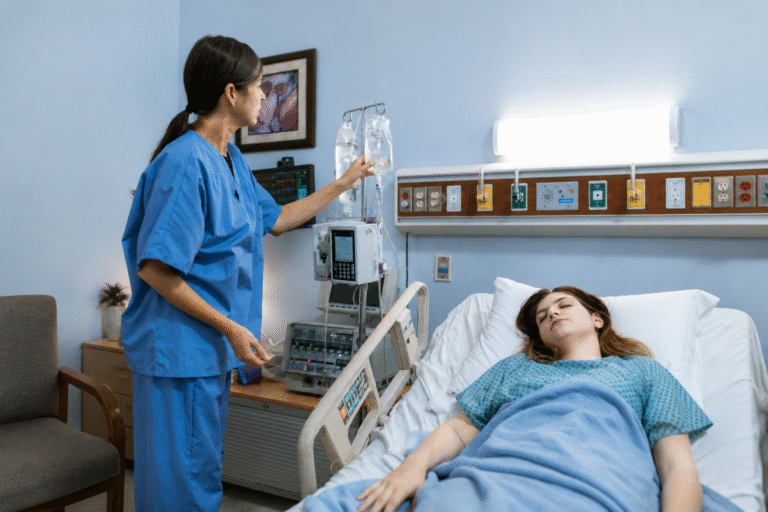
Modern medical training looks very different from the lecture-heavy approach of the past. Today, future healthcare professionals build their skills through a combination of online learning and hands-on experience in real clinical settings.
Studying remotely gives you the flexibility to learn from almost anywhere, but every healthcare degree eventually comes down to one question: how do you turn online coursework into confident patient care? It’s a fair concern.
After all, no one becomes a capable clinician by reading textbooks alone. The answer lies in a carefully designed mix of virtual simulations, supervised placements and partnerships with healthcare providers in your local community.
Bridging the Digital and Physical Worlds
Healthcare education demands both knowledge and practical ability. While lectures and theory work well online, developing clinical skills requires a different approach.
High-fidelity simulations let you work with virtual patients, assess symptoms and make treatment decisions in a safe environment where mistakes become learning opportunities rather than real-world consequences.
You can repeat scenarios as many times as needed to build confidence before stepping into a clinical setting.
Technology is designed to support that transition, not replace it. Interactive case studies and branching clinical scenarios show how every decision affects patient outcomes.
You practise reading vital signs, completing documentation and applying clinical reasoning through specialised platforms. Instead of simply memorising information, you’re learning how to use it in realistic situations.
By the time you begin your first placement, many of the processes already feel familiar. Virtual learning lays a foundation that makes the transition to patient care far less daunting, helping you build confidence as your training progresses.
Fulfilling Clinical Benchmarks in Specialised Tracks
Some healthcare professions have particularly structured clinical requirements. For example, if you choose to pursue an online masters in SLP to become a speech-language pathologist, you’ll need to meet specific accreditation standards.
Accredited programs generally require 400 hours of professional experience, including 375 hours of direct clinical practicum and 25 hours of supervised observation. These benchmarks ensure graduates develop the same practical competencies as students completing campus-based degrees.
Clinical experiences usually span several semesters and include work with both children and adults. Alongside approximately 46 credits of coursework, you’ll complete placements involving speech, language and swallowing disorders.
Many programs also include mandatory in-person residencies where faculty assess your progress, provide feedback and observe your clinical skills firsthand.
This combination of online study and supervised practice ensures you’re ready for professional work after graduation.
Building Local Networks for Hands-On Internships
One of the biggest concerns for online students is finding a suitable clinical placement. Rather than leaving students to organise everything themselves, many established programs have dedicated placement teams that coordinate these experiences.
They handle legal agreements, insurance requirements and accreditation checks with approved healthcare providers close to where you live.
This approach offers several practical advantages:
- You build professional relationships with healthcare providers in your local area.
- Clinical placements can sometimes lead to future employment opportunities.
- You avoid the expense and disruption of relocating for extended placements.
- Working within your own community helps you understand local healthcare needs.
Because placement coordinators maintain networks of approved clinics, hospitals, schools and healthcare organisations, they can often match students with sites that support their certification requirements. That means you can spend more time developing your clinical skills and less time navigating administrative processes.
The Role of Immersive Technology in Diagnostic Thinking
Online learning in healthcare has moved far beyond simple recording of lectures and audio/video conferencing. Some institutions use new technologies, such as virtual reality, to provide you with the experience of working in a challenging clinical environment.
You could face emergency situations in a virtual intensive care unit or make decisions in a virtual operating room.
All of these allow you to make clinical decisions in a realistic environment without harming patients, which will help increase your confidence and reinforce the theoretical knowledge acquired through online classes.
Interactive discussion of medical cases is another important part of your study. Along with other students, you analyse the patient’s medical history, interpret his/her imaging studies and discuss treatment options and clinical decisions under the supervision of your professors.
All these activities are consistent with what is happening in modern medicine, where healthcare professionals have to cooperate with each other on a regular basis and provide the best care to the patient regardless of their specialisation.
Mastering Telehealth in a Digital-First Era
As healthcare increasingly includes virtual care, clinical education has adapted to reflect these changes. Online programs are well suited to introducing telehealth because you’re already working in digital learning environments.
Many include training in remote patient monitoring, secure video consultations, electronic health record (EHR) systems and privacy requirements such as HIPAA.
These skills become part of your routine long before you begin treating patients independently.
Communicating through a screen also requires its own approach. You’ll learn how to build rapport remotely, recognise non-verbal communication and keep patients engaged during virtual appointments.
Some programs also include simulated telehealth consultations and training on regulatory requirements that apply across different jurisdictions, helping prepare you for the realities of modern healthcare.
As digital healthcare continues to expand, experience with telehealth can be valuable when entering the workforce. Graduates leave prepared to provide care in both traditional clinical environments and virtual settings.
Finding Balance During Your Final Semesters
Succeeding in a hybrid healthcare degree takes planning, organisation and consistency. During your final semesters, your focus gradually shifts from online coursework to intensive clinical placements. Managing both successfully means setting realistic routines and staying organised throughout the process.
Creating a dedicated study space at home can help separate academic work from your personal life, making it easier to stay focused during online classes.
Many programs spread this progression across five semesters. Early coursework concentrates on scientific foundations and virtual learning activities, while later semesters place greater emphasis on supervised clinical experience with patients.
Using digital tools to track clinical hours, following a structured study schedule and participating in peer study groups can help you manage the workload. Just as importantly, these habits provide valuable academic and personal support during one of the busiest stages of your degree.
Ultimately, combining flexible online learning with structured, community-based clinical experience produces graduates who are knowledgeable, adaptable and prepared for the realities of modern healthcare.
About the Author