Continuing education is booming: U.S. professionals now invest $95 billion a year in courses, webinars, and micro-credentials to keep licenses current (GlobeNewsWire, 2025). Yet every CME, CLE, CEU, and CPE credit demands airtight records, and spreadsheets buckle under hybrid learning’s complexity.
A purpose-built learning management system fixes that. It verifies attendance, stamps each quiz, and emails certificates instantly—so your team can scale programs without audit-night panic.
In this guide, we rank the ten LMS platforms that nail credit tracking, spotlighting compliance, engagement, and integrations in crisp, jargon-free bites. Ready? Let’s dive in.
Why credit tracking matterS
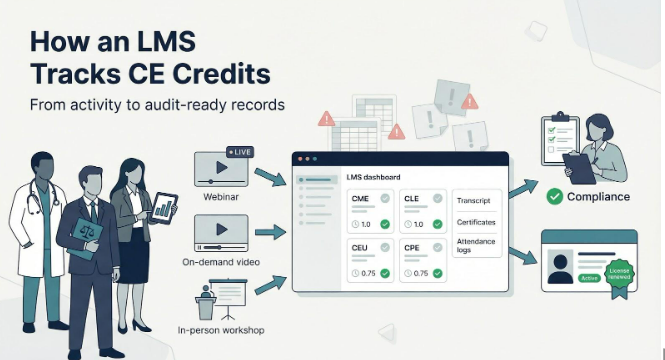
Credits are the currency of continuing education. Without airtight records, a physician cannot renew a license, an attorney faces malpractice penalties, and a finance professional risks losing a designation.
Many programs still juggle hours in spreadsheets. That manual shuffle is error-prone and costly. A 2025 analysis found administrators spend up to 40 percent of their week reconciling attendance logs, only to spot missing data just before an audit (creators.toolsinfo.com).
A modern LMS stops the scramble. It stamps every webinar minute, quiz score, and survey response on the learner’s transcript as each action occurs. Certificates generate automatically. Multi-credit activities, such as a single course that grants both CME and nursing contact hours, receive the same precise tracking.
The payoff is twofold: regulators see flawless compliance, and learners get instant proof that keeps them coming back.
The shift to digital learning (and why it accelerates credit chaos)
Classrooms still matter, but screens now lead. By late 2025, hybrid and fully online delivery eclipsed in-person sessions for the first time, powered by webinars, virtual conferences, and bite-sized modules professionals fit between patient rounds or court hearings (GlobeNewsWire, 2025).
Learners love the flexibility, and they vote with their wallets. Programs that bundle credit-bearing micro-credentials see enrollment jump more than two times compared with identical courses that skip the formal credit hook (myceapp.com, 2025).
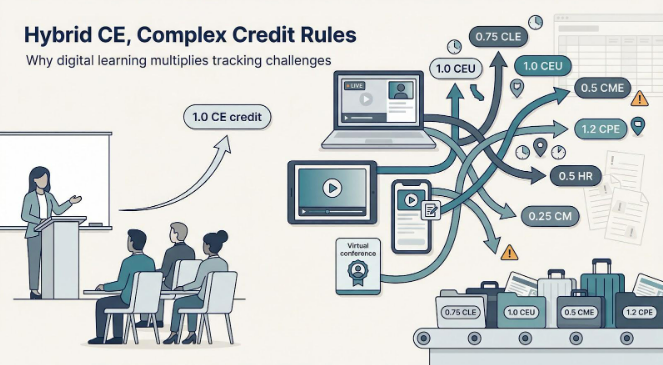
Every new format adds another timestamp, attendance rule, and partial-credit edge case to track. A one-hour live webinar may grant 0.75 CLE in one state and 1 CEU elsewhere. Self-paced videos demand their own timers. Without a smart LMS, those nuances stack up like unchecked luggage, slowing teams and frustrating regulators.
Digital growth is great for reach, yet brutal for anyone still logging hours by hand.
How we ranked the top CE LMS platforms
We approached our ranking like an accreditation board auditing a course, systematically and with no wiggle room.
First, we built a scoring matrix that mirrors the headaches CE administrators face. Credit tracking and certificate automation carried the most weight because, without them, nothing else matters. Integration muscle came next; an LMS must talk to your webinar tool, AMS, or payment gateway without drama. We then considered learner experience, content flexibility, reporting depth, opportunities to monetize, and, finally, overall value for money.
To put numbers behind the matrix, we ran each platform through:
- Hands-on demos that let us issue test certificates, map credit types, and pull compliance reports.
- Verification of integration catalogs and API docs.
- Analysis of hundreds of recent user reviews to spot support or scalability red flags.
- Interviews with CE program managers who rely on these systems daily.
Scores rolled up on a 100-point scale, and the ten highest performers made the cut you will see next. The result is a list grounded in field evidence, not vendor talking points, so you can shortlist with confidence.
The top 10 CE LMS platforms (ranked)
1. GoSkills: fast, friendly, and surprisingly flexible
GoSkills began as a corporate training portal, yet its polished interface and built-in certificate engine suit continuing education programs well. Upload SCORM files or choose from hundreds of ready-made soft-skills courses, then set pass marks and expiration dates with a few clicks. Learners glide through clear dashboards, collect branded certificates instantly, and earn badges that encourage repeat visits.
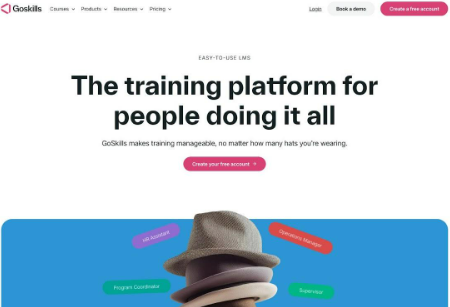
Administrators appreciate the low-stress setup; most teams launch in under an hour and move all training and certification records out of spreadsheets and into one clean dashboard—you can learn more about the LMS to see the shift in action.
Pricing follows a predictable per-learner subscription, so you can pilot with a small cohort before scaling. GoSkills does not provide direct integrations with state boards or ACCME’s PARS, so advanced compliance reporting remains on your to-do list. If you need quick deployment, smooth user experience, and basic credit tracking, this platform delivers strong value.
2. Oasis LMS: compliance powerhouse for multi-credit programs
Oasis focuses on one job: satisfying regulators. The platform tracks multiple credit types in a single activity, handles fractional hours, and sends physician CME directly to ACCME’s PARS with no manual clicks.
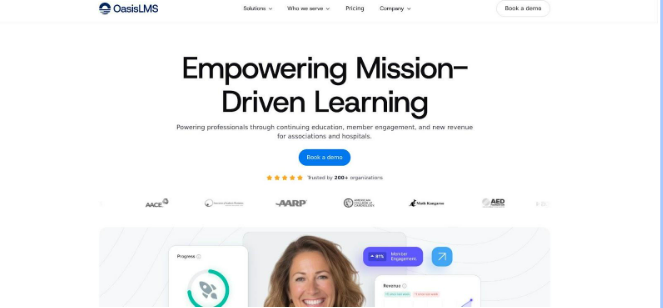
It excels for associations and hospital systems that run large catalogs of live webinars, on-demand videos, and in-person workshops. Each event feeds a unified transcript, so learners see every CME, CNE, or CLE in one place.
E-commerce is strong, too. Price courses by member tier, bundle subscriptions, or sell conference recordings the next day. Custom portals let client hospitals apply their own branding while you keep master data under one roof.
Setup takes longer and pricing sits in the enterprise range, yet programs that juggle strict accreditation rules across thousands of learners often recover the cost through audit time saved.
4. Blue Sky eLearn (Path LMS): association-friendly and admin-approved
Path LMS meets associations where t
hey work: a mix of live webinars, annual conferences, and an expanding library of on-demand courses. Its standout feature is usability. New admins launch sessions in minutes, drag in SCORM files, and sync registrants from Zoom or Salesforce without decoding complex settings.
Learners browse a clean catalog, register at the member rate, and download a certificate as soon as they complete the post-event evaluation. Discussion boards and bite-size quizzes add enough interactivity to keep professionals engaged between tasks.
Pricing falls in the mid-range, and deep customization is limited, yet Path’s blend of simplicity and capability suits small-to-mid-size associations that need solid credit tracking without adding specialist staff.
5. EthosCE: healthcare’s gold standard for CME compliance
Hospitals and medical schools choose EthosCE when precision is non-negotiable. The platform embeds every ACCME rule in its workflow, from faculty disclosures to post-test score thresholds, then reports credits directly to PARS without human intervention.

Adaptive quizzes, case-based assessments, and maintenance-of-certification tracking live in one system. Security meets clinical expectations with HIPAA-ready hosting, detailed audit trails, and role-based permissions that satisfy strict IT teams.
EthosCE delivers deep functionality and carries a learning curve along with enterprise pricing. For programs managing grand rounds, enduring materials, and joint accreditation across thousands of clinicians, few LMS options match its compliance coverage out of the box.
6. CE21: one login for members, courses, and credits
CE21 blurs the line between an association management system and an LMS, reducing passwords and data silos. Members register for events, pay dues, and launch courses from the same portal, while staff access a unified record that merges attendance, purchases, and earned credits.
Credit reporting is strong, especially for legal education. In states that accept electronic CLE submissions, CE21 submits data directly to the bar, saving administrators manual work. A branded mobile app lets busy professionals stream lessons in transit and download certificates immediately after completion.
Feature depth is intentionally moderate, so highly custom workflows may feel limited. For associations seeking simplicity and an all-in-one tech stack, CE21 keeps operations organized and learners on track.
7. InReach CE: big catalogs, bigger reports
For organizations that handle hundreds of courses and thousands of learners, InReach has delivered reliable scale for more than two decades. Staff tag content by topic, license type, or state, then sell individual courses or bundled subscriptions through a storefront that feels familiar to ecommerce shoppers.
InReach excels at analytics. Administrators segment data by user, region, credit category, and revenue stream, producing board-ready audit files in minutes. Automated reminder emails alert learners before certificates expire, reducing compliance gaps.
The interface feels dated beside newer SaaS tools, and social learning features are limited. Programs that prioritize stability, ecommerce strength, and detailed reporting will find InReach a dependable option.
8. Academy of Mine: customizable, commerce-ready, and client-friendly
Think of Academy of Mine as a modular platform for professional training businesses. Administrators assemble components—SCORM modules, live Zoom classes, client sub-portals, custom certificates—into a branded site that also manages marketing pages and checkout.
Most plans allow unlimited learners, keeping costs predictable as you grow. Corporate clients value dedicated dashboards where HR tracks staff credits without viewing other companies’ data. Need a niche workflow? The vendor’s development team often builds it on request.
You provide the content and should budget time for configuration, yet providers selling CE at scale and seeking control over every page and purchase path will appreciate Academy of Mine’s flexibility.
9. Cornerstone OnDemand: enterprise muscle for global CE rollouts
Cornerstone is the heavy hauler of learning platforms: large, configurable, and capable of unifying every training program—internal or external—under one roof. Extended-enterprise modules create branded portals for members or customers while HR continues to use the same backend for employee compliance.
Certification paths are fully programmable. Set courses to expire each year, trigger automatic re-enrollment, and surface AI-driven recommendations so learners always know what is next. Robust APIs connect to almost any AMS, CRM, or data warehouse you require.
The trade-off is complexity. Implementations can span months, and licensing targets Fortune-level budgets. Organizations delivering CE to tens of thousands worldwide gain scale they will not outgrow; smaller programs may find the platform more than they need.
10. TalentLMS: budget-friendly and live in an afternoon
TalentLMS shows you do not need a large budget to run a polished CE program. Sign up, brand your portal, drag and drop content, and start issuing certificates the same day. Branches create mini-sites for separate clients or departments, while mobile apps allow learners to download modules for offline study.

Gamification elements—badges, points, leaderboards—encourage voluntary learners to finish courses. Pricing is transparent and low, with tiers that expand as your roster grows. The platform does not auto-report nursing hours or split a single course into multiple credit categories, yet for straightforward certificate issuance and a user experience that works consistently, TalentLMS is a cost-effective choice.
At-a-glance comparison
The table below distills the essentials—credit capability, integration depth, user experience, commerce tools, analytics strength, and approximate price tier—into one quick scan.
| LMS | Credit tracking | Compliance integrations | Ease of use | E-commerce | Reporting | Price tier* |
| GoSkills | Basic certificates, single-type credits | APIs only | Excellent | Limited | Standard | $ |
| Oasis LMS | Multi-credit, fractional hours | ACCME, CE Broker | Good | Robust | Detailed | $$ |
| BeaconLive | Auto certificates for live and on-demand | Webinar platforms | Good | Strong store | Strong | $$ |
| Blue Sky eLearn | Solid certificates and SCORM | AMS, Zoom | Excellent | Basic | Strong | $ |
| EthosCE | Full CME suite | Direct PARS feed | Moderate | Minimal | Granular | $$ |
| CE21 | Multi-type certificates | Bar submissions | Excellent | Storefront | Standard | $ |
| InReach CE | Reliable transcripts | APIs | Fair | Excellent | Excellent | $–$$ |
| Academy of Mine | Custom certificate logic | APIs, Zoom | Good | Full suite | Good | $ |
| Cornerstone | Complex renewals | Extensive APIs | Moderate | Add-on | Enterprise | $$ |
| TalentLMS | Basic certificates | APIs, Zapier | Excellent | Simple | Basic | $ |
*One dollar sign equals entry-level pricing; four would indicate high enterprise spend.
How to choose the right CE LMS
Start with a mirror, not a product brochure. List the must-haves your program cannot live without—multi-credit tracking, PARS reporting, member pricing, and so on. Circle the top three. Any platform that fails those tests exits the stage early.

Next, match platform scale to audience size. A 500-member nursing association rarely needs Cornerstone’s horsepower, while a global medical society may outgrow a starter tool quickly. Pick the smallest system that still leaves room to expand.
Budget includes more than the license. Factor in implementation hours, integration work, and staff training. A mid-priced vendor with white-glove onboarding can beat a bargain tool that costs weeks of internal time.
Demand story-driven demos. Ask vendors to show a real scenario: a learner attends a webinar, passes a quiz, and receives a multi-credit certificate. If clicks pile up or reports look confusing, note the red flag.
Finally, test with real users. A one-week pilot reveals more than any slide deck. If learners navigate intuitively and admins pull reports without frustration, you have likely found your fit.
About the Author