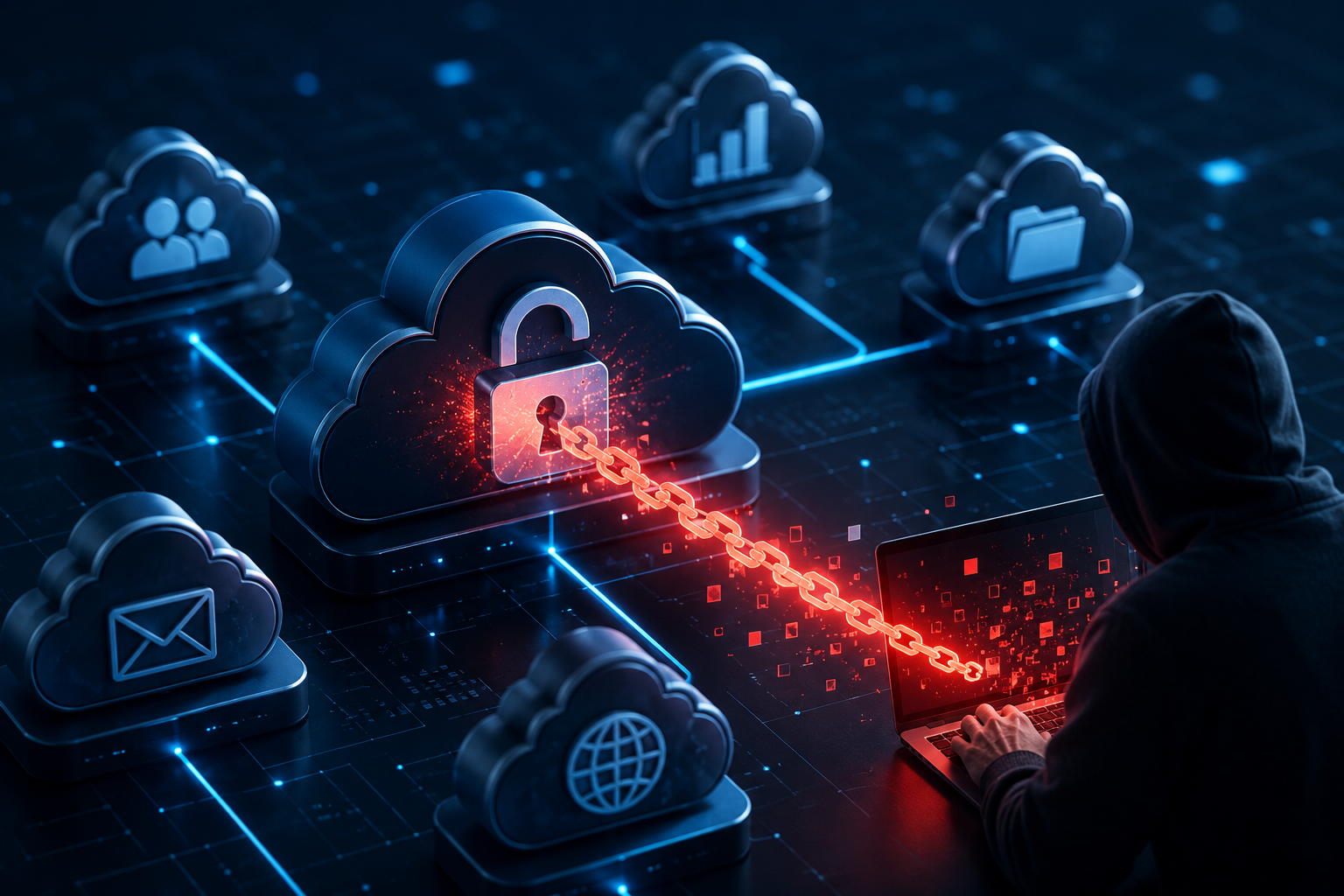
As businesses continue moving critical operations to the cloud, SaaS Supply-Chain Breaches have emerged as one of the fastest-growing cybersecurity threats. Modern organizations depend on dozens, or even hundreds, of interconnected Software-as-a-Service (SaaS) applications that exchange data through trusted integrations. Instead of attacking a company’s network directly, cybercriminals are increasingly targeting these trusted software connections and exploiting weaknesses in the software supply chain. One of the most concerning techniques involves stealing OAuth tokens, which allow attackers to gain authorized access to cloud applications without needing a user’s password. This shift has made cloud security and SaaS security top priorities for organizations of every size.
As Bruce Schneier famously said, “Security is a process, not a product.” That statement is especially relevant today, as protecting interconnected SaaS environments requires continuous monitoring, strong identity controls, and careful management of third-party access. This article explains how OAuth token theft works, why SaaS Supply-Chain Breaches are increasing, and the practical steps organizations can take to reduce their risk.
What Are SaaS Supply-Chain Breaches?
SaaS Supply-Chain Breaches occur when attackers compromise a trusted Software-as-a-Service (SaaS) provider, integration, or third-party application to gain unauthorized access to multiple organizations. Rather than attacking each business individually, cybercriminals exploit the trusted connections between cloud applications. Because companies rely on interconnected software to manage communication, customer data, finance, and daily operations, a single compromised service can have widespread consequences.
Many organizations use cloud-based productivity suites, CRM platforms, finance software, and collaboration tools that continuously exchange information. These applications often communicate using APIs and OAuth permissions, allowing them to share data without requiring users to log in repeatedly. While this improves efficiency, it also creates additional opportunities for attackers. If one trusted application or integration is compromised, attackers may gain access to several connected systems, making cloud security, SaaS security, and protection of the software supply chain more important than ever.
What Are SaaS Supply-Chain Breaches?
SaaS Supply-Chain Breaches occur when attackers compromise a trusted Software-as-a-Service (SaaS) provider, integration, or connected application instead of attacking an organization directly. To understand the concept, it helps to know the SaaS meaning: SaaS refers to software delivered over the internet that users access through a web browser rather than installing it on local computers. Businesses rely on these cloud-based services for communication, customer management, finance, collaboration, and productivity.
Today’s SaaS applications exchange information through APIs and OAuth permissions, allowing employees to sign in once and securely share data between multiple services. While these trusted connections improve productivity, they also expand the organization’s attack surface. If attackers steal an OAuth token or compromise a trusted integration, they may gain access to several connected applications without needing passwords. As a result, a single data breach can spread across an organization’s entire software supply chain, making cloud security, SaaS security, and identity and access management more important than ever.
Common examples include productivity suites connected with document storage, CRM platforms synchronized with marketing tools, finance software linked to payment systems, and cloud collaboration platforms integrated with hundreds of third-party applications.
Understanding the SaaS Ecosystem
Modern businesses depend on dozens of cloud applications that communicate through APIs, OAuth permissions, webhooks, and automation platforms. These integrations allow information to flow automatically between systems, reducing manual work and improving efficiency. For example, a CRM platform can automatically update customer information in an email marketing tool, while finance software exchanges data with accounting applications. Although these connections save time, they also introduce third-party risk management challenges because every connected application becomes part of the organization’s broader computer security and information security strategy. Effective cyber security SaaS programs require organizations to continuously monitor these trusted relationships and apply SaaS security best practices.
Why Supply Chain Attacks Are Increasing
Cybercriminals increasingly prefer targeting software vendors and SaaS providers because one successful compromise can affect thousands of customers simultaneously. Rather than attacking organizations individually, attackers exploit trusted software relationships, stolen OAuth tokens, or vulnerable integrations to maximize their reach. Rapid cloud adoption, growing reliance on third-party services, and increasingly interconnected business systems have made these attacks far more attractive.
Several high-profile incidents demonstrate this trend. The SolarWinds supply chain attack showed how compromised software updates could impact thousands of organizations worldwide. More recent incidents such as the 3CX supply chain attack, npm supply chain attack, PyPI supply chain attack, and the Shai-Hulud npm supply chain attack highlight how attackers increasingly target software repositories and developer ecosystems. These examples reinforce why securing the modern supply chain attack landscape requires stronger visibility, continuous monitoring, and proactive identity protection.
Traditional Data Breach vs SaaS Supply-Chain Breach
| Feature | Traditional Data Breach | SaaS Supply-Chain Breach |
| Initial Target | Organization | Trusted SaaS Vendor |
| Entry Method | Stolen passwords | OAuth Tokens |
| Scale | Single organization | Multiple organizations |
| Detection | Often quicker | Usually delayed |
| User Interaction | Required sometimes | Often none |
| Risk Level | Moderate | Very High |
What Is OAuth and Why Do SaaS Apps Use OAuth Tokens?
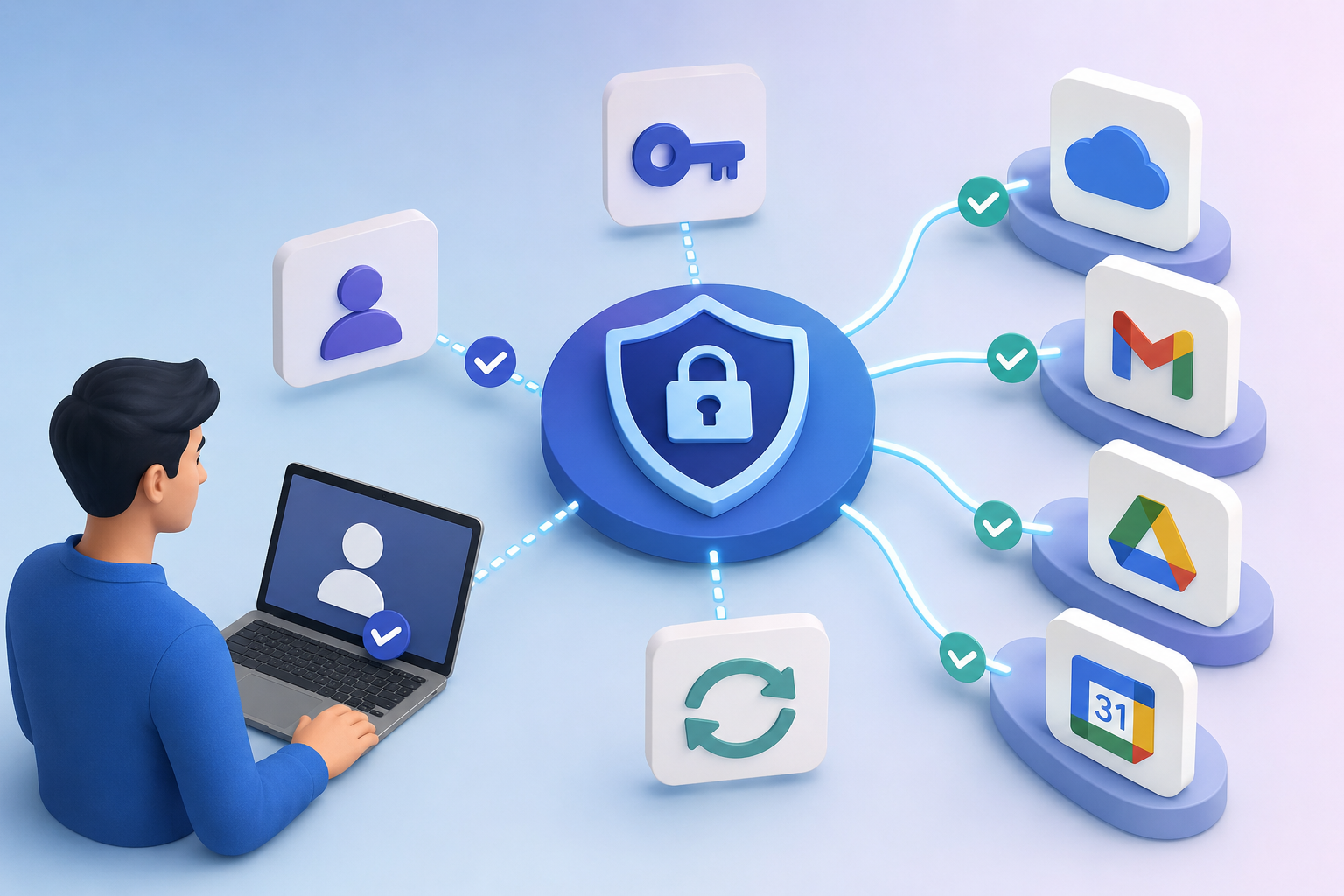
To understand why SaaS Supply-Chain Breaches are becoming more common, it is important to understand OAuth. OAuth is an open authorization framework that allows one application to access specific resources in another application without knowing or storing the user’s password. Instead of sharing login credentials, users simply approve the requested permissions, and the application receives a secure token that grants limited access.
Think of OAuth like receiving a hotel key card. Your identity is verified when you check in, but the key card only grants access to your assigned room, not every room in the hotel. Similarly, OAuth tokens grant limited permissions instead of unlimited access. This approach improves cloud security, simplifies identity and access management, and enhances the user experience because people do not need to repeatedly enter passwords for every connected application.
However, OAuth also introduces new security challenges. If attackers steal an access token through phishing, malware, or a compromised SaaS application, they may gain authorized access without ever knowing the user’s password. This is one reason modern SaaS Supply-Chain Breaches can spread rapidly across interconnected cloud environments and become a serious data breach affecting multiple organizations.
Authentication vs Authorization
Authentication and authorization are related but different concepts.
- Authentication answers the question: Who are you? It verifies your identity using a password, biometric scan, or multi-factor authentication.
- Authorization answers the question: What are you allowed to access? After your identity is confirmed, the system decides which files, applications, or services you can use.
For example, entering your office building with your employee ID is authentication. Being allowed to enter only your department’s workspace is authorization. OAuth focuses on authorization by allowing users to safely delegate access without exposing passwords.
How OAuth Tokens Work
OAuth relies on several components that work together to provide secure delegated access:
- Access Token: A short-lived token used by an application to access approved resources.
- Refresh Token: A longer-lived token that requests a new access token after the previous one expires.
- Scopes: Define exactly what the application can access, such as email, files, or calendar events.
- Permissions: Specify the actions the application can perform, such as viewing or editing data.
- Expiration: Access tokens typically expire after a limited time to reduce the impact of token theft.
- Delegated Access: Users grant limited access without revealing their passwords.
A typical OAuth workflow looks like this:
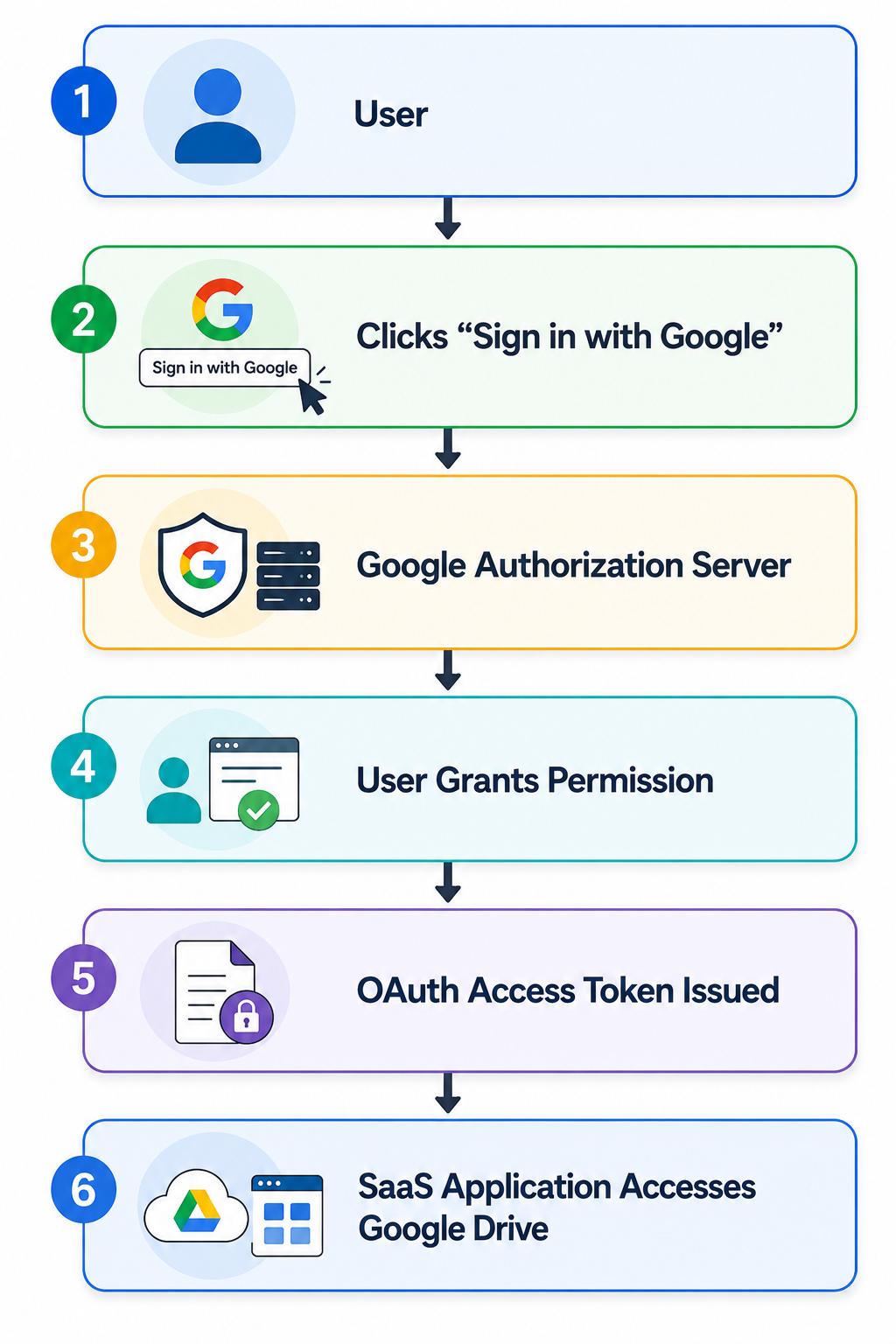
Once permission is granted, the application uses the access token whenever it needs information. Instead of sending the user’s password, it includes the token in each request.
GET /userinfo HTTP/1.1
Host: api.example.com
Authorization: Bearer eyJhbGciOiJIUzI1Ni…
In this example, the application proves it has permission by presenting the OAuth access token. The user’s password never leaves the authorization server, improving information security and reducing credential exposure.
Why OAuth Is Widely Used in SaaS
Businesses rely on OAuth because it provides a secure and convenient way to connect cloud applications, automation platforms, CRM systems, productivity tools, and collaboration software. Employees can sign in once and securely access multiple connected services without repeatedly entering passwords. This reduces password fatigue while supporting modern SaaS security and cyber security SaaS strategies.
At the same time, organizations must follow SaaS security best practices, including monitoring OAuth permissions, limiting token scopes, regularly reviewing third-party integrations, and strengthening third-party risk management. These measures help reduce the likelihood that stolen tokens will be exploited in future software supply chain attacks.
Passwords vs OAuth Tokens
| Passwords | OAuth Tokens |
| Verify identity | Grant permissions |
| Usually permanent until changed | Usually temporary with expiration |
| User-managed | Application-managed |
| Shared directly during login | Never shared directly with third-party apps |
| Easier for users to rotate manually | Often forgotten after approval, requiring careful monitoring |
What Is OAuth Token Theft?
OAuth token theft is a cyberattack in which attackers steal a valid OAuth access token instead of trying to steal a user’s password. Since the token already proves that an application has permission to access specific resources, attackers can use it to access cloud services as if they were the legitimate user. This technique has become a major driver behind modern SaaS Supply-Chain Breaches because organizations increasingly rely on interconnected SaaS applications and trusted integrations.
Imagine an employee approves a third-party application to access their cloud storage or email account. Instead of targeting the employee’s password, an attacker steals the issued access token. If the token remains valid, the attacker may be able to access sensitive business data, increasing the risk of a data breach across the organization’s software supply chain. This is why cloud security, SaaS security, and strong identity and access management have become essential components of modern computer security and information security strategies.
A simplified workflow looks like this:
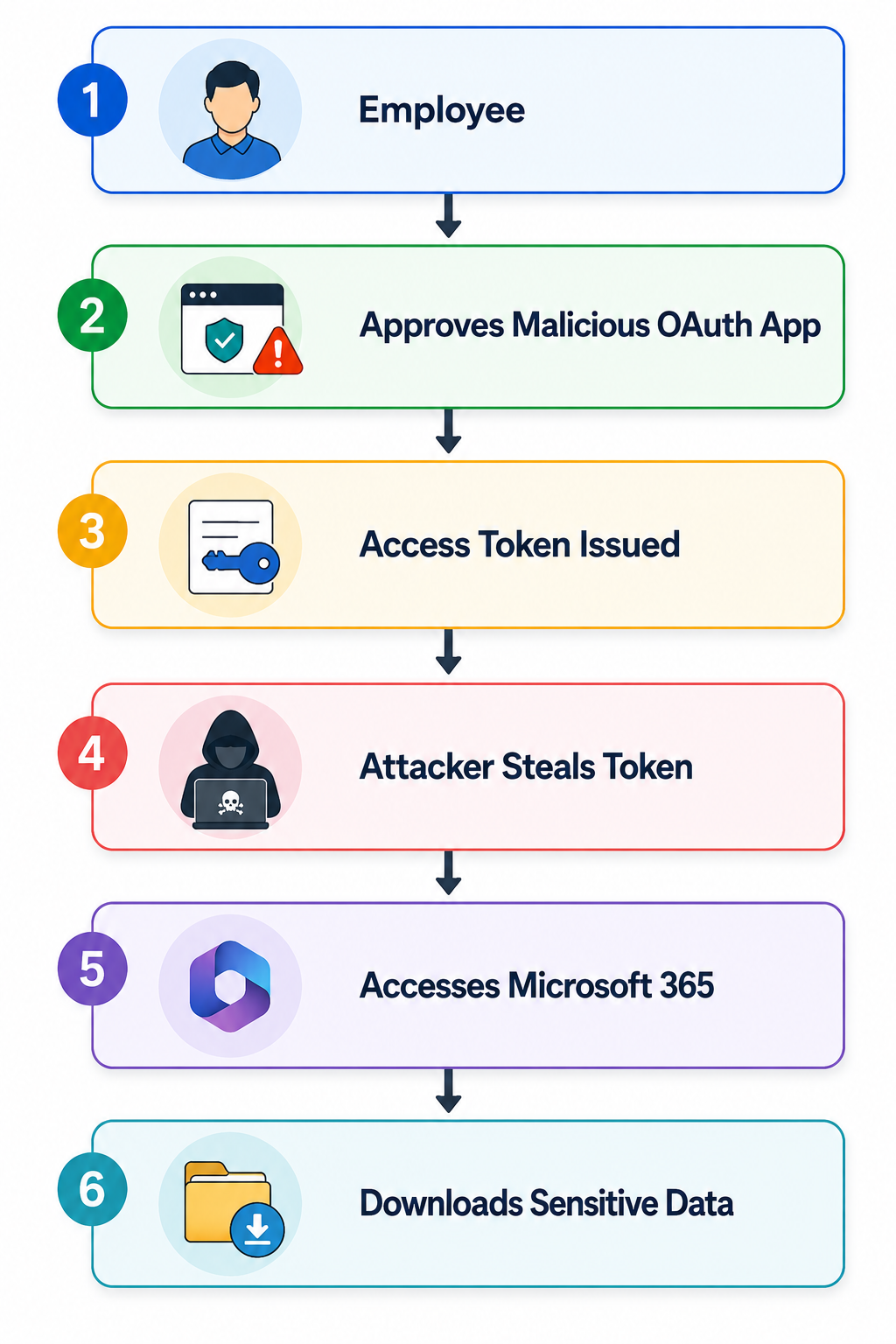
This example illustrates how the attacker abuses an already approved permission rather than breaking into the account through traditional login methods.
Common Token Theft Techniques
Attackers use several techniques to obtain valid OAuth tokens. Common methods include phishing emails that redirect users to fake login pages, deceptive OAuth consent screens requesting excessive permissions, malicious browser extensions that capture authentication information, malware designed to steal browser session data, compromised APIs, and stolen session tokens from infected devices. In some cases, attackers compromise trusted third-party applications, turning them into entry points for a broader supply chain attack. These evolving tactics highlight why effective third-party risk management and SaaS security best practices are critical for organizations using cloud-based services.
Many OAuth implementations also use JSON Web Tokens (JWTs). A simplified JWT has three sections:
Header.Payload.Signature
A decoded JWT might look like this:
{

  "sub": "user123",

  "scope": "read:files",

  "exp": 1750000000

}
In this example:
- sub identifies the authenticated user or application.
- scope specifies the permissions that have been granted, such as reading files.
- exp indicates the token’s expiration time, after which it should no longer be accepted.
The Header identifies the token type and signing algorithm, the Payload contains approved claims such as user identity and permissions, and the Signature helps verify that the token has not been altered. Understanding these components helps explain how OAuth securely delegates access without exposing passwords.
Why Token Theft Is So Dangerous
Token theft is especially dangerous because stolen tokens often allow attackers to bypass passwords and even multi-factor authentication (MFA). Since the user has already completed the authentication process, the token acts as proof of authorized access until it expires or is revoked. This can make malicious activity difficult to detect, allowing attackers to quietly access emails, cloud storage, collaboration platforms, and business applications.
High-profile incidents involving the SolarWinds supply chain attack, 3CX supply chain attack, and attacks targeting package repositories such as the npm supply chain attack, PyPI supply chain attack, and the Shai-Hulud npm supply chain attack demonstrate how trusted software relationships can become valuable attack paths. While these incidents did not all involve OAuth token theft, they underscore the growing importance of securing every component of the software ecosystem. Discussions surrounding the TanStack supply chain attack have similarly reinforced the need for continuous monitoring, least-privilege access, and comprehensive cyber security SaaS practices.
How SaaS Supply-Chain Breaches Happen (OAuth Token Theft Wave)
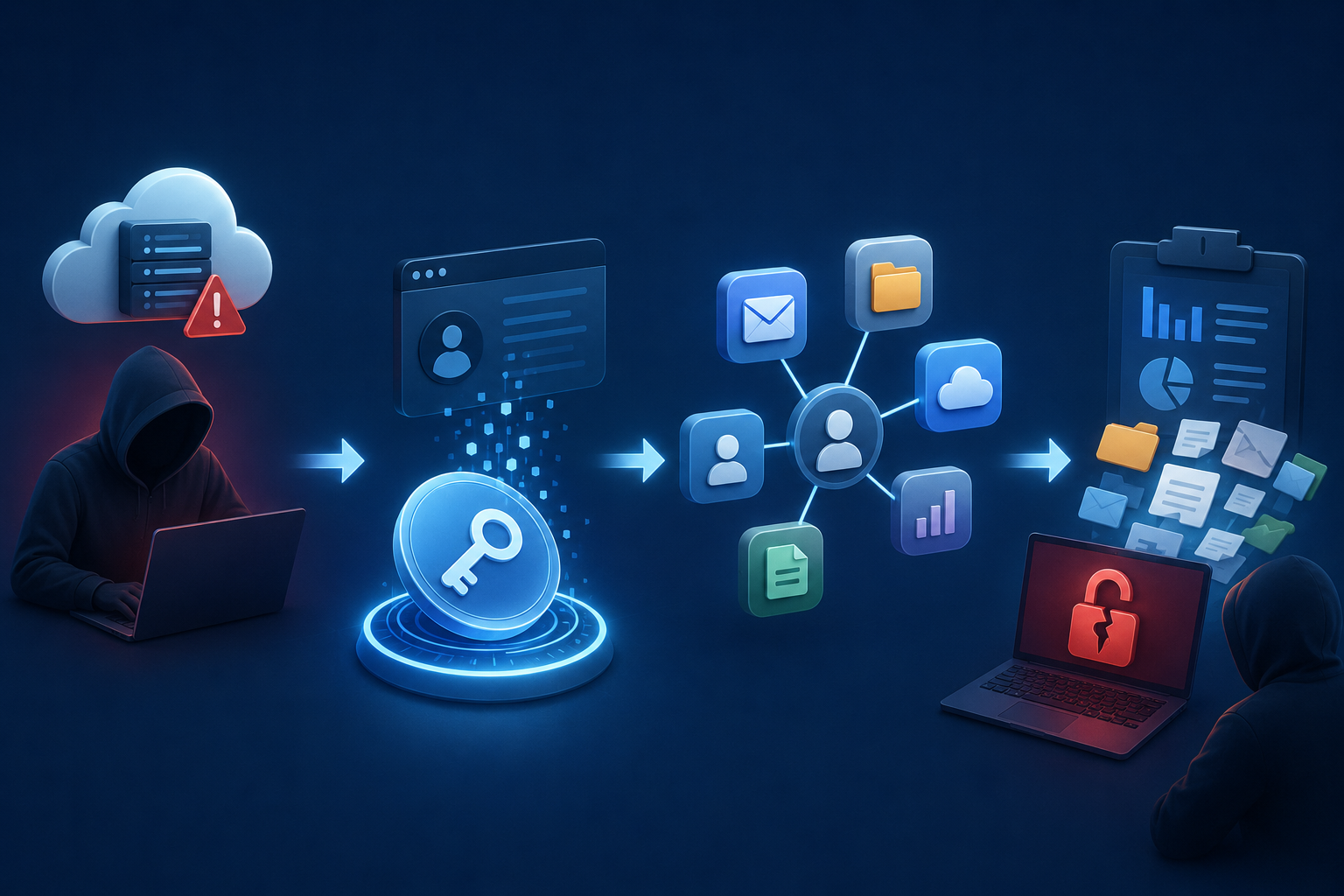
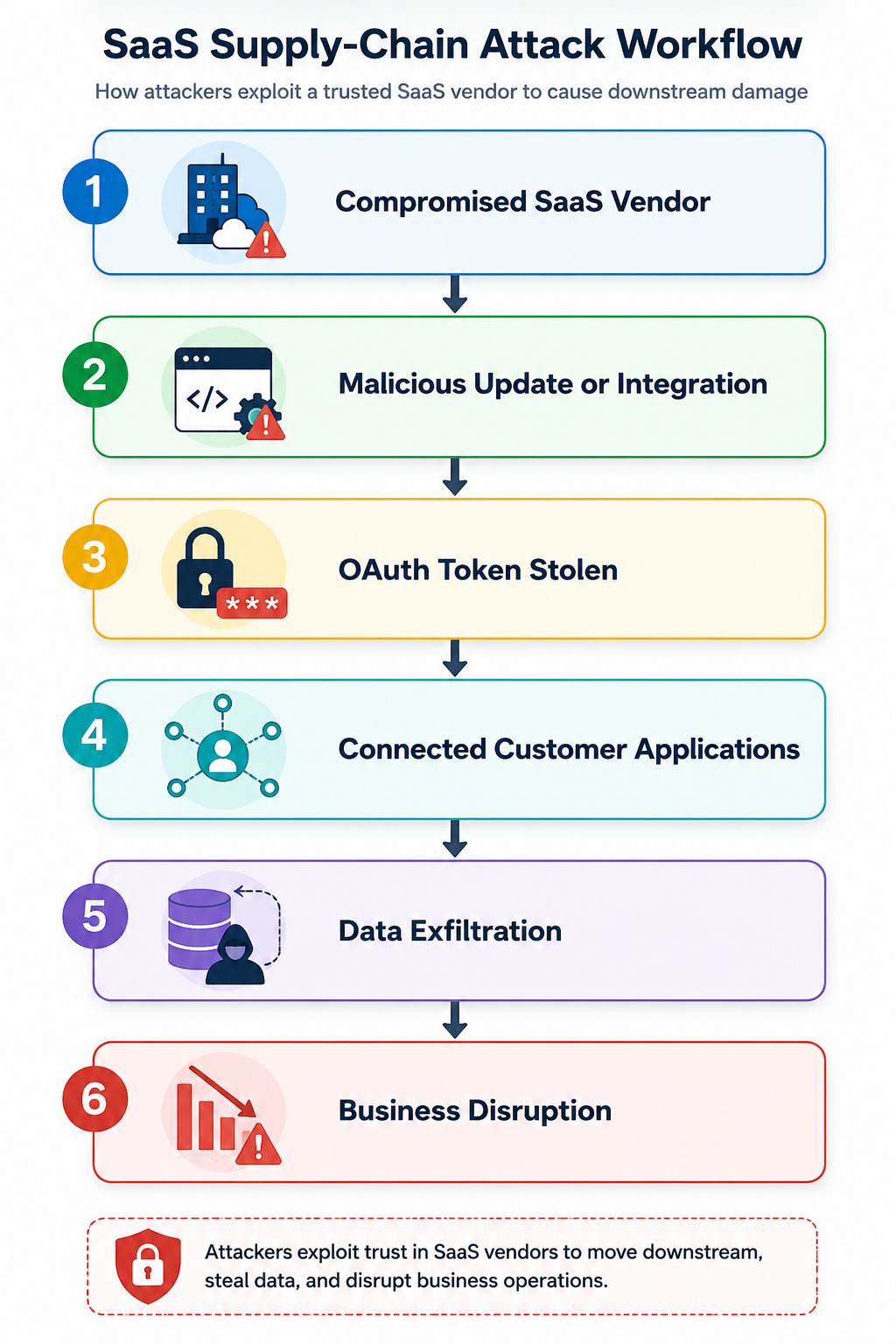
Understanding how SaaS Supply-Chain Breaches unfold helps organizations recognize why these attacks are so dangerous. Instead of attacking every company individually, cybercriminals often compromise a trusted SaaS vendor or third-party application that serves many customers. Once inside, they steal OAuth tokens and use the existing trust between connected applications to move across cloud environments. This attack chain can lead to a large-scale data breach, making cloud security, SaaS security, identity and access management, and third-party risk management essential parts of modern computer security and information security strategies.
The simplified workflow below shows how a single compromise can spread across multiple organizations:
Step 1: Compromising a Trusted Application
The attack usually begins when cybercriminals compromise a trusted SaaS provider, developer tool, or software component. They may exploit a vulnerability, compromise developer accounts, or insert malicious code into a software update. Because customers already trust the vendor, the malicious update or integration is often installed without suspicion. Incidents such as the SolarWinds supply chain attack, 3CX supply chain attack, and attacks involving open-source repositories like the npm supply chain attack and PyPI supply chain attack demonstrate how one compromised vendor can impact thousands of organizations. Discussions surrounding the TanStack supply chain attack and the Shai-Hulud npm supply chain attack have further highlighted the risks associated with trusted software dependencies.
Step 2: Stealing OAuth Tokens
Once the malicious application is running, attackers attempt to obtain OAuth access or refresh tokens. This may happen through malicious OAuth consent requests, compromised APIs, browser malware, or hidden code inside the infected application. Since OAuth tokens represent previously approved permissions, attackers can often gain access without needing usernames or passwords. Weak token management significantly increases the risk of a successful compromise across the software supply chain.
Step 3: Accessing Connected SaaS Platforms
Using the stolen tokens, attackers authenticate as legitimate users and move into connected cloud applications. They may access email services, cloud storage, CRM systems, finance platforms, collaboration tools, and automation services. Because these requests use valid credentials and authorized permissions, traditional security controls may not immediately detect suspicious activity. This highlights why cyber security SaaS programs increasingly focus on monitoring identities, application behavior, and OAuth permissions instead of passwords alone.
Step 4: Data Theft and Business Disruption
After gaining access, attackers search for valuable business information, customer records, financial documents, intellectual property, and confidential communications. Sensitive files may be copied, modified, encrypted, or deleted, resulting in a serious data breach. Some attackers also create additional OAuth permissions or persistent access methods to remain inside the environment even after passwords are changed. These long-term intrusions can interrupt daily operations, damage customer trust, trigger regulatory investigations, and create significant financial losses. Following SaaS security best practices, including least-privilege access, continuous token monitoring, rapid token revocation, and regular third-party security assessments, helps reduce the impact of these increasingly sophisticated attacks.
OAuth Token Theft Attack Chain
| Attack Stage | Attacker Action | Business Impact |
| Vendor Compromise | Infect SaaS provider | Initial foothold |
| Token Theft | Steal OAuth credentials | Unauthorized access |
| Lateral Movement | Reach connected apps | Wider compromise |
| Data Exfiltration | Download sensitive files | Data breach |
| Persistence | Maintain access | Long-term risk |
Real-World Supply Chain Attack Examples
Several high-profile incidents have demonstrated how attackers can exploit trusted software and third-party services to reach thousands of organizations. These attacks have shaped today’s approach to SaaS Supply-Chain Breaches, emphasizing that securing the software supply chain is just as important as protecting internal networks. Rather than focusing on technical details, the following examples highlight the key lessons businesses can apply to strengthen cloud security, SaaS security, and identity and access management.
SolarWinds Supply Chain Attack
The SolarWinds supply chain attack remains one of the most significant cybersecurity incidents in recent history. Attackers compromised the software build process for SolarWinds’ Orion network management platform and inserted malicious code into legitimate software updates. Because customers trusted these updates, thousands of organizations, including government agencies and private enterprises, unknowingly installed the compromised software.
The incident demonstrated that trusted vendors can become attractive targets for sophisticated attackers. It also reinforced the importance of verifying software integrity, monitoring vendor activity, and implementing strong third-party risk management practices instead of assuming trusted software is always safe.
3CX Supply Chain Attack
The 3CX supply chain attack showed that even widely used business communication software can become a delivery mechanism for malicious code. Attackers compromised the software development process, allowing a modified version of the desktop application to be distributed to customers through legitimate update channels.
This incident highlighted that software vendors must secure every stage of their development pipeline. Organizations also learned that continuous monitoring, application allowlisting, and rapid detection capabilities are essential components of modern computer security and information security, even when software originates from trusted suppliers.
npm Supply Chain Attacks
The JavaScript ecosystem has experienced numerous npm supply chain attack incidents involving malicious or compromised packages published to the npm registry. Because developers often rely on thousands of open-source dependencies, a single malicious package can affect many applications and organizations.
One widely discussed example is the Shai-Hulud npm supply chain attack, which demonstrated how malicious packages can be disguised as legitimate software or introduced through compromised publishing accounts. Developers have also closely followed discussions surrounding the TanStack supply chain attack, which reinforced the importance of verifying package authenticity, securing maintainer accounts, and carefully reviewing third-party dependencies before deployment.
These incidents remind organizations that open-source software offers tremendous value but also requires ongoing package validation, dependency auditing, and continuous monitoring to reduce risk.
PyPI Supply Chain Attacks
The Python ecosystem has also experienced multiple PyPI supply chain attack campaigns involving fake or malicious packages uploaded to the Python Package Index (PyPI). In many cases, attackers publish packages with names that closely resemble legitimate libraries, hoping developers will accidentally install them. Some malicious packages are designed to steal credentials, collect sensitive information, or execute unauthorized code during installation.
These attacks emphasize that developers should verify package publishers, review download activity, scan dependencies for known risks, and maintain secure software development practices. Automated dependency scanning and code review have become important safeguards for organizations building Python applications.
Common Lessons From These Incidents
Although each incident followed a different path, several recurring themes emerge. Attackers consistently exploit trust rather than attempting direct attacks against every organization individually. Compromised software updates, malicious open-source packages, stolen credentials, and abused vendor relationships are all examples of how a single weakness can spread throughout the broader software supply chain.
These events also reinforce the importance of SaaS security best practices, including strong identity and access management, continuous security monitoring, dependency scanning, vendor risk assessments, least-privilege access, and rapid incident response. As organizations continue adopting cloud-based services and interconnected applications, strengthening cyber security SaaS programs has become essential for preventing the next large-scale data breach or supply chain attack.
Major Supply Chain Incidents
| Incident | Attack Vector | Main Target | Primary Lesson |
| SolarWinds | Software update | Enterprise networks | Trust verification |
| 3CX | Desktop application | Corporate users | Vendor security |
| npm attacks | Malicious packages | Developers | Package validation |
| PyPI attacks | Fake libraries | Python ecosystem | Dependency scanning |
Business Impact of SaaS Supply-Chain Breaches

SaaS Supply-Chain Breaches affect far more than an organization’s IT systems. Because modern businesses rely on interconnected cloud applications, a single compromise can disrupt operations, expose sensitive information, damage customer relationships, and trigger costly legal and regulatory consequences. As organizations continue expanding their digital ecosystems, protecting the software supply chain has become a critical part of cloud security, SaaS security, and identity and access management.
Major incidents such as the SolarWinds supply chain attack, 3CX supply chain attack, and attacks involving the npm supply chain attack and PyPI supply chain attack ecosystems have demonstrated that even trusted software providers can become entry points for widespread compromise. These events reinforce why organizations must invest in proactive third-party risk management and stronger information security controls.
Financial Costs
The financial impact of a data breach extends well beyond the immediate incident response. Organizations may face costs related to forensic investigations, system recovery, legal support, regulatory penalties, customer notifications, and cybersecurity improvements. Business interruption can reduce revenue, while contractual obligations and cyber insurance claims may further increase expenses. Investing in preventive SaaS security best practices is often far less costly than recovering from a major incident.
Operational Downtime
When attackers compromise trusted SaaS applications, business operations can slow or stop entirely. Employees may lose access to email, document storage, CRM platforms, finance systems, and collaboration tools that support daily work. Security teams often need to revoke OAuth permissions, reset credentials, investigate affected systems, and temporarily disable integrations, resulting in reduced productivity. Effective computer security and cyber security SaaS strategies help organizations recover more quickly and minimize operational disruption.
Customer Trust
Customers expect organizations to protect their personal and business information. A successful supply chain attack can weaken that trust, especially if sensitive data is exposed or critical services become unavailable. Rebuilding confidence often requires transparent communication, improved security measures, and a demonstrated commitment to protecting customer information. Strong security practices can become a competitive advantage in industries where trust is essential.
Regulatory Compliance
Organizations affected by SaaS Supply-Chain Breaches may also face increased scrutiny from regulators and industry auditors. Depending on the type of data involved and applicable laws, businesses may be required to investigate the incident, notify affected individuals, and demonstrate that appropriate security controls were in place. Maintaining strong identity and access management, regularly reviewing third-party integrations, monitoring vendor risks, and following recognized SaaS security best practices help organizations strengthen compliance while reducing the likelihood and impact of future security incidents.
Best Practices to Prevent SaaS Supply-Chain Breaches
Preventing SaaS Supply-Chain Breaches requires more than installing security software. Organizations must protect the entire ecosystem of cloud applications, third-party integrations, and user identities. Since attackers increasingly exploit trusted connections rather than individual systems, businesses should adopt a layered security approach that combines cloud security, SaaS security, identity and access management, and effective third-party risk management. The following best practices can significantly reduce the likelihood of a data breach and strengthen overall computer security and information security.
Apply Least Privilege Access
The principle of least privilege means users and applications should receive only the permissions they genuinely need. Instead of granting full access to emails, files, calendars, and contacts, administrators should restrict permissions to specific tasks. Limiting access reduces the damage an attacker can cause if an OAuth token is compromised.
For example, a scheduling application may only require access to calendars and contacts, not email messages or cloud storage.
Conceptual OAuth Scope Example
| Permission | Access |
| Read Contacts | ✔ |
| Read Calendar | ✔ |
| Read Email | ✘ |
| Manage Files | ✘ |
Granting only the minimum required scopes is one of the most effective SaaS security best practices.
Review OAuth Permissions Regularly
OAuth permissions should never be treated as permanent. Organizations should routinely review connected applications, revoke unnecessary permissions, and remove unused integrations. Employees often authorize applications for short-term projects and forget about them, creating unnecessary security risks over time.
Regular permission audits help identify excessive privileges before they can be exploited.
Monitor Third-Party Integrations
Every connected application becomes part of the organization’s software supply chain. Businesses should continuously monitor third-party integrations for unusual behavior, unexpected API activity, or unauthorized access requests.
Modern security platforms can alert administrators when applications suddenly request broader permissions or begin accessing sensitive information outside their normal behavior.
Strengthen Identity and Access Management
Strong identity and access management protects both users and applications. Organizations should enforce multi-factor authentication (MFA), adopt Single Sign-On (SSO), apply conditional access policies, and regularly review privileged accounts. Although stolen OAuth tokens may bypass password verification, stronger identity controls still reduce the likelihood of attackers obtaining those tokens in the first place.
Enable Continuous Cloud Security Monitoring
Continuous monitoring allows security teams to detect suspicious behavior before it becomes a major incident. Organizations should monitor login activity, API usage, token creation, permission changes, and unusual data transfers across cloud applications.
These capabilities improve cyber security SaaS programs by identifying abnormal activity early and reducing attacker dwell time.
Train Employees Against OAuth Phishing
Many OAuth attacks begin with deceptive consent requests rather than fake password pages. Employees should learn how to recognize suspicious application permissions, verify the legitimacy of OAuth consent screens, and avoid approving unknown third-party applications.
Regular awareness training reduces human error, which remains one of the leading causes of successful supply chain attack campaigns.
Vendor Risk Assessments
Organizations should carefully evaluate SaaS providers before integrating them into business operations. Vendor assessments should include security certifications, incident response capabilities, access control policies, software development practices, and compliance with industry standards.
Lessons learned from incidents such as the SolarWinds supply chain attack, 3CX supply chain attack, npm supply chain attack, PyPI supply chain attack, Shai-Hulud npm supply chain attack, and discussions surrounding the TanStack supply chain attack demonstrate why ongoing vendor evaluation is just as important as initial security reviews.
Incident Response Planning
Even with strong preventive measures, no organization can eliminate cyber risk entirely. A well-defined incident response plan enables security teams to react quickly when suspicious OAuth activity or a compromised third-party application is detected.
An effective response plan should include procedures for revoking OAuth tokens, isolating affected applications, notifying stakeholders, preserving forensic evidence, restoring services, and reviewing security controls after the incident. Regular tabletop exercises ensure teams can respond confidently during a real attack while minimizing operational disruption and protecting customer trust.
Best Practices Comparison
| Weak Practice | Recommended Practice |
| Permanent permissions | Limited OAuth scopes |
| Blindly trusting vendors | Vendor risk assessment |
| No token monitoring | Continuous monitoring |
| Shared admin accounts | Least privilege access |
| Annual audits | Continuous security reviews |
Future Trends in SaaS Security and OAuth Protection

Zero Trust and Identity-First Security
As organizations continue adopting cloud-based applications, defending against SaaS Supply-Chain Breaches will require smarter, more proactive security strategies. Traditional perimeter-based defenses are no longer sufficient for protecting today’s interconnected software supply chain. Instead, businesses are embracing security models that continuously verify users, devices, and applications before granting access.
One of the most significant trends is Zero Trust architecture, which assumes that no user or application should be trusted automatically, even if it operates within the organization’s network. Combined with stronger identity and access management, continuous authentication, and least-privilege access, Zero Trust helps reduce the impact of stolen OAuth tokens. Organizations are also adopting AI-assisted threat detection and behavioral analytics to identify unusual login patterns, suspicious API activity, and abnormal application behavior in real time, strengthening both cloud security and SaaS security.
Emerging Technologies for SaaS Security
Another emerging trend is token binding and improved token lifecycle management, making stolen OAuth tokens more difficult for attackers to reuse on unauthorized devices. Automated vendor monitoring, continuous dependency scanning, and enhanced third-party risk management are also becoming essential as businesses rely on an increasing number of external SaaS providers. These capabilities help identify potential supply chain attack risks before they affect customers.
Lessons from incidents such as the SolarWinds supply chain attack, the 3CX supply chain attack, and attacks involving the npm and PyPI ecosystems continue to shape the future of computer security and information security. Although discussions surrounding events like the Shai-Hulud npm supply chain attack and the TanStack supply chain attack have raised awareness of open source risks, the broader focus is shifting toward identity-first security, automated threat detection, and continuous security validation. By adopting these evolving SaaS security best practices, organizations can strengthen cyber security SaaS programs, reduce the likelihood of a data breach, and build more resilient cloud environments for the future.
Frequently Asked Questions (FAQ)
1. Can stolen tokens cause security breaches in SaaS environments?
Yes. Stolen OAuth tokens can allow attackers to access cloud applications without knowing a user’s password. Since these tokens represent previously approved access, attackers may bypass normal login checks and move across connected SaaS platforms. This is one reason SaaS Supply-Chain Breaches have become a growing concern for organizations using multiple cloud services.
2. What is supply chain token theft?
Supply chain token theft occurs when attackers obtain OAuth tokens through compromised software vendors, malicious applications, or trusted third-party integrations. Instead of attacking an organization directly, cybercriminals exploit weaknesses in the software supply chain, allowing them to reach multiple businesses through a single trusted connection.
3. What is token theft and how does it affect SaaS security?
Token theft is the unauthorized capture of authentication or authorization tokens that grant access to cloud resources. In SaaS security, stolen tokens can provide attackers with access to email, file storage, customer records, and other connected applications. Protecting tokens is a key part of modern cloud security and identity and access management.
4. Do SaaS apps use OAuth tokens?
Yes. Most modern SaaS applications use OAuth tokens to securely authorize access between services without sharing passwords. OAuth improves the user experience by allowing trusted applications to exchange information while giving users control over the permissions they grant.
5. What are SaaS Supply-Chain Breaches?
SaaS Supply-Chain Breaches occur when attackers compromise a trusted SaaS provider, software dependency, or third-party integration instead of targeting an organization directly. Because many businesses rely on interconnected cloud applications, one compromised service can expose multiple organizations to a data breach or other security incidents.
6. How does OAuth improve cloud security?
OAuth improves cloud security by eliminating the need to share passwords with third-party applications. Instead, users grant limited permissions through access tokens with defined scopes. This reduces password exposure while allowing organizations to control, monitor, and revoke application access when necessary.
7. Can Multi-Factor Authentication stop OAuth token theft?
Multi-Factor Authentication (MFA) is an important security control, but it does not always stop OAuth token theft. If attackers steal a valid OAuth token after authentication has already occurred, they may be able to access cloud services without triggering another MFA challenge. Continuous monitoring and token management remain essential.
8. How do attackers steal OAuth tokens?
Attackers commonly steal OAuth tokens through phishing emails, fake OAuth consent screens, malicious browser extensions, compromised applications, malware, insecure APIs, or stolen session data. Organizations can reduce these risks by following SaaS security best practices, limiting token permissions, and educating employees about phishing attacks.
9. What is the difference between OAuth and API keys?
OAuth and API keys both enable application access, but they serve different purposes. Unlike API keys, OAuth grants temporary, permission-based access on behalf of a user. API keys identify an application or service and often provide broader access. Because permissions can be limited, monitored, and revoked, OAuth generally provides stronger security.
10. How can businesses reduce third-party risk?
Businesses can reduce third-party risk management challenges by evaluating vendor security, reviewing OAuth permissions regularly, monitoring connected applications, scanning software dependencies, and maintaining an up-to-date inventory of external integrations. Regular vendor assessments and continuous monitoring strengthen the overall security of the software ecosystem.
Conclusion
SaaS Supply-Chain Breaches have reshaped the modern cybersecurity landscape by showing that trusted software connections can be as valuable to attackers as traditional network vulnerabilities. The growing use of OAuth tokens, cloud applications, and interconnected services has improved business productivity, but it has also increased the need for strong cloud security, SaaS security, identity and access management, and effective third-party risk management. Rather than relying only on passwords or perimeter defenses, organizations should adopt proactive SaaS security best practices, including least-privilege access, continuous monitoring, regular OAuth permission reviews, and vendor risk assessments. Staying informed about evolving software supply chain threats, learning from incidents such as the SolarWinds supply chain attack and 3CX supply chain attack, and strengthening security controls can significantly reduce the risk of a data breach while helping businesses build a more resilient cybersecurity posture.
About the Author