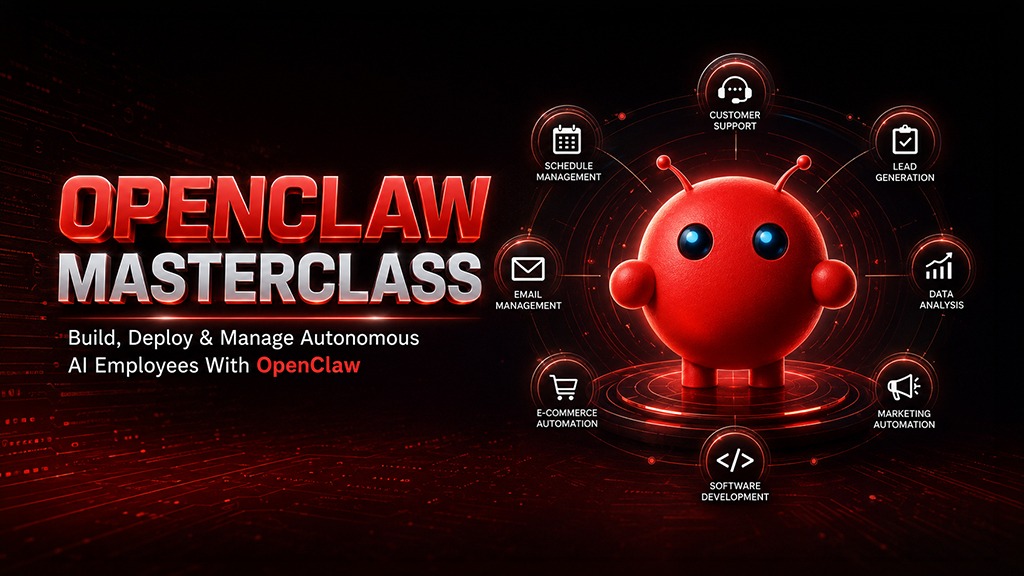
OpenClaw is transforming the future of work by enabling autonomous AI employees that can remember information, make decisions, automate workflows, and continue working without constant human input. The future of work is no longer powered by AI assistants alone. According to Gartner, nearly 40% of enterprise applications are expected to incorporate AI agents by the end of 2026, compared with less than 5% only a year earlier. Industry surveys also show that more than 60% of organizations plan to deploy AI agents within the next two years, highlighting a major shift toward intelligent automation. OpenClaw is helping organizations build and manage these AI employees, making it a powerful platform for the next generation of business automation.
If you’ve been wondering what OpenClaw is, you’re not alone. OpenClaw is an open-source AI agent framework designed to help developers, founders, marketers, consultants, freelancers, and businesses build production-ready autonomous AI employees that can operate around the clock. As interest in OpenClaw AI continues to grow, professionals are looking beyond chatbots and exploring AI systems that can manage real business tasks with minimal supervision.
This OpenClaw Masterclass serves as a complete, project-based learning guide for anyone who wants to master autonomous AI development. You’ll learn how to install and configure OpenClaw, design long-term memory systems, automate workflows, integrate external tools and APIs, deploy secure AI agents, and build scalable, production-ready digital employees. As Andrew Ng famously said, “AI is the new electricity.” This masterclass equips you with the practical skills to build that future instead of simply watching it unfold.
Welcome to OpenClaw Masterclass
Artificial intelligence has reached a turning point. While millions of professionals now use AI tools to write content, generate code, and answer questions, very few know how to build autonomous AI systems that can think, remember, communicate, and complete business tasks with minimal human supervision. That skills gap is exactly why we are launching the OpenClaw Masterclass.
Our mission is simple: help learners move beyond prompt engineering and become AI systems builders. Instead of teaching isolated tools or short-lived AI trends, this masterclass provides a structured roadmap for creating production-ready autonomous AI employees that solve real business challenges.
Whether you’re a complete beginner or an experienced developer, the course follows a step-by-step learning journey. You’ll start by installing and configuring OpenClaw, then gradually master agent memory, automation, API integrations, security, deployment, and multi-agent collaboration. Every lesson builds on the previous one, making advanced concepts approachable without sacrificing practical depth.
Learning is driven by implementation rather than theory. Throughout the program, you’ll complete hands-on projects that simulate real business scenarios, including AI assistants, research agents, customer support bots, workflow automation systems, and intelligent digital employees. By the end of the masterclass, you’ll have a portfolio of working AI solutions that demonstrate production-ready skills.
As businesses increasingly adopt autonomous AI, professionals who can design, deploy, and manage these systems will be in high demand. The OpenClaw Masterclass equips you with practical expertise that applies across startups, enterprises, consulting, freelancing, and entrepreneurship, preparing you for the next generation of AI-powered work.
| Traditional AI Learning | OpenClaw Masterclass |
| Focuses on prompts and AI chatbots | Focuses on building autonomous AI employees |
| Primarily theory and demonstrations | Hands-on, project-based learning |
| Covers individual AI tools | Covers complete AI systems from setup to deployment |
| Limited real-world implementation | Real business projects and production-ready workflows |
| Teaches AI usage | Teaches AI development, automation, deployment, and management |

What You’ll Learn (The Real Transformation)
The OpenClaw masterclass is designed to deliver more than technical knowledge. It transforms the way you think about artificial intelligence by teaching you how to build autonomous AI employees that can plan, execute, and improve business workflows with minimal human supervision. Instead of learning isolated AI tools, you’ll develop the practical skills needed to design intelligent systems that create measurable business value.
Your journey begins with the fundamentals of AI agents and the OpenClaw architecture. You’ll understand how autonomous agents differ from traditional chatbots and workflow automation tools, then learn how to install, configure, and deploy your first AI agent. From there, you’ll master prompt engineering techniques that help agents make better decisions, follow structured reasoning, and perform complex tasks consistently.
As your skills grow, you’ll build advanced memory systems that allow AI employees to remember users, conversations, preferences, and previous actions. You’ll also learn agent planning strategies that enable autonomous decision-making, task prioritization, and long-running workflows without requiring continuous human input.
The masterclass then expands into practical automation by teaching you how to connect agents with APIs, messaging platforms, cloud services, and productivity tools. You’ll build AI systems capable of researching information, generating reports, managing schedules, responding to customer inquiries, organizing files, and automating repetitive operational processes. Rather than completing one task at a time, your AI employees will coordinate multiple actions as part of complete business workflows.
Deployment is another major milestone in your transformation. You’ll confidently deploy AI agents on local environments, Docker containers, and cloud servers while implementing monitoring, logging, performance optimization, and security best practices. You’ll understand how to manage permissions, protect sensitive information, and maintain reliable AI infrastructure for long-term operation.
Finally, you’ll learn how to scale from a single AI assistant to an entire AI workforce. By coordinating multiple specialized agents, you’ll create systems that collaborate on marketing campaigns, customer support, business research, sales operations, content creation, and internal knowledge management. These production-ready projects provide practical experience that can strengthen your portfolio and prepare you for opportunities in AI engineering, automation consulting, digital transformation, and enterprise AI implementation.
By the end of the OpenClaw Masterclass, you’ll progress from simply using AI tools to designing, deploying, monitoring, securing, and managing intelligent AI employees that work continuously to solve real business problems.
| Learning Stage | Skills You’ll Gain | Real Business Outcome |
| AI Foundations | AI agent fundamentals, OpenClaw setup, prompt engineering | Build and configure your first autonomous AI agent |
| Intelligence & Memory | Memory management, context handling, agent planning | Create AI employees that remember users and make informed decisions |
| Automation & Integrations | Tool usage, APIs, workflow automation | Automate customer support, research, reporting, scheduling, and repetitive business tasks |
| Deployment & Operations | Docker, cloud deployment, monitoring, security | Run reliable, production-ready AI systems with continuous monitoring |
| AI Workforce Management | Multi-agent collaboration, orchestration, optimization | Build and manage teams of AI employees capable of handling complex business workflows 24/7 |
Complete Course Modules
The OpenClaw Masterclass follows a structured, project-based curriculum that takes learners from understanding AI agent fundamentals to designing, deploying, and managing production-ready autonomous AI employees. Each module builds upon the previous one, ensuring you gain practical experience while developing a portfolio of real-world AI projects.
| Module | Primary Focus | Hands-on Project | Outcome |
| Module 1 | Foundations & Setup | Build your first AI assistant | Configure a fully functional OpenClaw environment |
| Module 2 | Memory & Autonomy | Persistent research assistant | Create AI agents that remember and plan independently |
| Module 3 | Skills & Integrations | AI business assistant | Automate business workflows across multiple platforms |
| Module 4 | Deployment & Security | Production AI employee | Deploy secure, scalable AI infrastructure |
| Module 5 | Capstone Project | Complete AI workforce | Build and showcase a portfolio-ready autonomous AI system |
Module 1: OpenClaw Foundations & Setup
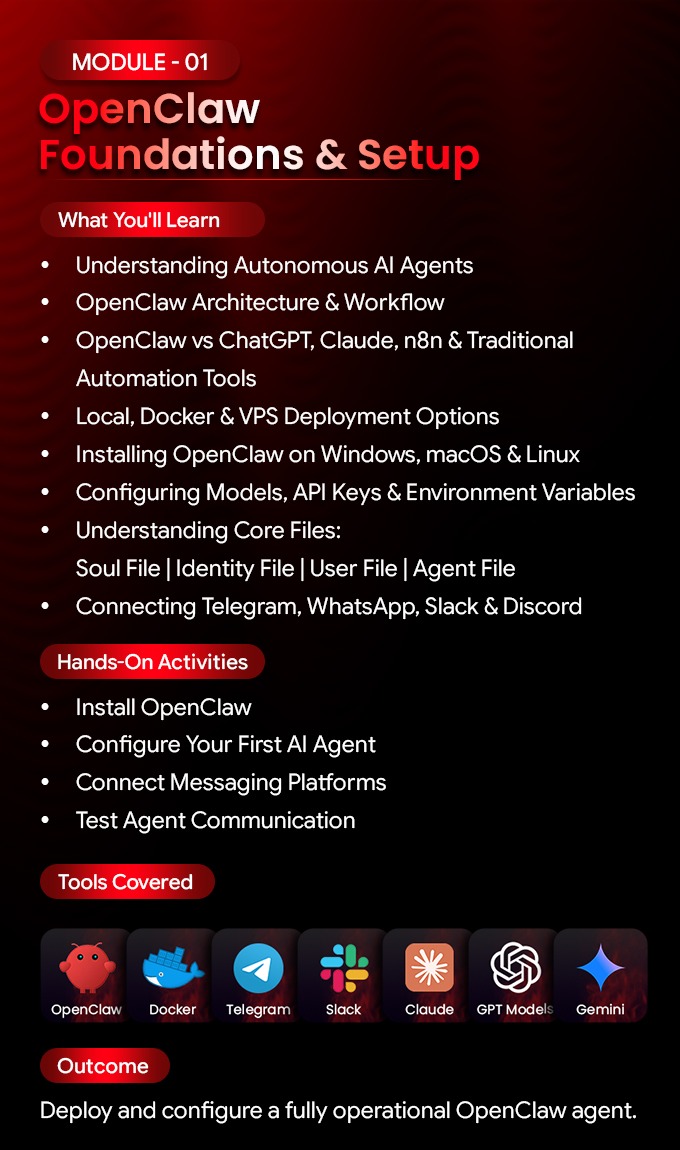
Every successful AI system starts with a solid foundation. The first module introduces learners to the OpenClaw ecosystem while walking through the complete installation and configuration process. Whether you prefer running OpenClaw locally or inside Docker containers, you’ll learn the best practices for creating a reliable development environment.
You’ll configure environment variables, API credentials, AI models, and essential services while understanding how each component communicates within the OpenClaw architecture. The course also introduces the OpenClaw Gateway, which manages requests between AI models, memory systems, external integrations, and automation workflows.
Beyond installation, you’ll explore API management, model selection, configuration files, and project organization. Instead of simply following setup instructions, you’ll understand why each configuration matters for performance, flexibility, and future scalability.
The module concludes by building your very first AI assistant. You’ll create an autonomous agent capable of understanding requests, responding intelligently, maintaining conversations, and interacting with external services. This project provides the foundation you’ll continue expanding throughout the remainder of the course.
Project: Build your first AI assistant from scratch with a fully configured OpenClaw environment.
Module 2: Agent Memory, Context & Autonomy
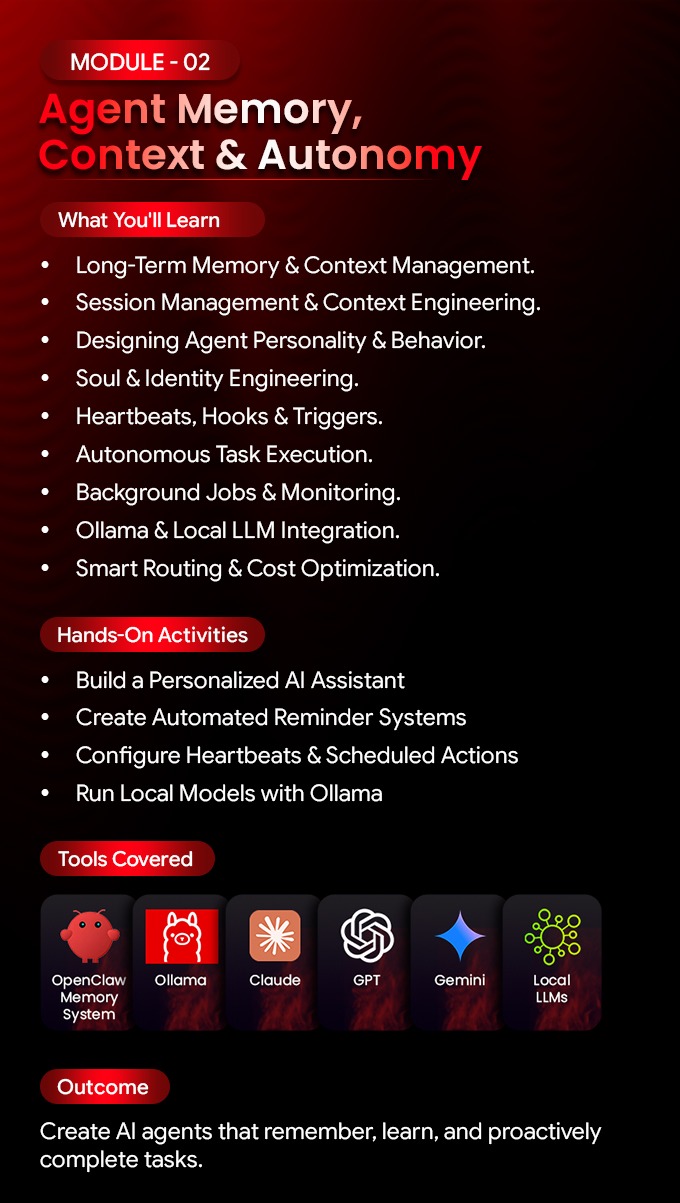
An AI employee becomes truly valuable when it remembers previous interactions, understands context, and can plan future actions. This module focuses on transforming simple chatbots into autonomous agents capable of long-term reasoning.
You’ll explore the differences between short-term memory, long-term memory, vector databases, and context windows while learning how OpenClaw retrieves relevant knowledge during conversations. Rather than restarting every interaction, your AI agents will build persistent relationships with users by remembering preferences, previous discussions, and ongoing tasks.
You’ll also learn how autonomous reasoning enables agents to break large objectives into smaller executable tasks. Through agent planning and multi-step execution, OpenClaw can perform research, gather information from multiple sources, summarize findings, and continue working without constant supervision.
The module also introduces persistent workflows, allowing AI agents to monitor events, trigger scheduled actions, and resume unfinished work automatically. These capabilities form the foundation of intelligent AI employees that operate continuously rather than responding only when prompted.
Project: Build a research assistant with persistent memory that retrieves knowledge, remembers conversations, and performs long-running research tasks autonomously.
Module 3: Skills, Automation & Integrations
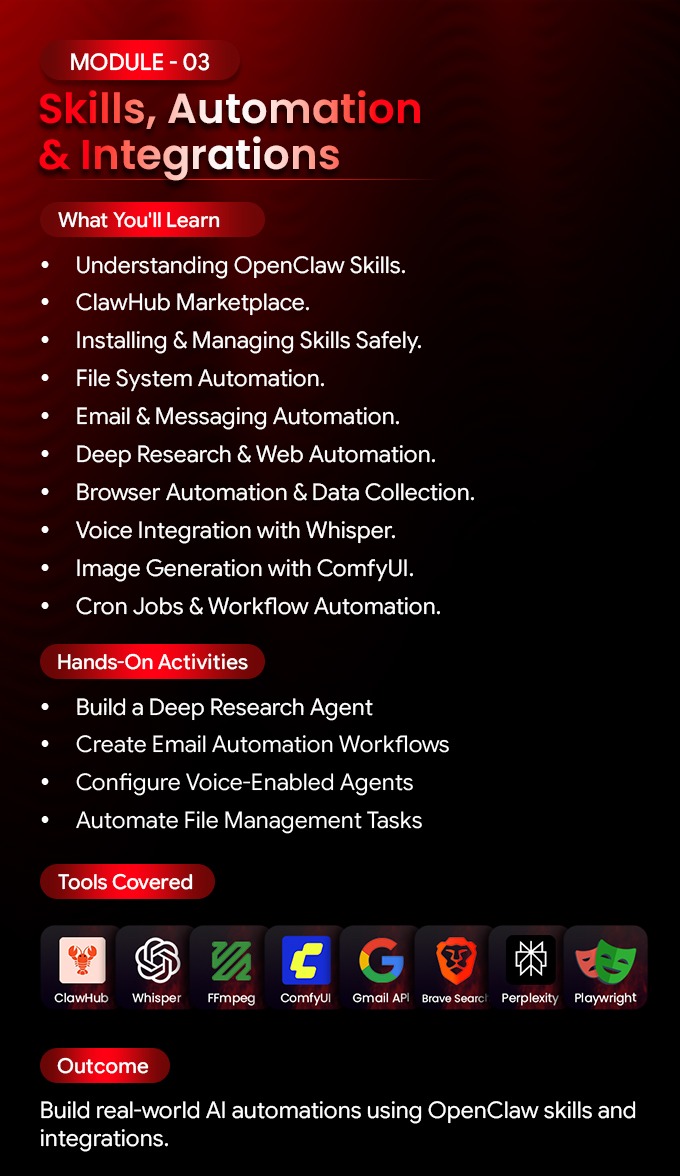
Autonomous AI becomes significantly more valuable when connected to the tools businesses use every day. In this module, you’ll learn how OpenClaw’s skills architecture enables AI agents to move beyond conversation and perform meaningful business operations.
You’ll build custom skills that allow agents to communicate with APIs, interact with Model Context Protocol (MCP) servers, and connect with platforms including Google Workspace, Slack, GitHub, Notion, databases, and web applications. Instead of limiting AI to answering questions, you’ll teach it to send emails, update documents, create reports, organize files, manage tasks, retrieve business data, and automate repetitive workflows.
You’ll also discover how web automation allows agents to browse websites, collect information, perform research, and trigger actions across multiple online services. By combining integrations with intelligent planning, you’ll create AI systems capable of handling complex business processes from start to finish.
Throughout the module, emphasis is placed on reusable workflows, scalable automation, and practical business applications that improve productivity across marketing, operations, customer service, and software development.
Project: Build an AI business assistant that automates daily operations by integrating multiple workplace tools into a unified workflow.
Module 4: Security, VPS Deployment & AI Workforce Design
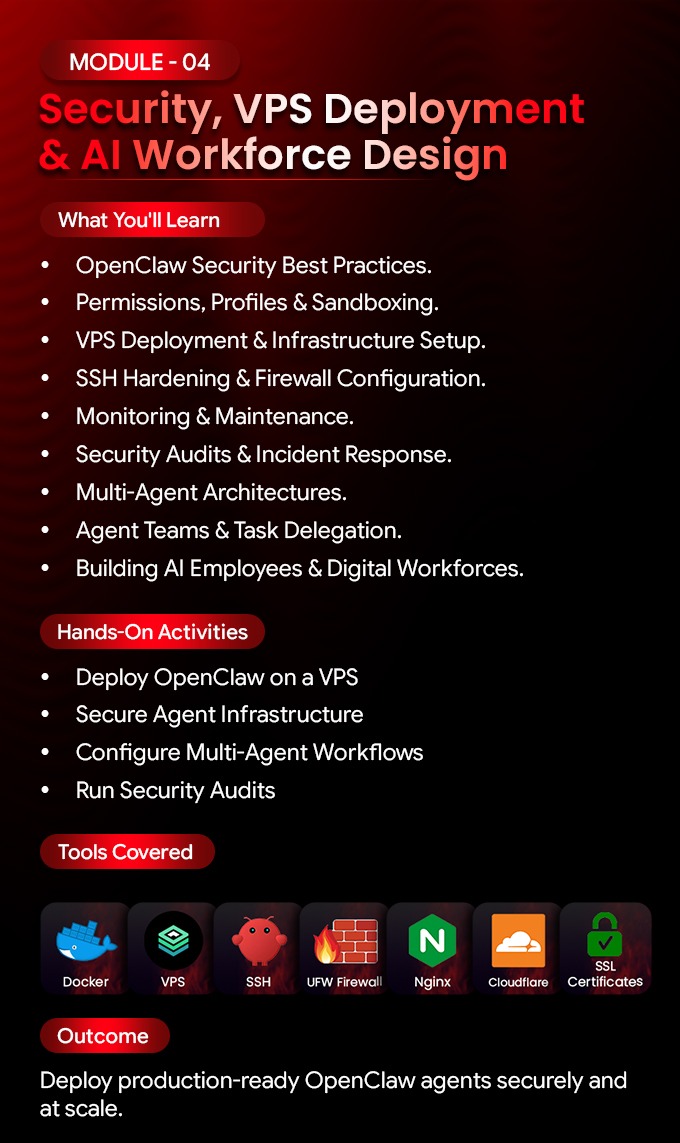
Building an AI agent is only part of the journey. Deploying it securely and reliably is what makes it suitable for production environments. This module teaches the infrastructure required to run autonomous AI employees around the clock.
You’ll deploy OpenClaw on a Virtual Private Server (VPS) using Docker Compose while configuring reverse proxies, HTTPS encryption, SSL certificates, authentication, secret management, and secure networking. You’ll also implement monitoring, centralized logging, automated backups, and performance optimization to ensure your AI infrastructure remains stable and secure.
The module expands beyond individual agents by introducing AI workforce design. You’ll learn how multiple specialized agents collaborate, delegate responsibilities, and exchange information while maintaining separate identities, permissions, and memory systems. This architecture enables businesses to assign different AI employees to marketing, customer support, documentation, research, software development, and internal operations.
By understanding deployment and infrastructure management, you’ll gain the confidence to operate autonomous AI systems at business scale.
Project: Deploy production-ready AI employees on a secure VPS with monitoring, authentication, encrypted communication, and multi-agent collaboration.
Module 5: Capstone Project
The capstone project combines every concept covered throughout the OpenClaw Masterclass into one comprehensive implementation. Instead of building a single AI assistant, you’ll create a complete AI workforce where multiple specialized agents collaborate to support real business operations.
Your AI workforce will include an executive assistant that manages schedules and communications, a customer support agent that handles inquiries, a research agent that gathers and summarizes information, a marketing agent that assists with content creation and campaign planning, a documentation agent that organizes internal knowledge, and a coding assistant that supports software development workflows.
Each AI employee will maintain its own memory, interact with external tools, automate repetitive processes, and collaborate with other agents whenever tasks require shared knowledge or coordinated execution. You’ll deploy the entire system using production-ready infrastructure while implementing monitoring, logging, authentication, secure credential management, and comprehensive documentation.
The finished project demonstrates your ability to design, deploy, secure, and manage enterprise-grade autonomous AI systems. Beyond showcasing technical expertise, it provides a portfolio-quality project that highlights practical experience with AI automation, cloud deployment, business integrations, and multi-agent orchestration, making it valuable for job opportunities, freelance consulting, startup development, and enterprise AI initiatives.
Final Deliverables
- Production-ready AI workforce deployment
- Persistent memory architecture
- Automated business workflows
- Monitoring and logging dashboards
- Secure cloud infrastructure
- Technical documentation and deployment guide
Tools & Platforms You’ll Master
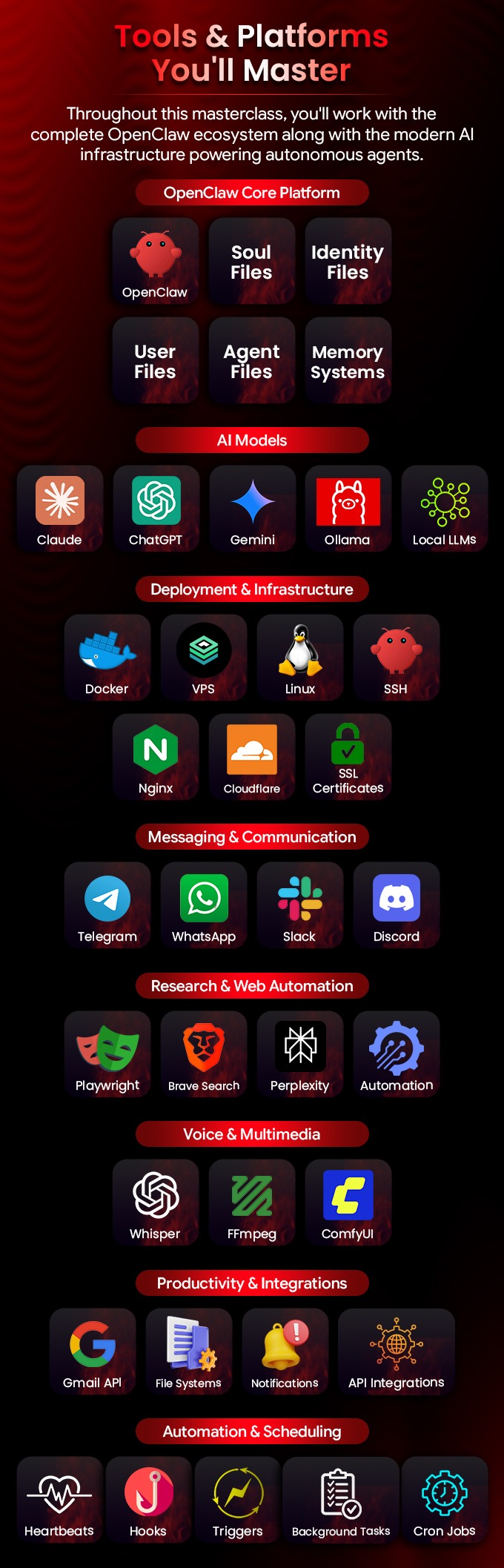
Building autonomous AI employees requires more than learning a single framework. Production-ready AI systems combine development tools, deployment platforms, databases, automation engines, and AI model providers into a unified ecosystem. Throughout the OpenClaw Masterclass, you’ll gain hands-on experience with the complete technology stack used by modern AI engineers, automation consultants, and software teams.
Rather than introducing tools in isolation, every technology is taught within practical projects. You’ll learn when to use each platform, how it integrates with OpenClaw, and how these components work together to create secure, scalable, and autonomous AI employees capable of operating 24/7.
Whether you’re building an AI-powered executive assistant, research agent, customer support representative, or an entire digital workforce, these tools provide the foundation for reliable deployment, efficient automation, long-term memory, and seamless collaboration across multiple business systems.
| Tool / Platform | Purpose | Why It Matters |
| OpenClaw | AI agent framework | Serves as the core platform for building autonomous AI employees with memory, reasoning, and workflow automation. |
| Docker | Deployment & containerization | Creates portable, reproducible environments that simplify development, testing, and production deployment. |
| GitHub | Version control & collaboration | Tracks code changes, enables team collaboration, and supports professional software development workflows. |
| VS Code | Development environment | Provides an efficient workspace for writing, debugging, and managing AI projects and configuration files. |
| OpenRouter | AI model gateway | Gives access to multiple leading language models through a single API, making it easy to compare performance and optimize costs. |
| Ollama | Local AI models | Runs open-source language models locally for improved privacy, reduced latency, and lower operating costs. |
| PostgreSQL | Database | Stores structured application data, user information, configurations, and operational records reliably. |
| Redis | Cache & session management | Improves application speed by caching frequently accessed data and supporting high-performance workflows. |
| n8n | Workflow automation | Connects business applications and automates repetitive processes using visual workflows and integrations. |
| MCP Servers | External tool access | Enables AI agents to securely interact with external tools, APIs, databases, and enterprise services using standardized interfaces. |
| Linux VPS | Production hosting | Hosts autonomous AI employees in secure cloud environments that operate continuously with high reliability. |
By mastering this technology stack, you’ll understand not only how each tool works individually but also how they integrate to build enterprise-grade AI systems. You’ll confidently develop AI agents, connect them to business applications, deploy them to secure cloud infrastructure, manage persistent data, automate complex workflows, and maintain production-ready environments that scale with business needs.
This practical experience mirrors the tools and workflows used by AI startups, software companies, consulting firms, and enterprise engineering teams, giving you skills that are directly applicable to real-world AI development projects.
Who Should Take This OpenClaw Masterclass?
The OpenClaw Masterclass is designed for anyone who wants to build autonomous AI systems that solve real business problems. Whether you’re starting your AI journey or already have technical experience, the course provides a practical roadmap that progresses from the fundamentals of OpenClaw to deploying production-ready AI employees.
Developers and software engineers will learn how to design intelligent AI agents, integrate APIs, automate workflows, and deploy scalable applications. AI engineers and automation specialists can deepen their expertise in agent memory, reasoning, orchestration, and multi-agent systems while building solutions that operate continuously with minimal supervision.
Startup founders and technical entrepreneurs will discover how autonomous AI employees can streamline operations, improve customer experiences, and reduce repetitive work without expanding their teams. Freelancers can use these skills to deliver advanced AI automation services, build custom AI solutions for clients, and create new revenue opportunities. DevOps engineers will gain practical experience deploying secure AI infrastructure using Docker, cloud servers, monitoring tools, and production-ready workflows.
Students and aspiring AI professionals will benefit from the project’s hands-on learning approach, building a portfolio of real-world AI applications that demonstrates practical skills to employers and clients. Regardless of your background, this masterclass equips you with the knowledge to design, deploy, and manage intelligent AI employees that are increasingly valuable across modern businesses.
| Learner | What You’ll Gain | Career Benefit |
| Developers & Software Engineers | AI agents, APIs, deployment, automation | Build intelligent production-ready applications |
| AI Engineers | Memory systems, reasoning, multi-agent workflows | Advance expertise in autonomous AI development |
| Startup Founders & Technical Entrepreneurs | AI-powered business automation | Scale operations with intelligent digital employees |
| Freelancers | Client-ready AI automation solutions | Expand high-value service offerings |
| DevOps Engineers | Secure deployment, monitoring, infrastructure | Manage reliable AI systems in production |
| Students | Hands-on projects and portfolio | Prepare for AI engineering and automation careers |
| Automation Specialists | Workflow orchestration and integrations | Design enterprise automation solutions |
OpenClaw vs Other AI Agent Frameworks
Choosing the right AI framework depends on what you want to build. If your goal is to create autonomous AI employees that can remember information, automate workflows, integrate with external tools, and operate continuously, you’ll need more than a conversational AI interface. This is where OpenClaw vs. Claude becomes an important comparison.
Claude is a powerful large language model that excels at reasoning, writing, coding, and answering questions. However, on its own, it is primarily a cloud-hosted AI model rather than a complete autonomous agent framework. OpenClaw, by comparison, is designed to orchestrate AI models, persistent memory, automation, integrations, and deployment into a unified system capable of handling long-running business workflows. Traditional chatbots typically focus on responding to user prompts and offer limited memory, automation, and extensibility.
The OpenClaw Masterclass teaches learners how to combine advanced language models with persistent memory, external tools, APIs, scheduling, and secure deployment to create production-ready AI employees. Instead of relying on a single conversation, learners build systems that can manage tasks, retrieve information, collaborate across applications, and continue working with minimal supervision.
| Feature | OpenClaw | Claude (Model-Based Workflows) | Traditional Chatbots |
| Memory | ✓ Persistent short-term and long-term memory | Limited conversation context | Limited session memory |
| Autonomous Planning | ✓ Multi-step task planning and execution | Partial with external orchestration | No |
| Tool Usage | ✓ Extensive API, MCP, and custom tool integrations | Yes, when connected to external tools | Limited |
| Deployment | ✓ Self-hosted or cloud deployment | Cloud-hosted model access | Primarily cloud-hosted |
| Workflow Automation | Advanced event-driven and scheduled automation | Medium with additional tooling | Basic automation capabilities |
| Extensibility | Highly customizable through skills, APIs, and integrations | Depends on surrounding application | Generally limited |
Rather than replacing powerful language models like Claude, OpenClaw complements them by providing the infrastructure needed to build autonomous AI systems. It allows developers and businesses to combine leading AI models with memory, planning, automation, and secure deployment, creating intelligent AI employees capable of supporting real-world business operations at scale.
Final Thoughts
Autonomous AI is redefining how software is built and how businesses operate. Instead of relying on AI to answer individual questions, organizations are increasingly adopting intelligent systems that can remember information, automate workflows, interact with business tools, and perform meaningful work with minimal supervision. OpenClaw brings these capabilities together in a flexible, open framework that empowers developers and businesses to build production-ready AI employees.
The OpenClaw Masterclass provides a practical path to mastering this emerging technology. Through structured lessons, hands-on projects, and real-world deployments, you’ll progress from setting up your first AI agent to designing secure, scalable, multi-agent systems capable of supporting everyday business operations.
Whether your goal is to advance your career, launch AI-powered products, automate internal workflows, or build enterprise-grade AI solutions, mastering OpenClaw gives you practical experience that extends beyond prompt engineering. The future belongs to professionals who can design, deploy, and manage intelligent AI systems. By learning through experimentation, real projects, and continuous practice, you’ll be well prepared to build the next generation of autonomous AI employees.
Frequently Asked Questions (FAQs)
What is OpenClaw AI?
OpenClaw AI is an open-source framework for building autonomous AI agents that can remember information, use external tools, automate workflows, and complete business tasks with minimal human supervision. Unlike a standard chatbot, OpenClaw provides the infrastructure for creating AI employees that can operate continuously across multiple platforms.
How to learn OpenClaw?
The best way to learn OpenClaw is through structured, project-based practice. Begin with installation and configuration, then progress to agent memory, automation, integrations, deployment, and security. Building real-world projects is the fastest way to understand how autonomous AI systems work.
How to build an AI agent using OpenClaw?
Building an AI agent typically involves installing OpenClaw, configuring an AI model, creating an agent profile, enabling memory, connecting external tools, and deploying the agent. As the project grows, you can add automation, scheduling, APIs, and monitoring to create production-ready AI employees.
Why is OpenClaw so popular?
OpenClaw is gaining attention because it combines AI models, memory, automation, and integrations into one framework. Developers can build AI systems that perform real business tasks instead of simply responding to prompts.
Is OpenClaw free or paid?
OpenClaw is an open-source framework. While the platform itself may be freely available, costs can arise from cloud infrastructure, premium AI models, APIs, or hosting services depending on your deployment.
How do I install OpenClaw?
OpenClaw can typically be installed on Windows, macOS, or Linux using a local environment or Docker. After installation, you’ll configure environment variables, API keys, AI models, and supporting services before creating your first AI agent.
What is OpenClaw Gateway?
OpenClaw Gateway acts as the communication layer between AI models, memory systems, integrations, and external services. It helps route requests efficiently while managing interactions between different components of the AI system.
Can OpenClaw run locally?
Yes. OpenClaw supports local deployment, allowing developers to build and test AI agents on their own computers. Local deployment is particularly useful when using local language models and privacy-focused workflows.
Does OpenClaw support multiple AI models?
Yes. OpenClaw is designed to work with multiple AI models. Depending on your configuration, you can connect cloud-based models or local language models or switch between providers based on performance, availability, or cost.
Is OpenClaw suitable for beginners?
Yes. Beginners with basic programming knowledge can start learning OpenClaw by following structured tutorials and hands-on projects. As learners gain confidence, they can move into more advanced topics such as memory systems, automation, and multi-agent architectures.
Can OpenClaw automate business workflows?
Absolutely. OpenClaw can automate repetitive business processes such as customer support, document management, scheduling, reporting, research, notifications, and task coordination by integrating with external tools and APIs.
What programming languages work with OpenClaw?
OpenClaw is commonly used alongside modern development technologies, with Python frequently serving as the primary language for AI development and automation. Depending on integrations and APIs, other programming languages may also be used within broader application architectures.
Can OpenClaw integrate with GitHub, Slack, and Notion?
Yes. OpenClaw can integrate with platforms such as GitHub, Slack, Notion, databases, email services, and other business applications through APIs, custom skills, and supported integration methods.
What projects can I build using OpenClaw?
You can build a wide range of autonomous AI applications, including executive assistants, research assistants, customer support agents, coding assistants, marketing assistants, document processing systems, workflow automation tools, and collaborative multi-agent business solutions.
Is OpenClaw better than traditional chatbots?
For autonomous automation, OpenClaw offers capabilities beyond traditional chatbots. It supports persistent memory, external tool usage, workflow automation, and long-running task execution, whereas most traditional chatbots primarily respond to user messages.
What skills should I learn before using OpenClaw?
Basic programming, API fundamentals, Git, Docker, and prompt engineering provide a strong starting point. Familiarity with databases, Linux, cloud deployment, and automation concepts becomes increasingly valuable as you build more advanced AI systems.
Can OpenClaw be deployed on a VPS?
Yes. OpenClaw can be deployed on a Virtual Private Server (VPS), making it suitable for hosting production-ready AI employees that operate continuously. Docker, reverse proxies, HTTPS, monitoring, and secure credential management are commonly used in production deployments.
Does OpenClaw support memory and long-term context?
Yes. One of OpenClaw’s strengths is its support for persistent memory and long-term context. AI agents can retain user preferences, previous conversations, and relevant information to deliver more consistent and context-aware interactions over time.
Can I build autonomous AI employees with OpenClaw?
Yes. OpenClaw is specifically designed for building autonomous AI employees capable of planning tasks, interacting with external tools, maintaining memory, automating workflows, and collaborating with other AI agents to complete complex business operations.
Is OpenClaw worth learning?
As businesses increasingly invest in autonomous AI systems and workflow automation, learning OpenClaw can be a valuable skill for developers, AI engineers, founders, consultants, and automation specialists. Mastering a framework that combines AI models, memory, deployment, and business automation prepares you for building practical AI solutions rather than relying solely on conversational AI.
Conclusion
Autonomous AI is rapidly transforming how businesses operate, shifting from simple conversational assistants to intelligent digital employees capable of planning tasks, remembering information, using external tools, and automating complete workflows. As organizations continue investing in AI-driven productivity, learning how to design and deploy these systems is becoming an increasingly valuable technical skill.
The OpenClaw Masterclass: Build, Deploy & Manage Autonomous AI Employees With OpenClaw provides a practical, project-based roadmap for mastering autonomous AI development. Rather than focusing only on theory or prompt engineering, the course guides you through building real AI employees, integrating them with business tools, deploying them securely, and managing production-ready AI infrastructure.
Whether you’re a developer, AI engineer, startup founder, freelancer, or automation specialist, mastering OpenClaw can help you create intelligent systems that solve real business problems and deliver long-term value. The future belongs to professionals who can build, deploy, and manage autonomous AI solutions. Start learning through hands-on projects continuous experimentation and real-world implementation, and you’ll be well positioned to lead the next generation of AI innovation.
About the Author