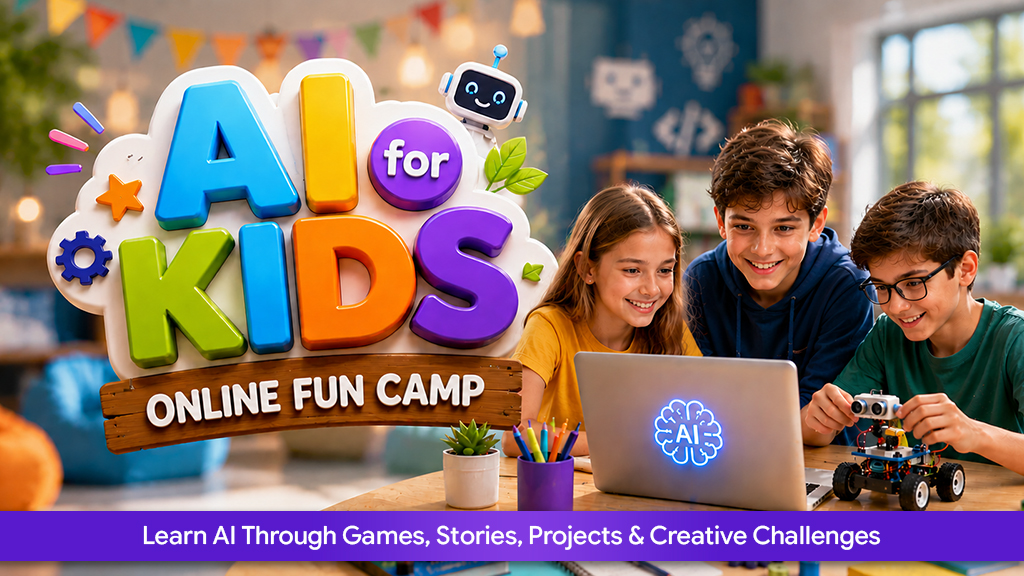
“The children who understand AI won’t simply use the future. They will help build it.”
Artificial Intelligence is no longer a futuristic technology. It is already part of everyday life.
Children interact with AI when they watch videos on YouTube, ask questions to voice assistants, play smart games, use learning platforms, generate images, or chat with AI-powered tools.
Yet most children use AI without understanding how it works.
They know AI can answer questions. They know AI can create images. They know AI can generate stories.
But few understand how AI learns, why it sometimes makes mistakes, how data influences decisions, or how to use it responsibly.
That is exactly why we launched the AI For Kids: Summer Online AI Camp & Training Program on Kickstarter.
Our goal is simple:
To help children aged 7–16 move beyond simply using AI and begin understanding how it works, how it learns, how it creates, and how it should be used responsibly.
The program combines games, stories, hands-on projects, creative challenges, machine learning activities, AI tools, ethics discussions, and guided learning experiences into a fun online bootcamp that children can complete from home.
We don’t believe children need to become programmers at age eight.
But we do believe every child deserves the opportunity to develop AI literacy, creativity, critical thinking, and digital confidence in a world increasingly shaped by Artificial Intelligence.
Why AI For Kids Matters More Than Ever Today
Artificial Intelligence is becoming one of the most important technologies of our generation.
Major technology companies are investing billions of dollars into AI research, development, and education.
Among them are:
- OpenAI
- Microsoft
- NVIDIA
- Amazon
- Meta
- Tesla
- Anthropic
- IBM
- Intel
- Salesforce
AI is already influencing:
- Education
- Healthcare
- Transportation
- Entertainment
- Business
- Communication
- Creativity
- Software Development
The reality is simple:
Children born today will enter a world where AI is as common as smartphones and the internet are today.
The question is not whether they will use AI.
They already do.
The question is whether they will understand it.
Is AI Too Advanced For Children?
One of the most common misconceptions parents have is that Artificial Intelligence is too advanced for children.
After all, AI often sounds like something reserved for engineers, researchers, and technology professionals.
But children don’t need to learn advanced algorithms to understand AI.
In the same way that children learn how to use computers before understanding how processors work, they can learn how AI learns, recognizes patterns, generates content, and makes decisions without needing complex mathematics or programming.
The goal isn’t to create AI engineers at age ten.
The goal is to help children become confident, informed, and responsible users of AI.
What Is AI For Kids? A Simple Guide For Parents
AI for Kids is the process of teaching Artificial Intelligence concepts in a simple, visual, practical, and age-appropriate way.
Instead of overwhelming children with complex mathematics and programming, AI can be introduced through:
- Stories
- Games
- Visual examples
- Interactive challenges
- Creative projects
- Experiments
- Simulations
- Guided AI tools
For example:
Instead of teaching machine learning theory, children can train an AI model to recognize fruits.
Instead of discussing computer vision algorithms, they can teach a computer to identify objects.
Instead of explaining data science formulas, they can learn how good data helps AI make better decisions.
Learning becomes fun, memorable, and meaningful.

Why Every Child Should Learn AI: Benefits Of AI Learning For Kids
1. AI Literacy Will Become a Core Skill
Reading literacy helped previous generations understand books.
Digital literacy helped people understand computers.
AI literacy will help future generations understand intelligent technology.
Children who understand AI will be better prepared to:
- Evaluate information
- Think critically
- Solve problems
- Use technology responsibly
- Adapt to future careers
Understanding AI is quickly becoming as important as understanding the internet.
2. AI Encourages Creative Thinking
Many parents assume AI is only for technical students.
The opposite is often true.
AI encourages creativity.
Children can use AI to:
- Write stories
- Design characters
- Create artwork
- Generate ideas
- Build games
- Develop projects
- Create digital worlds
AI becomes a creative partner rather than simply a technology tool.
“The future belongs not only to those who can code, but to those who can imagine, create, and collaborate with intelligent tools.”
3. AI Helps Children Become Problem Solvers
One of the greatest benefits of AI education is learning how to think.
Children learn:
- How to ask better questions
- How to test ideas
- How to evaluate results
- How to identify mistakes
- How to improve solutions
These skills extend far beyond technology. They support learning across every subject.
4. AI Builds Confidence Around Technology
Many children use technology every day without understanding what happens behind the screen.
Learning AI removes the mystery.
Instead of seeing AI as magic, children begin to understand:
- How it learns
- How it predicts
- How it recognizes patterns
- Why it makes mistakes
Understanding creates confidence.
Confidence creates curiosity.
Curiosity drives learning.
Read More: Top 15 Coding Games For Kids to Learn Programming
What Children Will Learn Inside The AI For Kids Program
When we designed the AI For Kids: Summer Online AI Camp & Training Program, we started with a simple question:
“What does a child actually need to understand about AI today?”
The answer wasn’t advanced mathematics.
It wasn’t complicated coding. And it certainly wasn’t university-level machine learning theory.
Instead, we focused on building a practical learning journey that helps children understand how AI works, how it learns, where they encounter it in everyday life, and how they can use it responsibly and creatively.
Through age-appropriate activities, guided projects, games, challenges, and creative exercises, children gradually build confidence while exploring some of the most important concepts behind modern Artificial Intelligence.
Throughout the program, children learn:
AI Fundamentals
- What AI is
- What AI is not
- AI vs Human Intelligence
- Real-world AI applications
Data and Learning
- What data is
- How AI learns
- Training data
- Testing data
- Good data vs bad data
Machine Learning
- Pattern recognition
- Predictions
- Model training
- Model testing
Generative AI
- AI-generated text
- AI-generated images
- AI creativity
- Prompting fundamentals
AI Ethics
- Bias
- Fairness
- Privacy
- Safety
- Responsible AI use
AI Projects
- Image recognition
- Object detection
- Chatbots
- Creative storytelling
- AI assistants
- Interactive challenges
Fun AI Projects For Kids That Make Learning Exciting
One of the biggest reasons children enjoy the AI For Kids program is that they don’t simply watch lessons.
They build.
They experiment.
They test ideas.
They create.
Every module includes hands-on activities designed to help children understand AI through real experiences rather than memorization.
Depending on their age group and learning track, students participate in projects inspired by real-world AI systems while keeping the experience fun, safe, and beginner-friendly.
Because the program includes two age-based learning tracks, projects are carefully matched to each child’s learning level.
Younger learners focus on visual AI activities and beginner-friendly experiments, while older students explore machine learning, creativity tools, computer vision concepts, and AI-powered projects.
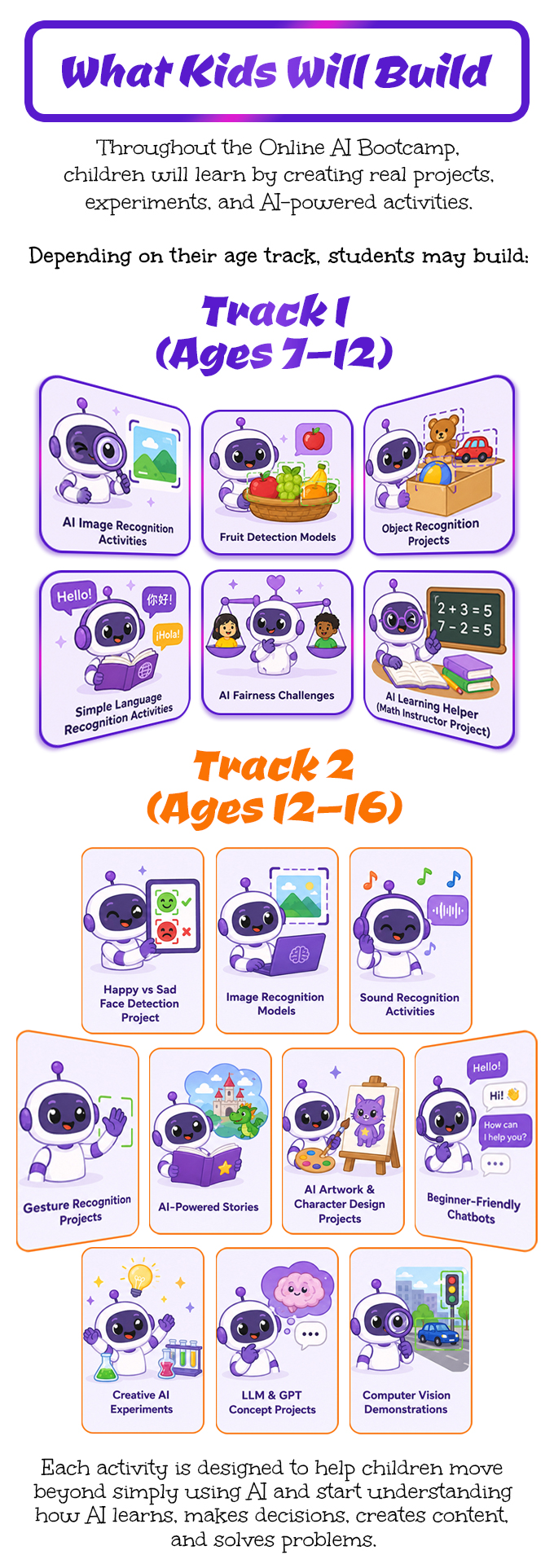
Some of the projects children may build throughout the program include:
Fruit Detection Model
Children train AI to recognize different fruits using images.
Skills learned:
- Data collection
- Training models
- Testing predictions
Happy vs Sad Face Detection
Students teach AI to identify facial expressions.
Skills learned:
- Pattern recognition
- Computer vision basics
- AI training
Sound Recognition Activity
Children train AI to identify different sounds.
Skills learned:
- Audio data
- Machine learning
- Testing models
AI Story Creator
Students use AI tools to generate characters, stories, and adventures.
Skills learned:
- Creativity
- Prompt writing
- Storytelling
AI Artwork Generator
Children create original artwork using AI image generation tools.
Skills learned:
- Design thinking
- Creativity
- Visual communication
Beginner-Friendly Chatbot
Students build a simple chatbot that answers questions.
Skills learned:
- Logic
- User interaction
- AI conversations
Best AI Tools For Kids Used In The Program
A common misconception is that children need advanced programming skills to begin learning Artificial Intelligence.
They don’t.
One of the goals behind the AI For Kids: Summer Online AI Camp & Training Program is to introduce AI using beginner-friendly tools that allow children to focus on learning concepts, creativity, experimentation, and problem-solving.
Throughout the program, students are introduced to carefully selected tools that make AI learning visual, engaging, interactive, and age-appropriate.
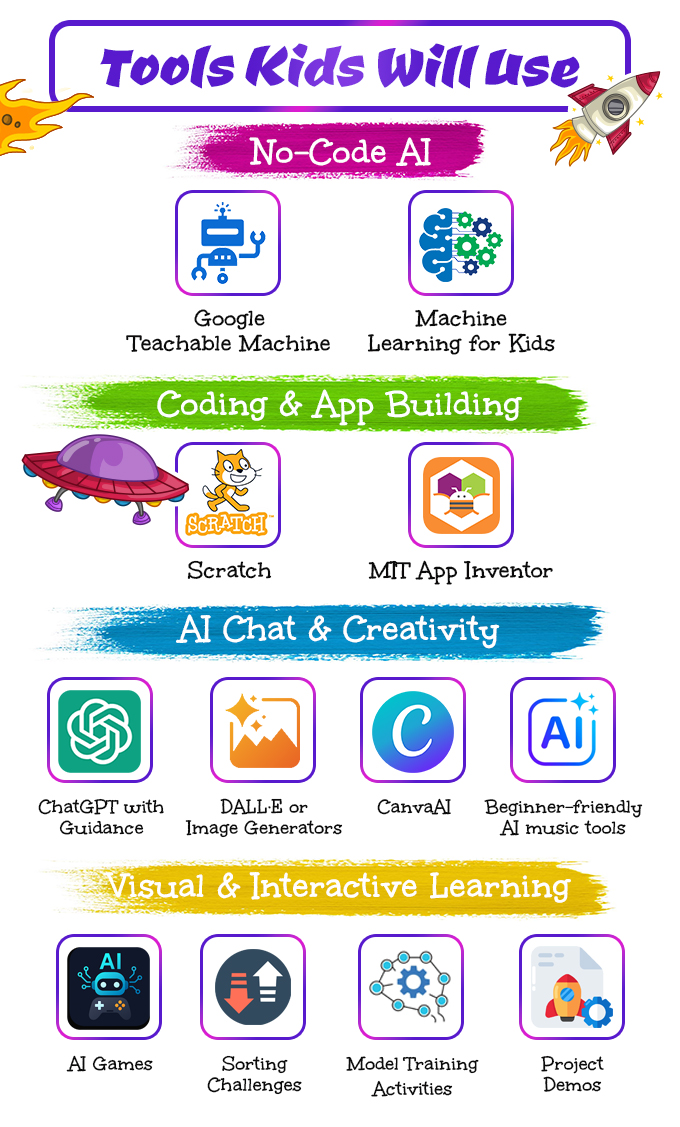
Some of the tools used throughout the learning journey include:
Google Teachable Machine
A visual machine learning tool that helps children train image, sound, and gesture recognition models.
Machine Learning For Kids
A platform specifically designed to introduce AI concepts to younger learners.
Scratch
A visual programming environment perfect for creating interactive projects.
MIT App Inventor
A beginner-friendly platform for building apps without advanced coding.
ChatGPT
A guided AI assistant that helps children explore ideas, ask questions, and create content.
Canva AI
Allows children to create presentations, artwork, posters, and designs using AI-powered features.
Why AI Ethics Matters For Children
AI is powerful.
But it is not perfect.
Children should understand that AI can:
- Be inaccurate
- Show bias
- Produce misleading information
- Make incorrect predictions
That is why responsible AI education is essential.
Children should learn:
Privacy
What information should never be shared with AI tools.
Fairness
How biased data can create unfair outcomes.
Critical Thinking
Why AI answers should be verified.
Responsibility
How AI should be used respectfully and safely.
Understanding these concepts early creates more responsible digital citizens.
Why AI Learning For Kids Should Feel Like Play
One philosophy guided the creation of the AI For Kids program:
Children learn best when they are having fun.
That is why the program is designed more like an adventure than a traditional online course.
Instead of long lectures and memorization, children participate in missions, challenges, activities, creative projects, and guided experiments that make learning feel like discovery.
Throughout the bootcamp experience, children unlock new concepts, complete mini challenges, earn achievement badges, and build projects that reinforce what they have learned.
This gamified approach helps children stay engaged while developing confidence, curiosity, and a genuine interest in technology.
The most effective methods include:
- Missions
- Challenges
- Games
- Quests
- Projects
- Team activities
- Creative exercises
When learning feels like exploration rather than instruction, children remain motivated.
That is why many modern AI camps use gamified learning experiences instead of traditional lectures.
What Skills Children Develop Through The AI For Kids Program
While the program teaches Artificial Intelligence concepts, the outcomes extend far beyond technology.
Every activity, challenge, project, and learning exercise has been designed to help children develop valuable future-ready skills that can support them throughout school, higher education, and future careers.
By participating in the AI For Kids: Summer Online AI Camp & Training Program, students develop:
Technical Skills
- AI fundamentals
- Machine learning basics
- Digital literacy
- Problem solving
Creative Skills
- Storytelling
- Design
- Innovation
- Idea generation
Personal Skills
- Confidence
- Communication
- Presentation skills
- Collaboration
Future Skills
- Critical thinking
- Adaptability
- Creativity
- Responsible technology usage
These are the same skills many experts believe will be essential in the future workforce.
The Future Belongs To AI-Literate Children
The goal of AI education is not to turn every child into a programmer.
It is not about advanced mathematics.
It is not about building complex algorithms.
It is about helping children understand one of the most important technologies shaping their future.
Children should know:
- What AI is
- How it learns
- Why it makes mistakes
- How to use it safely
- How to create with it responsibly
The earlier they develop that understanding, the more prepared they will be for the opportunities ahead.
As parents, educators, and mentors, we have an opportunity to help children move beyond simply consuming technology.
We can help them become creators.
We can help them become thinkers.
We can help them become builders.
And in an AI-powered world, that may be one of the most valuable gifts we can give them.
Final Thoughts: Why AI For Kids Is A Future-Ready Skill
Artificial Intelligence is no longer a technology of tomorrow.
It is already shaping how children learn, create, communicate, and explore the world around them.
The question is no longer whether children will encounter AI.
The question is whether they will understand it.
That belief is what inspired us to create the AI For Kids: Summer Online AI Camp & Training Program.
We wanted to build a learning experience that introduces children to AI through creativity, curiosity, projects, experimentation, and responsible learning rather than complexity and confusion.
Through games, challenges, machine learning activities, AI-powered creative projects, and guided exploration, children can begin developing the skills and confidence needed to thrive in an AI-powered future.
Because when children understand AI, they don’t just learn how technology works.
They learn how to think critically, solve problems, create responsibly, and become active participants in shaping the future.
And that may be one of the most valuable skills they can develop in the years ahead.
About the Author