Introduction: The Invisible Environmental Cost Behind Artificial Intelligence
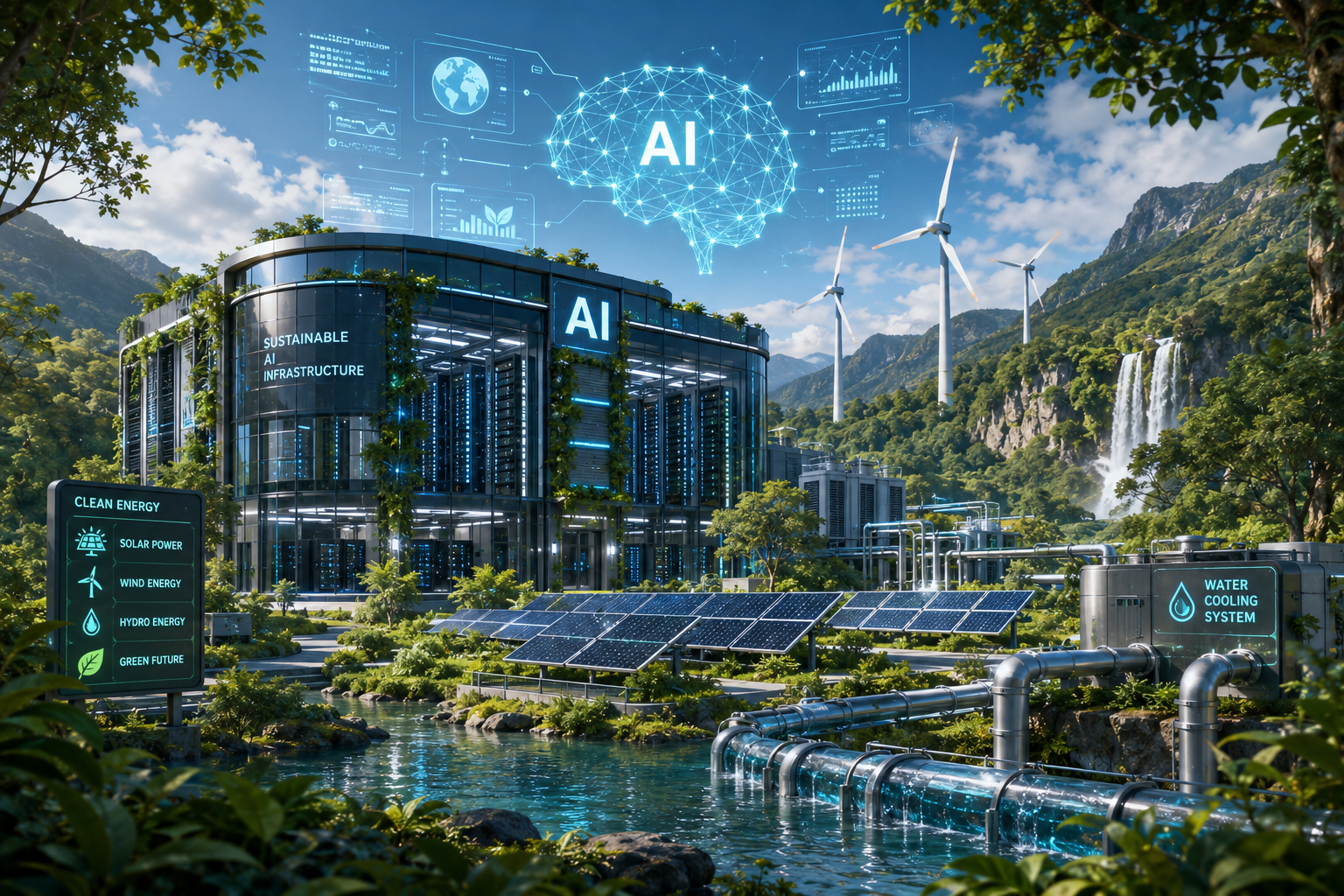
Green AI is becoming one of the most important conversations in modern technology. Yet for most people, artificial intelligence still feels almost invisible.
A student asks an AI assistant to summarize a topic.
A developer generates code within seconds.
A business automates customer support.
A designer creates images using generative AI.
Everything happens instantly on a screen.
No factories. No transportation. No physical product.
It almost feels like AI exists somewhere in the digital world without touching the physical one.
But behind every AI-generated answer, there is a massive technological ecosystem working continuously.
Thousands of powerful processors run inside large data centers. These systems process information, train models, store data, and generate responses.
And just like every physical machine, they require resources.
They need electricity. They need hardware. They need cooling systems. And in many cases, they need water.
As artificial intelligence becomes part of education, healthcare, software development, business, entertainment, and almost every industry, a new challenge is appearing:
Can we continue building smarter AI without creating bigger environmental problems?
The answer is not about stopping AI innovation.
The answer is building AI differently.
This is where Green AI and sustainable AI engineering come in.
The future of technology will not only depend on who builds the most powerful artificial intelligence.
It will depend on who builds the most efficient, responsible, and Green AI systems.
Why Does Green AI Need Energy and Water?
Before understanding how Green AI reduces environmental impact, we need to understand why modern AI systems consume significant energy and resources.
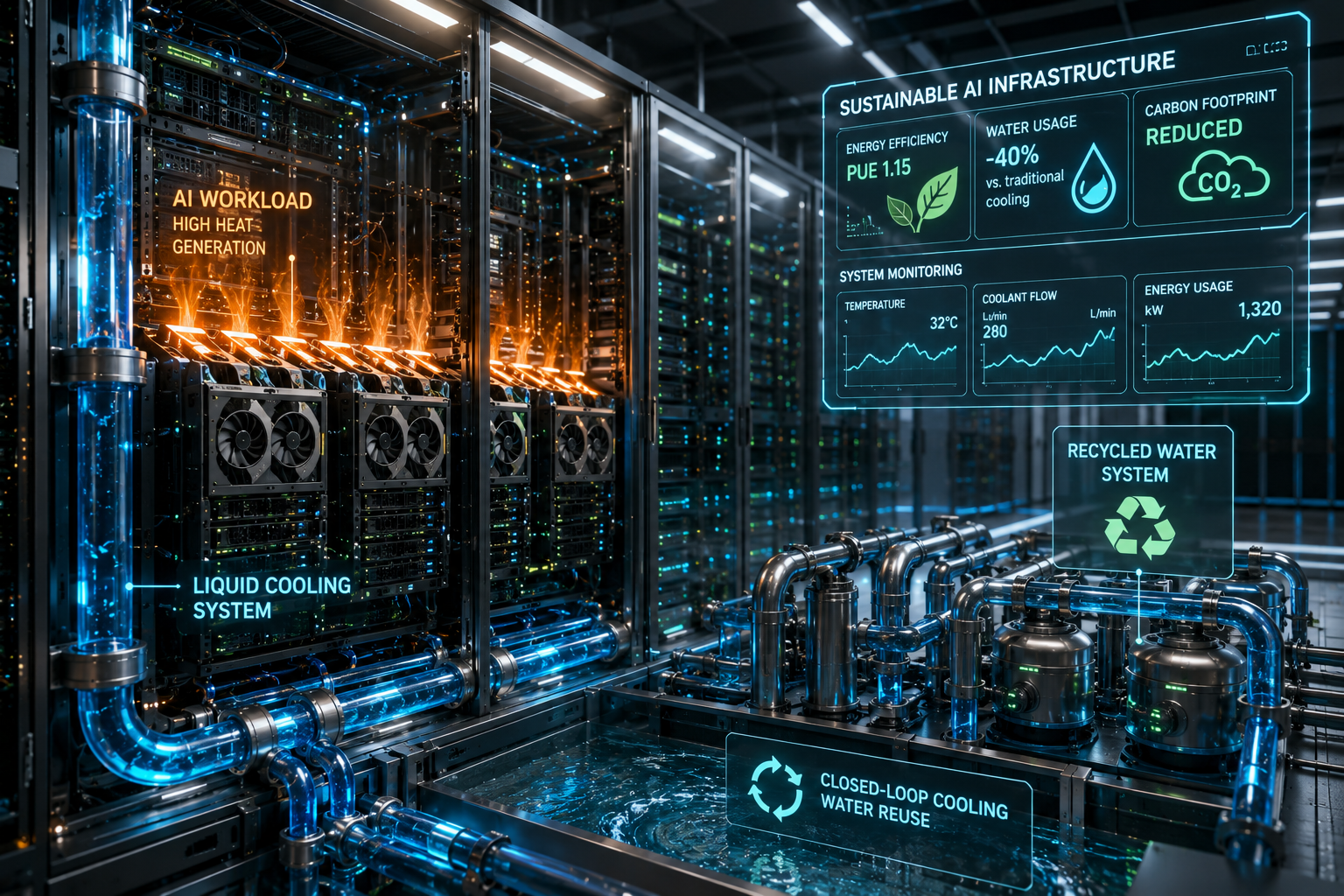
Whenever someone interacts with an AI model, the request travels to powerful computers inside data centers. These machines use specialized hardware like GPUs designed to perform billions of calculations.
The more complex the AI model, the more computing power it usually requires. And computing creates heat.
Think about your laptop.
When you run heavy software or games, the device becomes hot and the cooling fan starts running.
Now imagine thousands of extremely powerful computers running continuously.
That creates a huge cooling challenge.
Data centers use different cooling technologies to maintain safe temperatures. Some systems use water because water transfers heat efficiently.
Water can be involved in:
- Cooling servers
- Maintaining facility temperatures
- Supporting electricity generation
AI itself is not directly consuming water.
The infrastructure behind AI is where resource usage happens.
As AI adoption increases:
- More applications are created
- More servers are needed
- More processing happens
- More cooling is required
This has created one of the biggest engineering questions of the AI era:
How can Green AI scale intelligence without scaling environmental impact?
The Rise of Green AI Engineering
For decades, technology companies focused on one major goal: “How can we make computers faster?”
More processing power.
More storage.
More advanced systems.
But the future requires a different question: “How can we make powerful technology more efficient?”
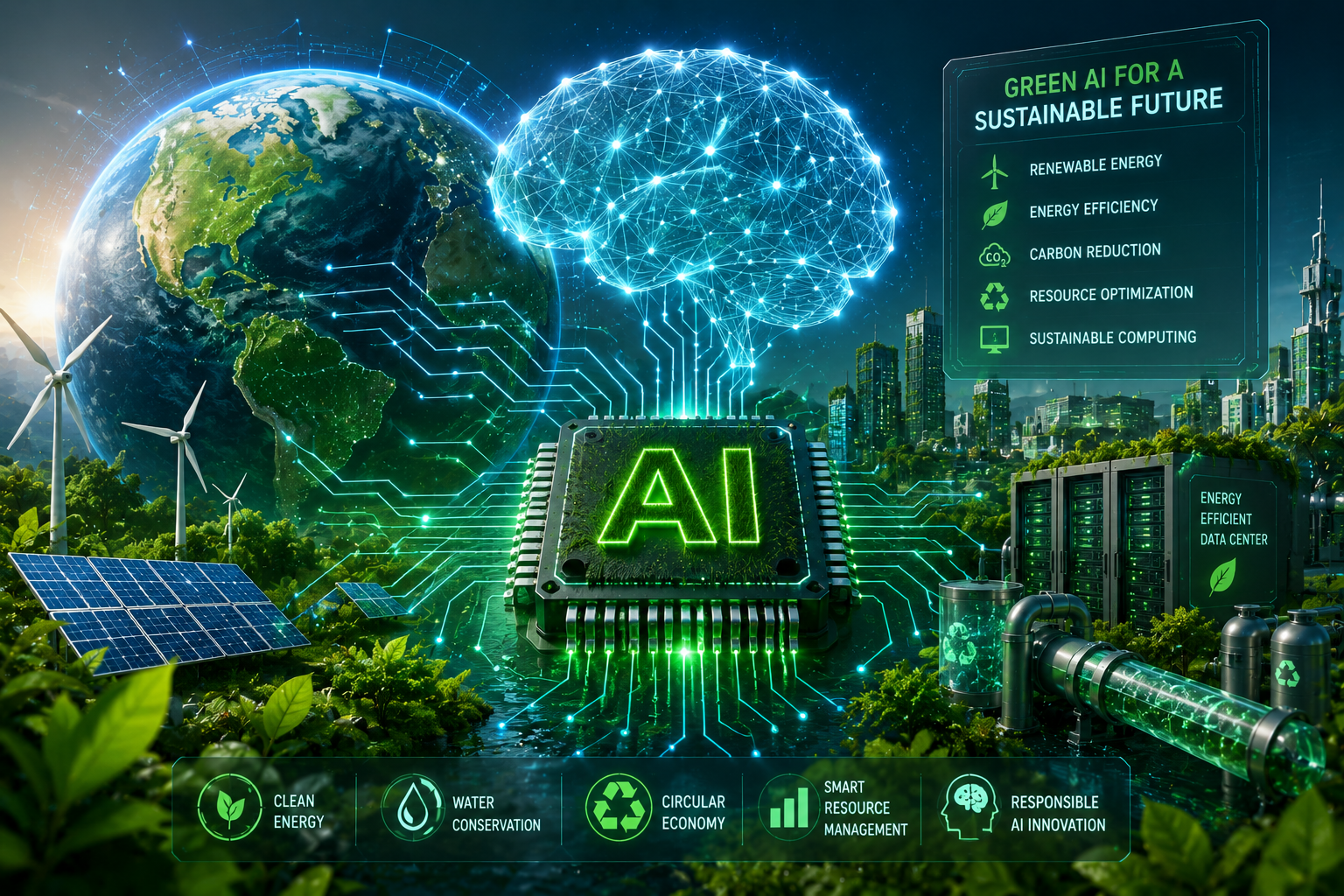
This is the foundation of Green AI.
Green AI focuses on creating artificial intelligence systems that balance:
- Performance
- Energy efficiency
- Resource optimization
- Environmental responsibility
The goal is not smaller innovation.
The goal is smarter innovation.
A sustainable AI future requires improvements across every layer:
Hardware engineers need better chips.
Cloud companies need efficient data centers.
Researchers need optimized AI models.
Developers need smarter software practices.
Sustainability is becoming a technical challenge—not just an environmental discussion—and Green AI is emerging as one of the industry’s most important engineering goals.
Solution 1: Green AI Through Smarter Cooling Systems and Water Recycling
One of the biggest opportunities for advancing Green AI is improving how data centers manage heat.
Traditional data centers often depend heavily on cooling infrastructure because servers must operate within safe temperature ranges.
If machines overheat:
Performance decreases.
Hardware can fail.
Energy efficiency drops.
As AI workloads become more demanding, cooling technology is evolving.
Liquid Cooling Technology
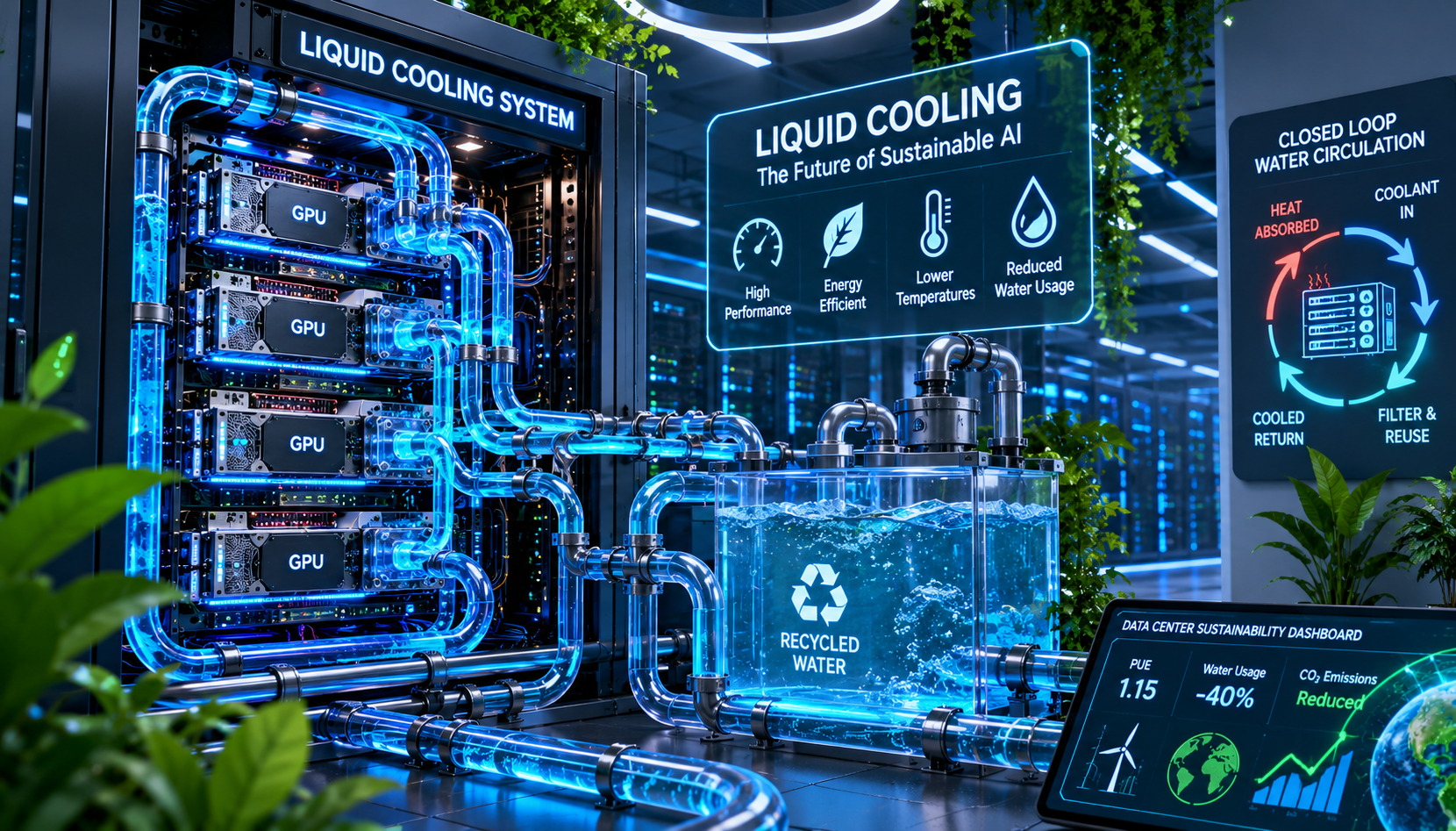
Instead of depending only on air cooling, many companies are moving toward liquid cooling systems.
Liquid can transfer heat more efficiently than air.
In these systems, cooling liquids move closer to heat-producing components and remove heat faster.
This approach is especially useful for AI hardware because modern GPUs generate significant heat during large-scale computations.
Liquid cooling can help:
- Improve hardware efficiency
- Reduce cooling energy requirements
- Support high-performance AI systems
Closed-Loop Cooling Systems
One important development is closed-loop cooling.
Instead of continuously consuming new water, these systems reuse cooling liquid repeatedly.
The liquid circulates through the system, absorbs heat, releases that heat, and returns again.
This recycling approach reduces dependency on freshwater resources.
Immersion Cooling
Another emerging method is immersion cooling.
Servers or components are placed inside special cooling liquids that do not damage electronics.
The liquid directly absorbs heat from hardware.
This can provide better thermal management compared to traditional cooling methods.
Turning Waste Heat Into Useful Energy
Future data centers may also reuse the heat they produce.
Instead of releasing server heat into the environment, companies are researching ways to redirect that energy.
Recovered heat could potentially support:
- Building heating systems
- Industrial processes
- Other energy requirements
The next generation of AI infrastructure will not only focus on generating more computing power.
It will focus on using every resource intelligently—a core principle of Green AI.
Solution 2: Green AI Models — Bigger Is Not Always Better
During the early AI race, bigger models received most of the attention.
More parameters. More data. More computing power.
The assumption was simple: Bigger means better.
But the future of Green AI is moving toward a different idea: Efficiency.
A smaller, optimized model can sometimes solve specific problems faster and with fewer resources than a massive general-purpose system.
Model Compression
Model compression reduces the size of AI models while maintaining performance.
Researchers remove unnecessary complexity so models require less storage and computation.
The goal is similar to optimizing software:
Do the same task using fewer resources.
Quantization
Quantization changes how AI models store and process numerical information.
By reducing unnecessary precision, models can run faster and require less computing power.
This helps reduce:
- Processing requirements
- Energy consumption
- Hardware pressure
Specialized AI Models
Not every task requires the largest AI system available.
For example:
A restaurant chatbot answering menu questions does not need the same level of AI power as a scientific research assistant.
Using smaller task-specific models can dramatically reduce unnecessary computation.
Edge AI
Another important development is Edge AI.
Instead of sending every request to cloud servers, AI can run directly on devices like:
- Phones
- Computers
- Smart devices
This reduces data center dependency and improves speed.
The future AI race may not be about who creates the biggest model.
It may be about who creates the smartest, most efficient, and most sustainable Green AI models.
Solution 3: Green Coding for Green AI — How Developers Can Reduce AI Waste
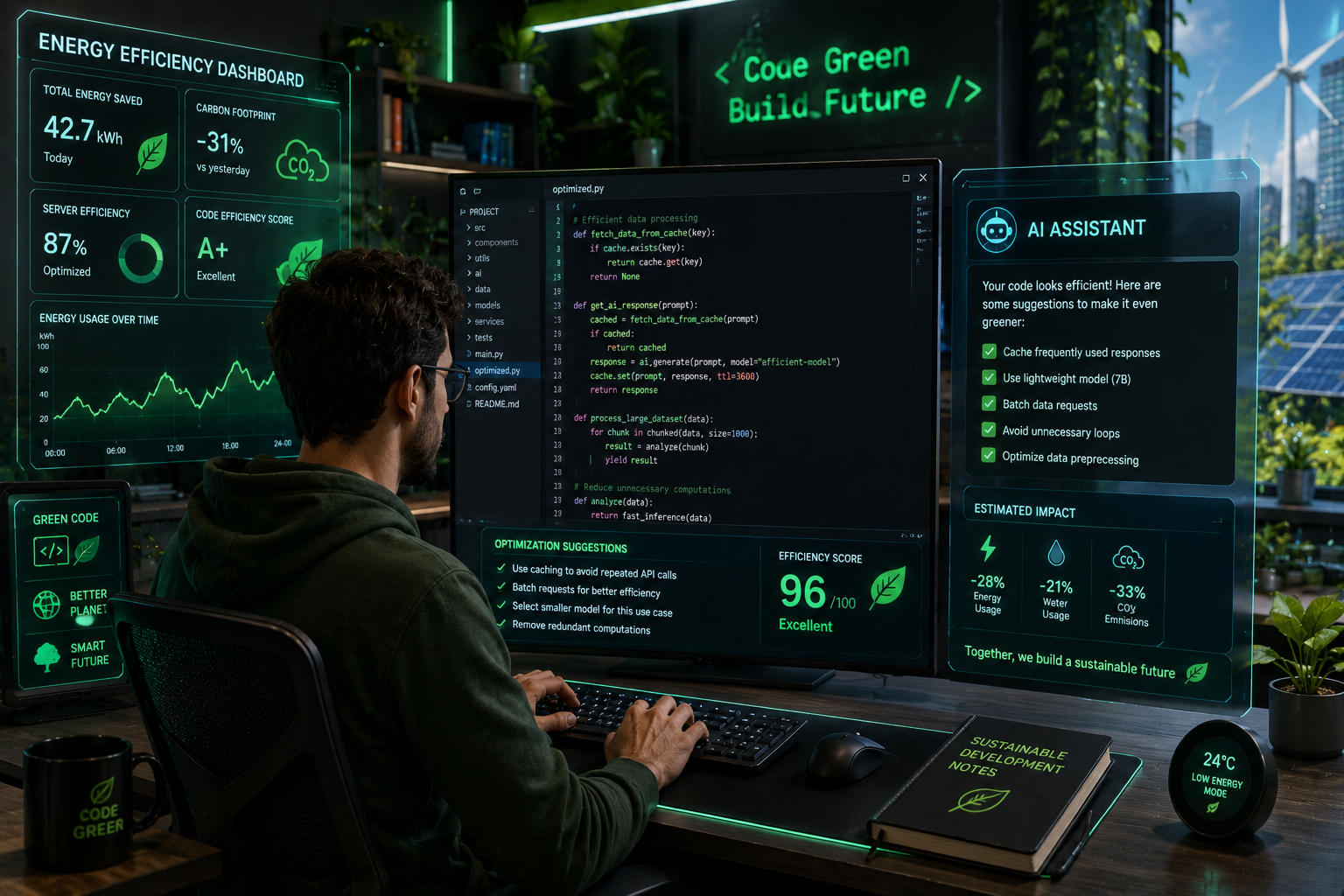
Building Green AI is not only a hardware problem.
Developers also play an important role.
Every software decision affects computing resources.
Poorly designed applications can waste enormous amounts of processing power.
Examples include:
- Sending repeated AI requests
- Running unnecessary calculations
- Using oversized AI models
- Processing duplicate data
Green coding focuses on creating software that is efficient from the beginning.
Smarter API Usage
Developers can reduce unnecessary AI calls by designing better request systems.
Instead of asking AI the same question repeatedly, applications can store and reuse responses.
Caching Systems
Caching allows applications to save previously generated information.
This reduces repeated processing and improves performance.
Better Algorithms
Efficient algorithms solve problems faster.
Less processing means:
Less computing.
Less energy.
Better scalability.
Choosing the Right AI Tool
Future developers will need to understand when to use:
Large AI models.
Small AI models.
Local AI systems.
Traditional programming.
The best solution is not always the most powerful one.
It is the most appropriate one.
The developers of tomorrow will not only ask: “Does my software work?”
They will ask: “Does my software work efficiently and support Green AI principles?”
Read More: AI-Powered Development: How AI Is Transforming the Future of Software Engineering
Solution 4: Renewable Energy-Powered Green AI Data Centers
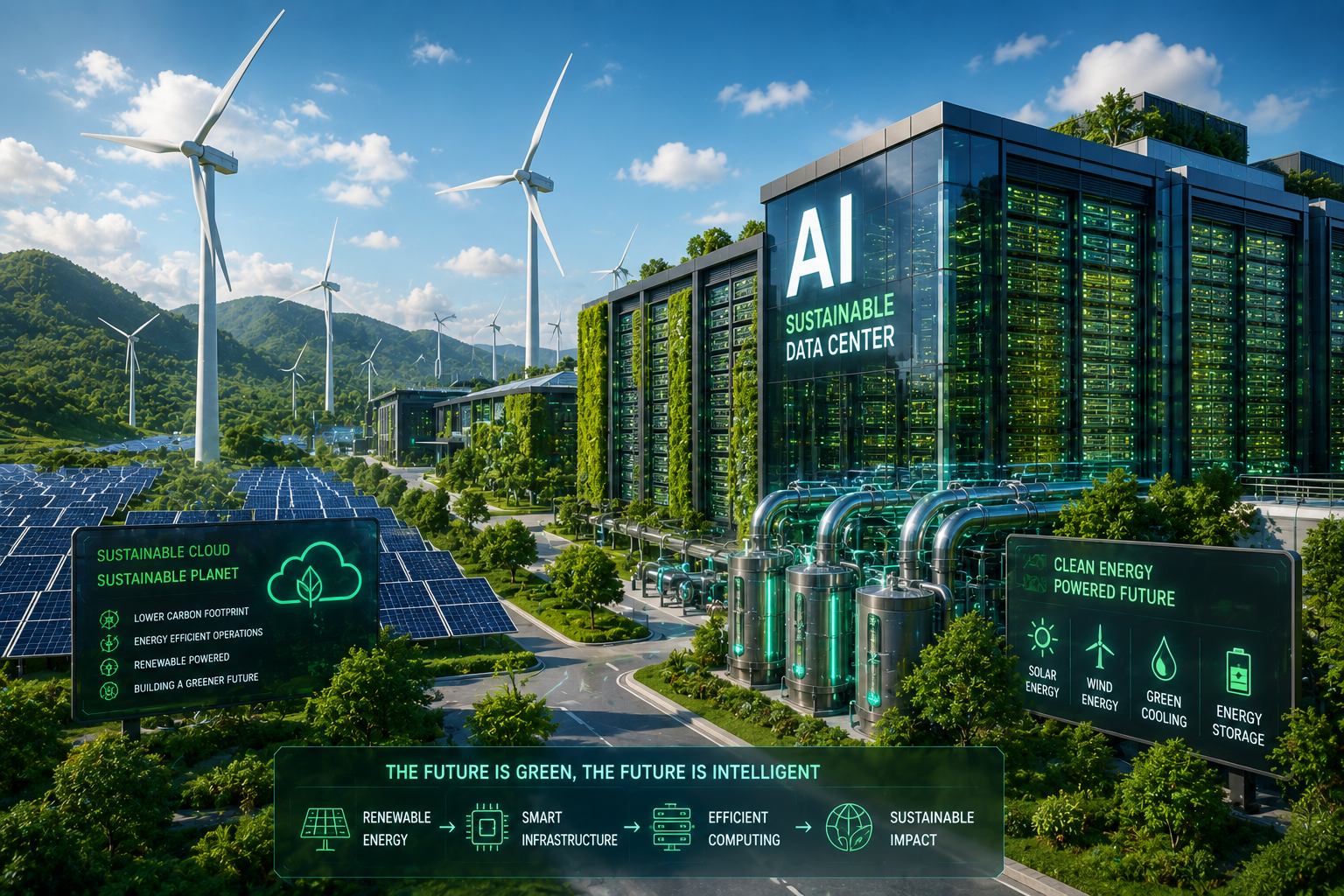
Reducing the environmental impact of AI is not only about using less energy.
It is also about changing where that energy comes from.
Traditional data centers depend on large amounts of electricity because servers, storage systems, networking equipment, and cooling systems operate continuously.
As AI adoption increases, energy demand becomes one of the biggest challenges.
This is why the future of AI infrastructure is moving toward renewable energy-powered data centers.
Instead of depending completely on traditional power sources, companies are investing in cleaner alternatives such as:
- Solar energy
- Wind energy
- Hydroelectric power
- Advanced energy storage systems
The goal is simple: Keep building powerful Green AI systems while reducing environmental impact.
Smarter Energy Management Using AI
Interestingly, artificial intelligence itself can help solve energy challenges.
AI systems can analyze thousands of signals inside data centers and optimize how resources are used.
For example, AI can help predict:
- When servers need more cooling
- Which workloads should run at specific times
- How power should be distributed
- When machines should enter low-energy states
Instead of running every system at maximum capacity all the time, intelligent management allows infrastructure to adjust based on actual demand.
This creates a new idea:
Using AI to make AI more sustainable.
Energy-Efficient Hardware
Another important area is chip development.
AI processors are becoming more powerful, but future innovation will also focus on performance per watt.
The question is changing from:
“How much computing power can we create?”
to:
“How much intelligence can we create from every unit of energy?”
Better hardware combined with renewable energy could significantly improve the sustainability of future Green AI systems.
AI will continue growing.
The challenge is designing infrastructure that grows responsibly.
Solution 5: The Future of Green AI Data Centers Could Look Completely Different
For decades, data centers have followed a familiar design:
Large buildings.
Thousands of servers.
Massive cooling systems.
Continuous electricity usage.
But AI growth is forcing engineers to rethink everything.
What if the future data center is not a building?
What if it operates underwater?
What if it floats in the ocean and generates its own power?
What if one day computing infrastructure moves beyond Earth?
These ideas may sound like science fiction, but companies are already exploring them.
Microsoft’s Underwater Data Center Experiment
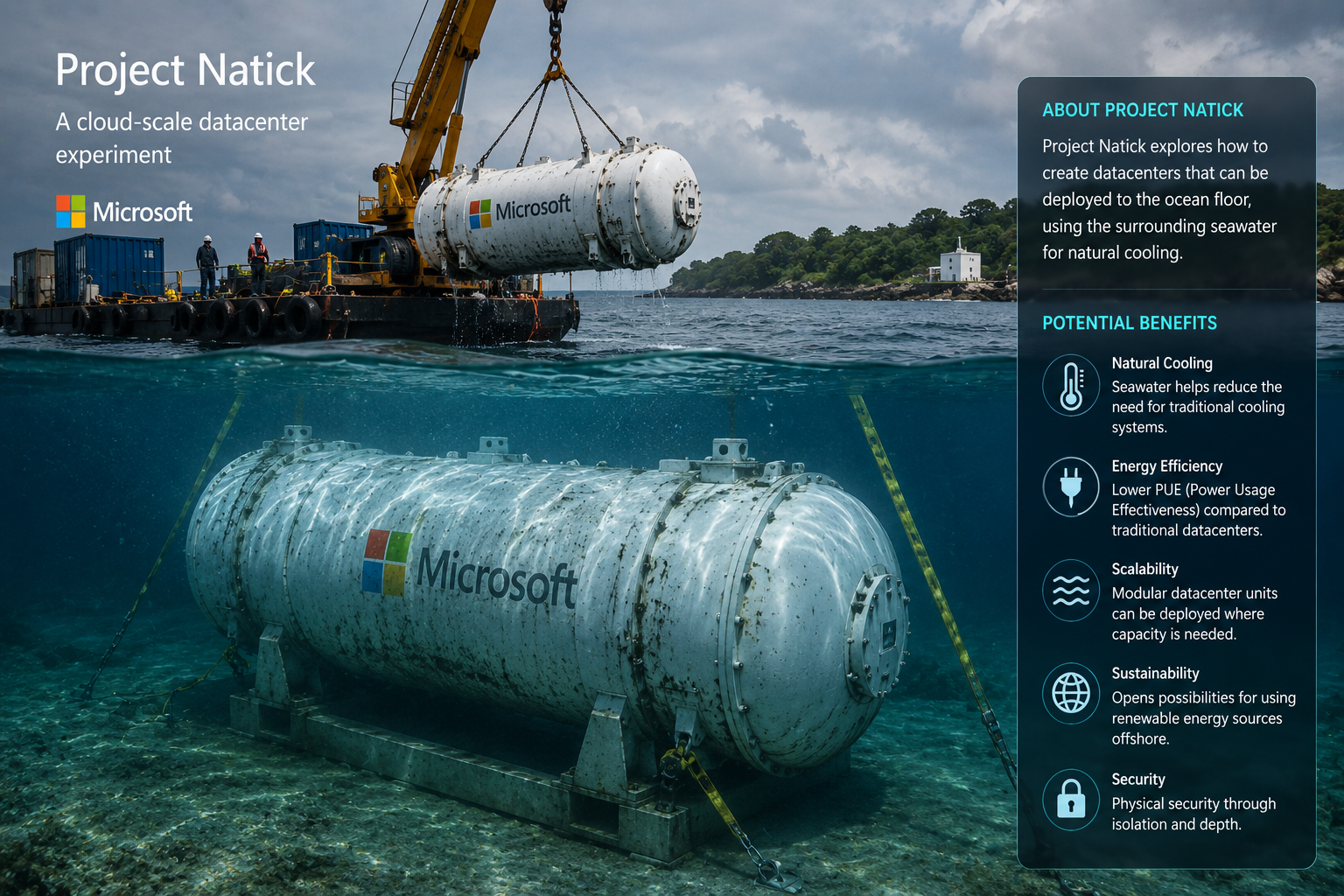
One of the most interesting experiments came from Microsoft through Project Natick.
Microsoft tested whether data centers could operate underwater by placing a sealed data center capsule beneath the ocean.
The idea was based on a simple observation:
The ocean naturally provides a cool environment.
Instead of constantly fighting against heat, engineers explored whether technology could work with nature.
Potential benefits included:
- Natural cooling assistance
- Lower cooling requirements
- Reduced land usage
- Possibility of connecting with offshore renewable energy
The underwater environment also provided another interesting advantage.
Because the container was sealed and protected from human interference, researchers studied whether hardware reliability could improve.
The experiment showed that alternative data center designs are possible and could play an important role in the future of Green AI.
Although Microsoft later completed the research phase of Project Natick, the lessons continue influencing conversations around sustainable computing infrastructure.
Floating AI Data Centers Powered by Ocean Energy
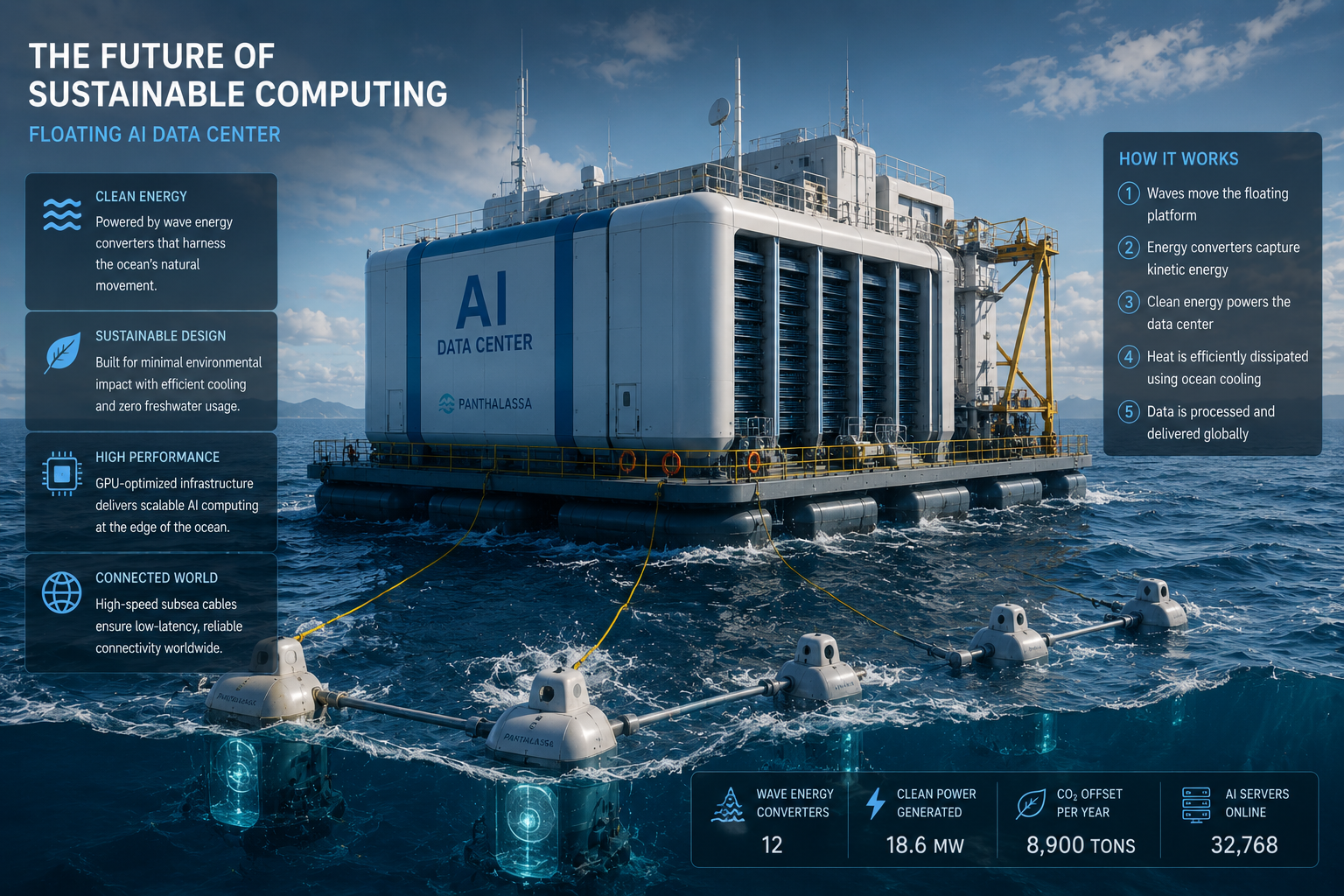
Another futuristic concept is taking computing infrastructure offshore.
Companies are exploring floating data centers that can use ocean environments to support AI computing.
One example is Panthalassa, a company researching ocean-based computing infrastructure powered by wave energy.
Unlike traditional data centers that depend heavily on land resources and electrical grids, floating systems explore a different approach.
They aim to:
- Capture renewable energy from ocean waves
- Power computing infrastructure
- Use the surrounding environments efficiently
- Reduce pressure on land-based resources
The idea represents a major shift toward building Green AI infrastructure.
Future data centers may not only consume energy.
They may become systems designed around generating and managing energy intelligently.
Cooling AI Chips From the Inside
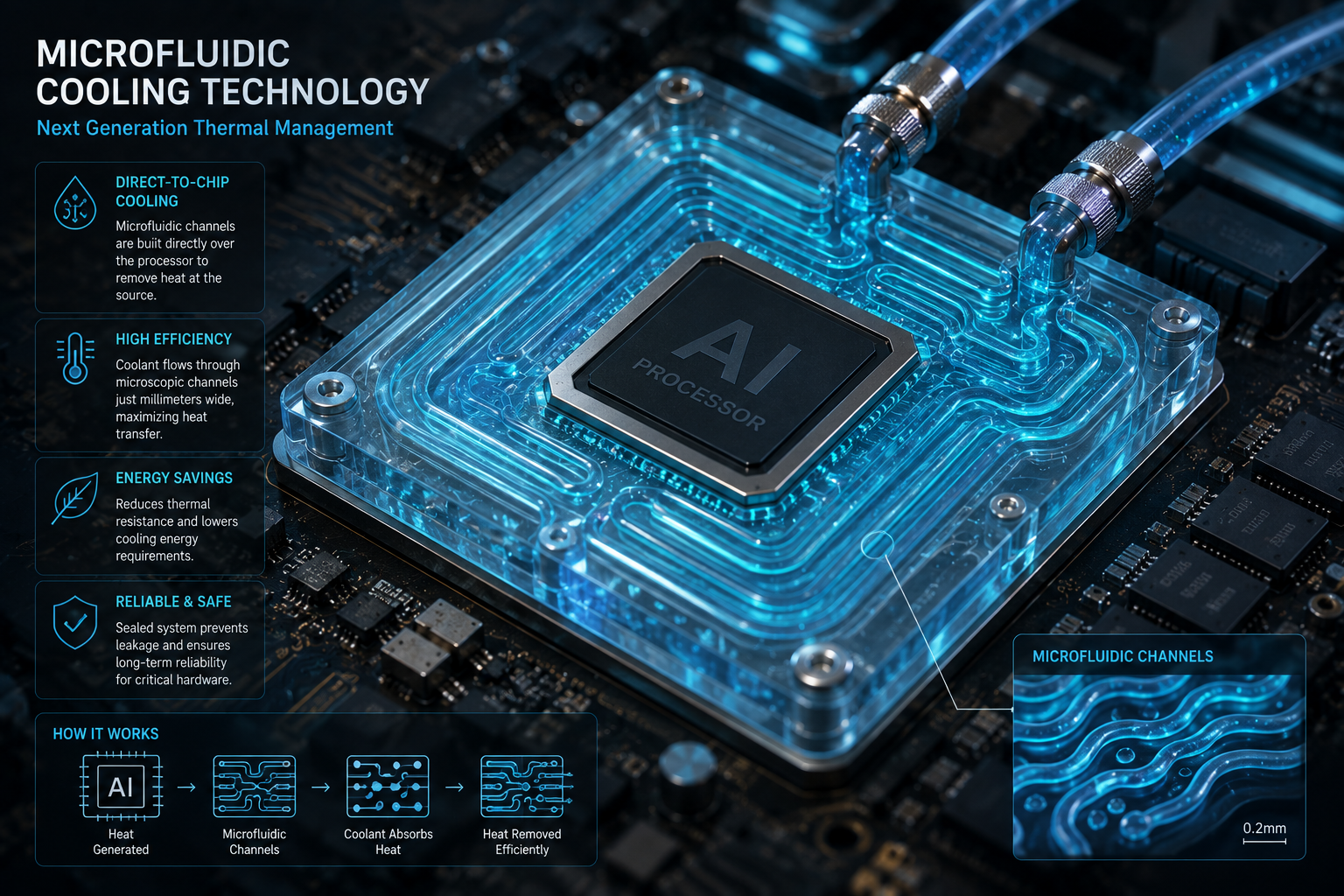
Another major breakthrough area is happening inside the hardware itself.
Today, most cooling systems focus on removing heat after it leaves processors.
But researchers are exploring a new question:
What if we remove heat directly from where it starts?
Microsoft has researched microfluidic cooling technology, which uses extremely tiny channels to move cooling liquid closer to the source of heat.
Imagine a tiny cooling network built around powerful computer chips.
Instead of cooling an entire room, engineers cool the exact area producing heat.
This approach could help:
- Improve AI processor efficiency
- Reduce cooling energy requirements
- Allow more powerful hardware designs
- Improve overall sustainability for future Green AI systems.
Future AI progress will not only come from better software.
It will also come from completely redesigned hardware.
Space-Based Data Centers: A Future Possibility?
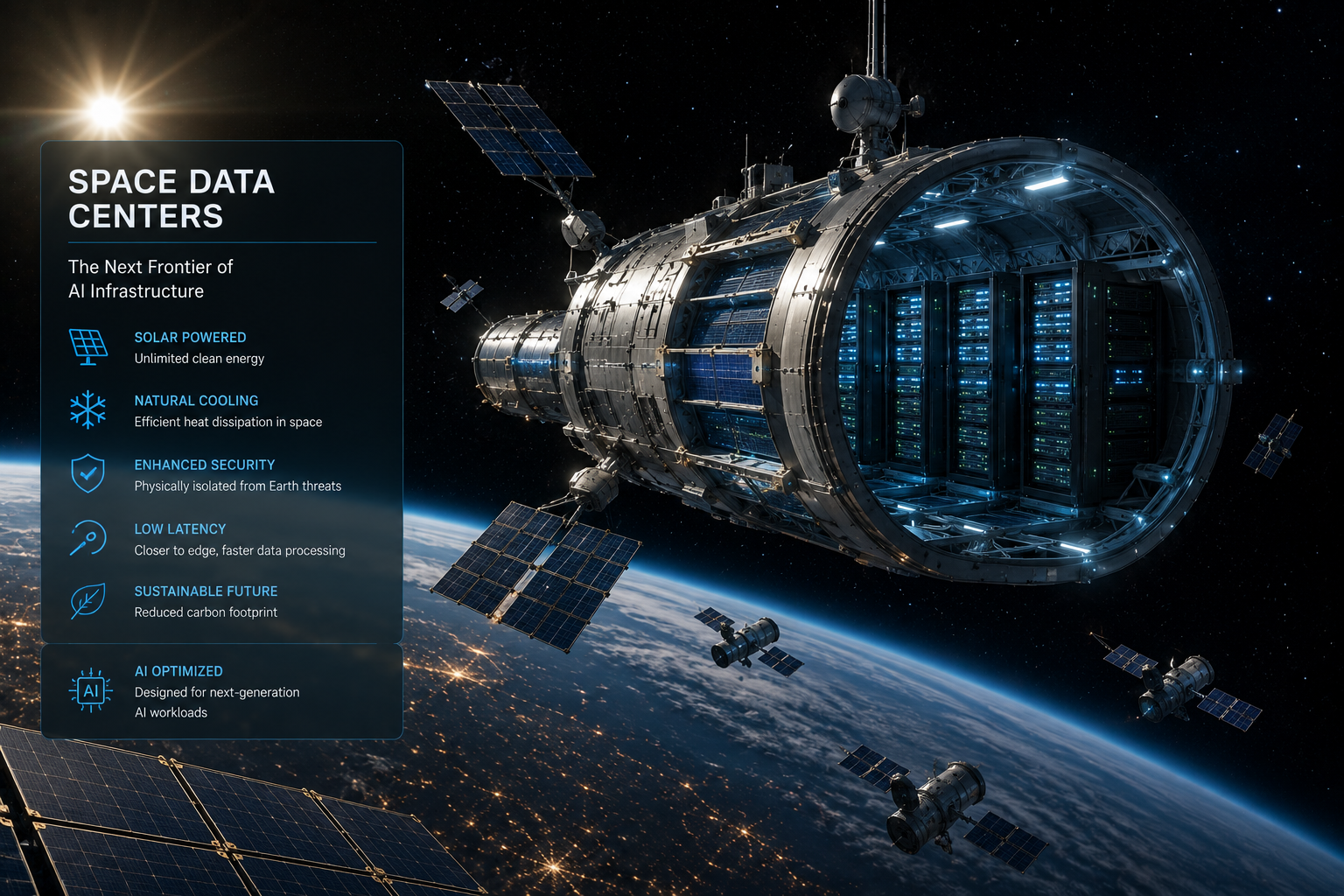
Some technology leaders are thinking even further ahead.
Jeff Bezos has discussed the possibility that future data centers could operate in space, powered by continuous solar energy.
The idea comes from the fact that solar energy availability in space is much greater because there are fewer interruptions from weather or day-night cycles.
Potential advantages:
- Continuous solar energy access
- Less pressure on Earth-based resources
- New possibilities for large-scale computing
However, major challenges remain:
- High launch costs
- Hardware maintenance
- Communication delays
- Space engineering complexity
Space-based computing is not replacing traditional data centers anytime soon.
But these ideas show how seriously the industry is reimagining the future of Green AI infrastructure.
Traditional AI Infrastructure vs Sustainable Green AI Infrastructure
| Traditional AI Infrastructure | Sustainable AI Infrastructure |
| High energy consumption | Renewable energy integration |
| Traditional cooling systems | Liquid cooling and advanced thermal management |
| Freshwater dependency | Closed-loop cooling and recycling |
| Bigger general AI models | Smaller optimized AI models |
| Heavy cloud dependency | Edge AI and efficient processing |
| Resource-heavy software | Green coding practices |
| Reactive energy management | AI-powered resource optimization |
| Standard data centers | Underwater, floating, and future infrastructure concepts |
The Future Developer Will Build Responsible Green AI
The role of developers is changing.
Earlier, developers mainly focused on:
Can this application work? Can this feature run? Can this system handle users?
But the future requires bigger thinking.
Tomorrow’s engineers will ask:
How efficient is this system?
How much energy does it require?
Can it scale responsibly?
Future developers will need skills across:
- Artificial Intelligence
- Cloud Computing
- DevOps
- Cybersecurity
- System Architecture
- AI Optimization
- Sustainable Engineering
Because the next generation of technology will not only reward those who build powerful systems. But also those who build smarter, more efficient, and more sustainable Green AI systems.
Frequently Asked Questions (FAQs)
1. Does AI really consume water?
AI itself does not directly consume water. However, the data centers running AI systems may use water-based cooling systems to control server temperatures.
2. Why do AI data centers need cooling?
AI workloads require powerful processors that generate heat. Cooling systems protect hardware and maintain performance.
3. Can Green AI become environmentally friendly?
Green AI can become more sustainable through renewable energy, efficient models, optimized software, better cooling technologies, and responsible infrastructure design.
4. Can developers help reduce AI’s environmental impact?
Yes.
Developers can create more efficient applications by reducing unnecessary AI requests, improving algorithms, using caching, and choosing suitable models.
5. Are underwater data centers real?
Yes.
Microsoft tested underwater data centers through Project Natick to study alternative cooling methods and reliability.
6. Can AI data centers really exist in oceans or space?
Research is happening in both directions.
Ocean-based systems are being explored through floating infrastructure concepts, while space-based data centers remain a future possibility with major engineering challenges.
7. What skills will future AI engineers need?
Future engineers will need a combination of:
- AI development
- Cloud systems
- Data engineering
- Security
- Automation
- Infrastructure knowledge
- Sustainable engineering practices
Preparing Developers for the AI-First Sustainable Future
The future of software development is changing.
Green AI is transforming how we build applications, manage infrastructure, automate workflows, and solve problems more efficiently.
But the next generation of developers will need more than the ability to write code.
They will need to understand how complete intelligent systems work while applying Green AI principles that improve efficiency, scalability, and sustainability.
Read More:
- 7 Sustainable DevOps Practices for a Greener Cloud Future
- The Hidden Costs of AI Agents: Energy, Ethics, and Efficiency
About the Author