
The rapid adoption of Generative AI, Agentic AI, and large language model (LLM) powered applications is transforming how organizations across the US and UK build software, automate operations, and deliver customer experiences. From AI coding assistants and intelligent customer support to autonomous business workflows, enterprises are deploying increasingly sophisticated AI systems at scale. However, this innovation comes with an unexpected challenge: AI-Native Cloud Cost is rising much faster than many infrastructure teams anticipated. GPU clusters for model training and inference, Kubernetes orchestration platforms, vector databases, inference APIs, autonomous AI agents, and serverless computing environments are significantly increasing cloud computing costs and overall public cloud spend. As organizations expand AI capabilities, they also face growing ai infrastructure costs, more complex kubernetes cost management, higher serverless cost analysis requirements, and continuous pressure to improve cloud infrastructure optimization.
According to the FinOps Foundation, AI workloads are becoming one of the fastest-growing drivers of enterprise cloud spending.
“The organizations that succeed with AI won’t simply build the smartest models. They’ll build the most economically sustainable ones.”
J.R. Storment, Executive Director, FinOps Foundation
This guide provides a practical FinOps for AI Overview, helping developers, DevOps engineers, platform engineers, cloud architects, AI engineers, and FinOps teams understand the growing impact of Agentic FinOps and the AI Cost Explosion. It explores proven strategies for cloud cost management, LLM cost optimization, database optimization, efficient kubernetes orchestration, and intelligent resource allocation so organizations can scale agentic ai applications while keeping generative ai cost under control without sacrificing performance or innovation.
Article Roadmap
This FinOps for AI Overview explains how to manage AI-Native Cloud Cost while reducing ai infrastructure costs and improving cloud infrastructure optimization for modern agentic ai platforms. You’ll learn:
- Why AI-native cloud costs are different
- Sources of AI infrastructure costs
- FinOps for Agentic AI
- Kubernetes optimization and kubernetes cost management
- LLM cost optimization
- Cost monitoring and cloud cost management
- Production workflows
- Real code examples
- Cloud governance
- Best practices for controlling cloud computing costs, public cloud spend, serverless cost analysis, database optimization, and kubernetes orchestration amid the ongoing Agentic FinOps and the AI Cost Explosion.
Understanding AI-Native Cloud Cost

AI-Native Cloud Cost refers to the total expense of running applications that rely on AI models as their core computing layer rather than traditional business logic. Unlike conventional SaaS platforms, AI-native systems continuously consume GPU resources, invoke LLM APIs, perform vector searches, maintain conversational memory, and execute autonomous reasoning. These workloads create highly variable cloud computing costs that are much harder to predict than traditional application hosting.
Modern AI platforms are built around GPU-first architecture, where expensive accelerators handle model inference and training. Every prompt is billed through token pricing, making both input and output size directly affect cost. Inference workloads become even more expensive when applications perform continuous AI reasoning, allowing autonomous agents to plan, evaluate, and retry tasks before returning a response. Additional expenses come from external LLM API calls, vector databases for semantic search, long-term memory systems, and supporting infrastructure such as serverless computing, kubernetes orchestration, and monitoring services. Together, these components significantly increase ai infrastructure costs, public cloud spend, and the need for effective cloud cost management and LLM cost optimization.
A simple developer scenario illustrates the challenge. A user asks an AI assistant to generate a market analysis report. Behind the scenes, the request triggers authentication, prompt preprocessing, multiple LLM API calls, retrieval from a vector database, memory lookups, external API requests, business logic execution, and response generation. Although the user sees a single interaction, the platform may execute dozens of cloud operations, each contributing to the overall generative ai cost. This growing complexity is a major reason why Agentic FinOps and the AI Cost Explosion has become a top priority for engineering and finance teams.
Traditional SaaS vs AI-Native SaaS
| Traditional SaaS | AI-Native SaaS |
| CPU workloads | GPU workloads |
| SQL queries | Vector search |
| REST APIs | LLM APIs |
| Predictable usage | Dynamic inference |
| Low cost variability | High cost variability |
Typical AI Request Workflow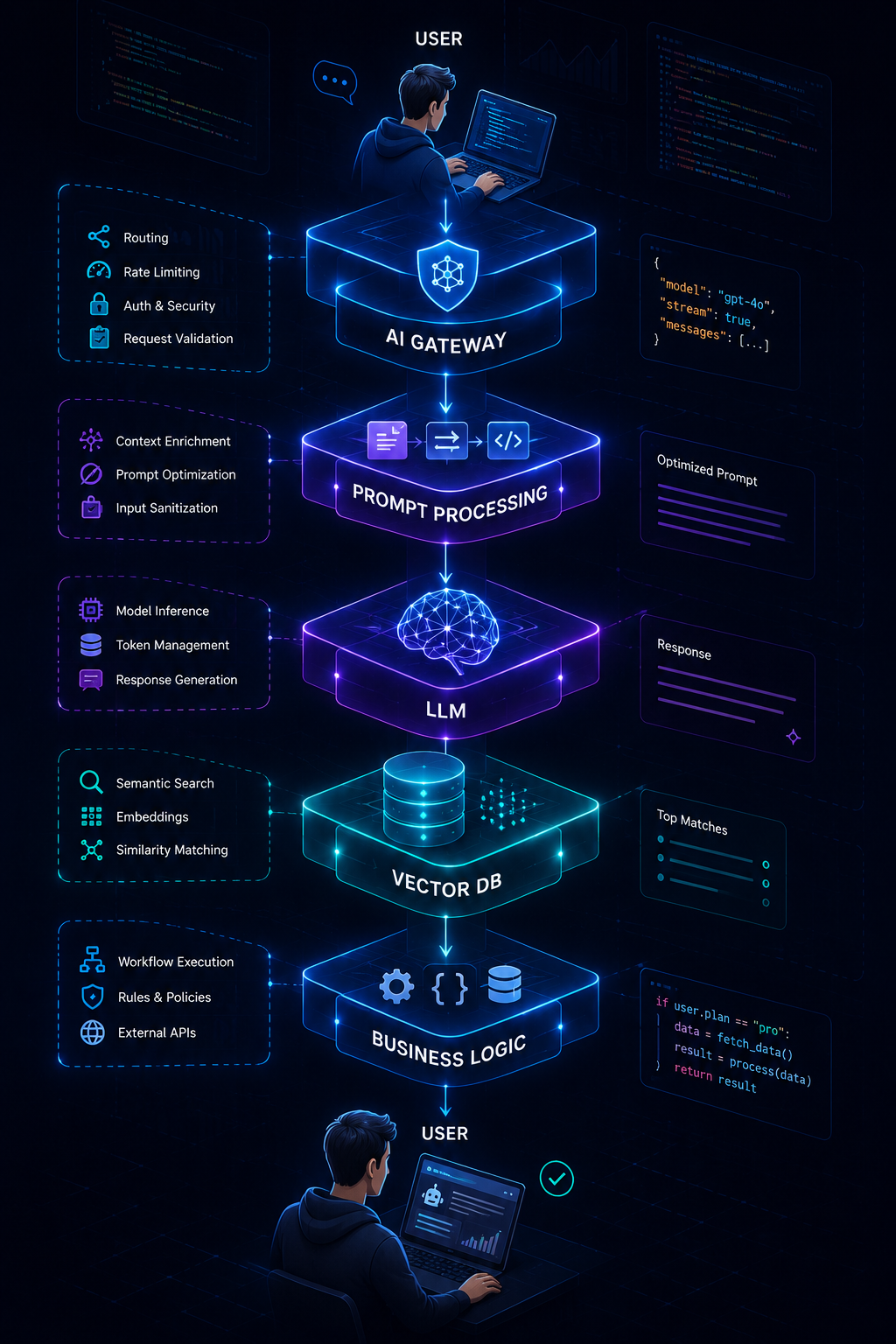
How each component contributes to cloud spending:
| Component | Cost Contribution |
| AI Gateway | Handles authentication, routing, rate limiting, and request management, adding networking and compute costs. |
| Prompt Processing | Cleans, enriches, and structures prompts, consuming CPU resources and increasing token usage. |
| LLM | The largest cost driver due to GPU-intensive inference and token-based billing. |
| Vector DB | Performs semantic retrieval using embeddings, increasing storage, indexing, and query costs. |
| Business Logic | Executes workflows, integrates external services, and may trigger additional API calls or serverless computing functions. |
| Response Delivery | Sends the generated output back to users while logging telemetry for governance and future optimization. |
Understanding how each stage consumes resources provides the foundation for FinOps for AI Overview, enabling teams to improve cloud infrastructure optimization, strengthen kubernetes cost management, perform effective serverless cost analysis, and build economically sustainable AI applications.
Why Agentic AI Causes Cloud Cost Explosion
The rise of agentic ai is fundamentally changing enterprise software economics. Unlike traditional AI applications that generate a single response, autonomous AI agents plan, reason, retrieve information, use external tools, and coordinate with other agents before completing a task. This shift is a major driver of AI-Native Cloud Cost because every reasoning step consumes compute, storage, networking, and API resources.
A modern multi-agent system often consists of a supervisor agent that delegates work to specialized agents such as research, coding, analytics, or compliance assistants. Each agent may perform recursive planning, breaking complex objectives into smaller tasks and evaluating whether additional actions are required. During execution, agents retrieve context from memory systems and vector databases, invoke LLM APIs, access enterprise databases, call external services, and coordinate results before producing a final answer. Every one of these operations increases ai infrastructure costs, making cloud computing costs less predictable than conventional applications.
Another significant contributor is autonomous reasoning. Instead of generating a single inference, an AI agent may perform multiple reasoning cycles to verify facts, compare alternatives, or retry failed actions. Combined with extensive tool usage, these repeated operations multiply GPU utilization, token consumption, API requests, and storage access. Organizations running thousands of concurrent agents also face higher public cloud spend, more complex kubernetes cost management, increased demand for serverless computing, and growing requirements for cloud infrastructure optimization, database optimization, and LLM cost optimization.
Industry analysts forecast that enterprise investment in AI infrastructure will continue to accelerate over the next several years, driven by expanding generative AI deployments, larger GPU clusters, and production-scale autonomous agents. As AI becomes embedded across business operations, controlling infrastructure efficiency through cloud cost management and a structured FinOps for AI Overview will be essential. This is the central challenge highlighted by Agentic FinOps and the AI Cost Explosion.
Multi-Agent Execution Workflow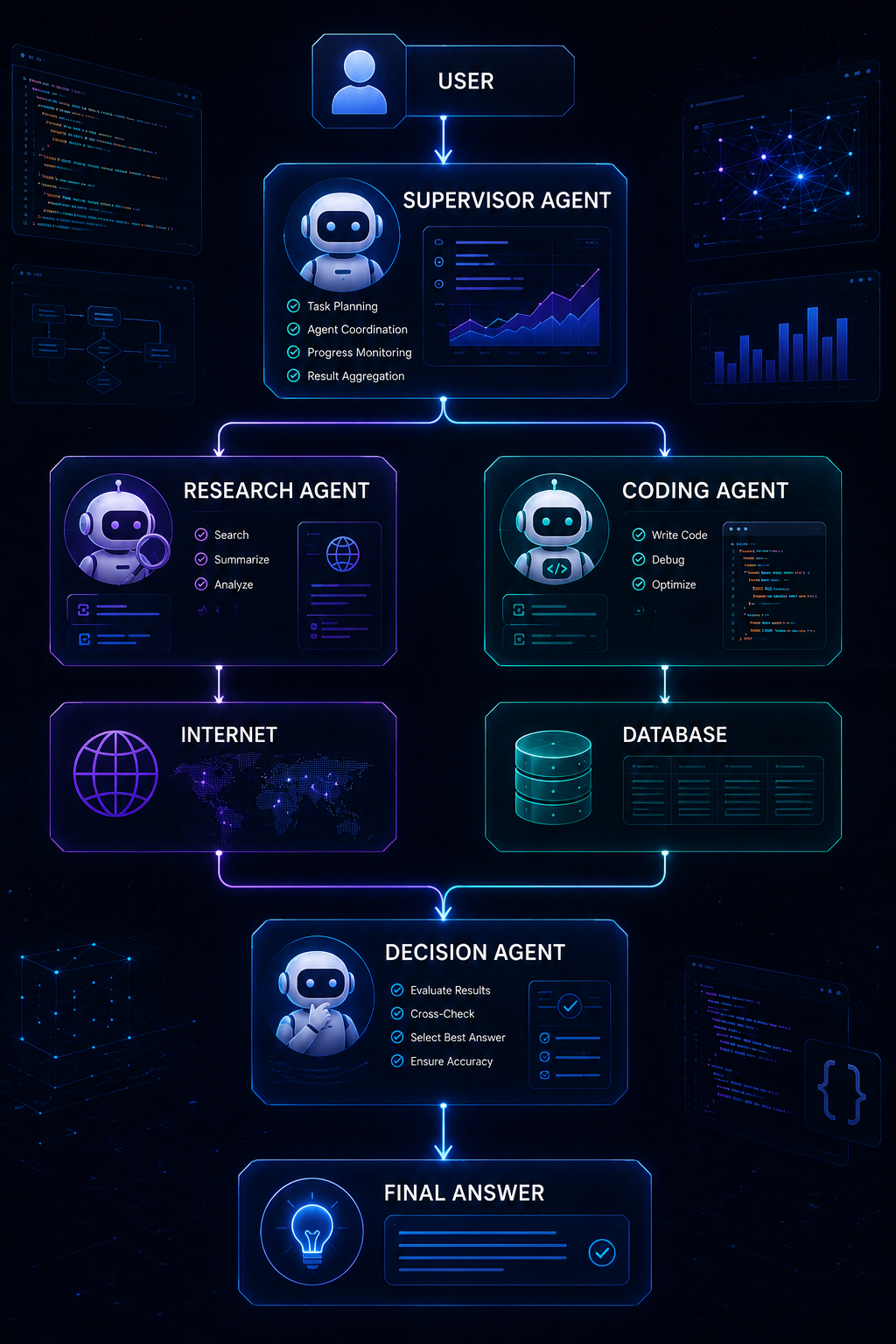
How compute costs accumulate during each reasoning cycle:
| Workflow Stage | Primary Cost Drivers |
| Supervisor Agent | Prompt orchestration, task planning, LLM inference, and token consumption. |
| Research Agent | Internet searches, API requests, retrieval calls, and repeated reasoning loops. |
| Coding Agent | Code generation, validation, debugging iterations, and additional LLM invocations. |
| Internet & Database Access | Network traffic, API pricing, database queries, vector retrieval, and storage operations. |
| Decision Agent | Aggregates outputs, performs final reasoning, ranks responses, and may trigger further inference cycles. |
| Final Answer | Response generation, logging, monitoring, observability, and governance workloads. |
As the number of agents, tools, and reasoning iterations increases, cloud resource consumption grows almost exponentially. Without disciplined FinOps practices, even a modest increase in autonomous workflows can result in rapidly escalating AI infrastructure expenses.
Anatomy of AI Infrastructure Costs

Understanding AI-Native Cloud Cost begins with identifying the infrastructure components that power modern AI applications. Every production deployment combines GPU compute, LLM inference, vector databases, Kubernetes clusters, and serverless computing, each contributing differently to ai infrastructure costs. Together, these resources influence cloud computing costs, public cloud spend, and long-term cloud infrastructure optimization. A successful FinOps for AI Overview requires measuring each layer independently before optimizing the entire platform.
GPU Compute
GPU infrastructure is typically the largest expense in AI platforms because model training and inference rely on high-performance accelerators. Costs depend on GPU pricing, utilization, autoscaling efficiency, idle time, and purchasing models such as reserved instances. Idle GPUs can generate significant waste if workloads are inconsistent, making dynamic scaling essential for cloud cost management.
apiVersion: autoscaling/v2

kind: HorizontalPodAutoscaler

metadata:

 name: llm-service

spec:

 minReplicas: 1

 maxReplicas: 12
The Kubernetes Horizontal Pod Autoscaler increases or decreases application replicas based on demand. By scaling GPU workloads only when requests increase, organizations minimize idle resources and improve kubernetes cost management while lowering overall AI-Native Cloud Cost.
Token Consumption
LLM providers typically charge based on prompt tokens and completion tokens. Larger context windows increase processing requirements, making efficient prompt design an important part of LLM cost optimization.
cost = (

   prompt_tokens * INPUT_PRICE +

   completion_tokens * OUTPUT_PRICE

)
This formula estimates inference expenses by multiplying input and output tokens by their respective pricing. Monitoring token usage helps engineering teams forecast generative ai cost and optimize application behavior.
Vector Database Costs
Vector databases introduce additional expenses through embedding generation, semantic retrieval, index growth, and long-term storage. As knowledge bases expand, efficient database optimization, compression, and lifecycle management become increasingly important for controlling infrastructure spending.
Kubernetes Cost Management
Effective kubernetes cost management includes organizing workloads with namespaces, separating node pools, rightsizing compute resources, and using intelligent GPU scheduling. These practices improve kubernetes orchestration, maximize utilization, and reduce unnecessary cloud resource allocation.
Serverless Cost Analysis
While serverless computing simplifies deployment, costs are driven by cold starts, invocation frequency, and execution duration. Optimizing function size, reducing execution time, and batching workloads help lower serverless cost analysis expenses and improve overall cloud infrastructure optimization.
AI Infrastructure Cost Comparison
| Component | Major Cost | Optimization |
| GPUs | Compute | Autoscaling |
| LLM | Tokens | Prompt optimization |
| Kubernetes | Nodes | Rightsizing |
| Storage | Embeddings | Compression |
| Serverless | Execution | Batch processing |
FinOps for AI Overview
A strong FinOps for AI Overview helps organizations manage AI-Native Cloud Cost by combining financial accountability with engineering best practices. Unlike traditional cloud optimization, AI workloads introduce GPU-intensive inference, token-based billing, vector database operations, and autonomous agent execution, making ai infrastructure costs more dynamic and difficult to predict. The FinOps Foundation framework encourages finance, engineering, operations, and business teams to work together to improve cloud cost management without slowing innovation.
The FinOps lifecycle emphasizes shared cost ownership, where developers, platform engineers, DevOps teams, cloud architects, and business leaders all contribute to controlling cloud computing costs. Engineering accountability includes designing efficient prompts, optimizing inference pipelines, improving kubernetes cost management, and reducing unnecessary GPU usage. Business alignment ensures AI investments deliver measurable value instead of simply increasing public cloud spend. At the same time, effective cloud governance establishes policies for resource allocation, budget monitoring, access controls, and continuous cloud infrastructure optimization across production environments.
FinOps Lifecycle Workflow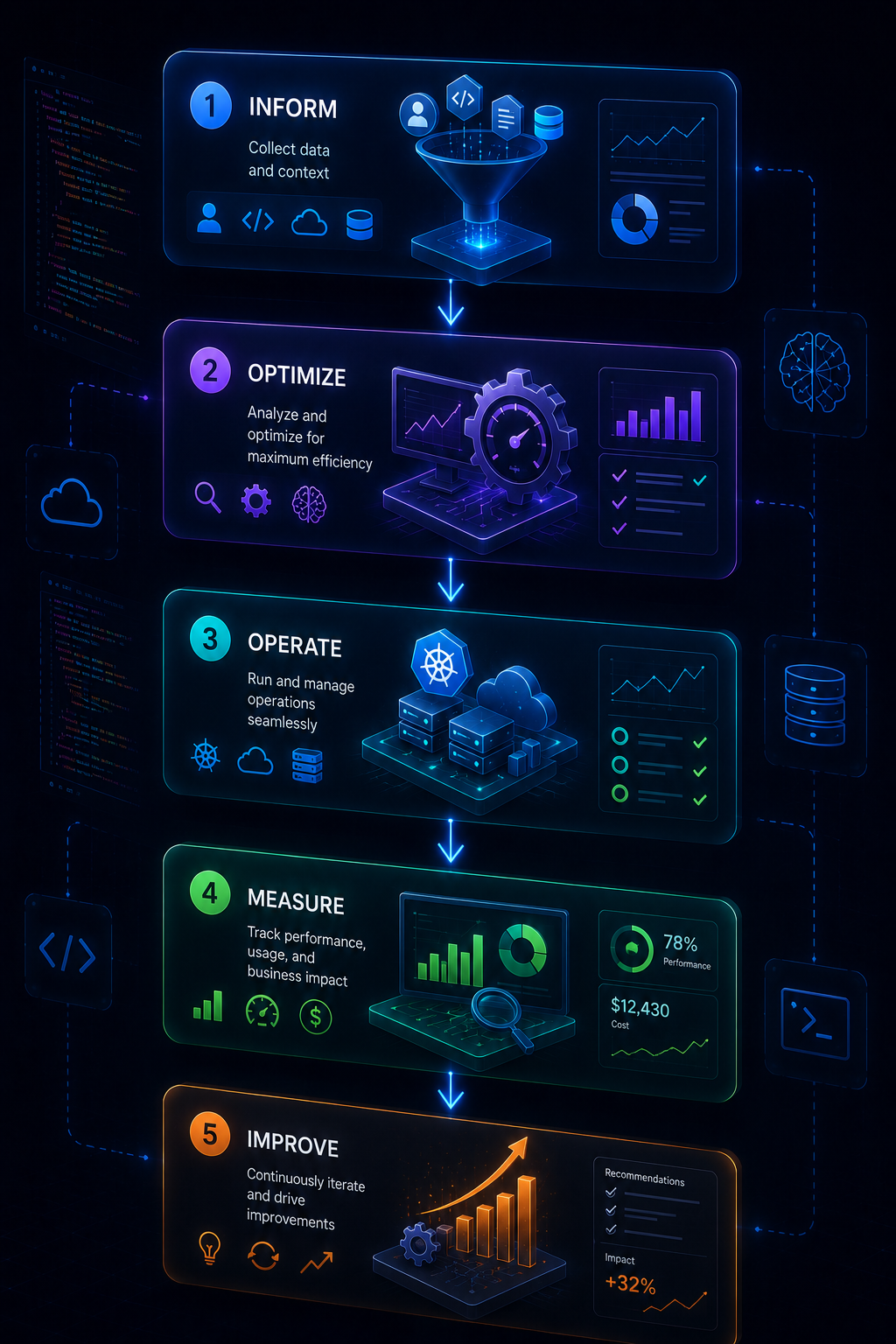
How each phase applies to AI workloads:
| Phase | Role in AI Workloads |
| Inform | Collect spending data for GPUs, LLM APIs, vector databases, serverless computing, and kubernetes orchestration to understand where AI-Native Cloud Cost originates. |
| Optimize | Improve prompt efficiency, implement LLM cost optimization, rightsize Kubernetes clusters, perform database optimization, and eliminate idle GPU resources. |
| Operate | Deploy governance policies, automate scaling, monitor production AI agents, and enforce budgets across engineering teams. |
| Measure | Track KPIs such as token consumption, inference latency, GPU utilization, and overall generative ai cost to evaluate operational efficiency. |
| Improve | Continuously refine infrastructure, automate recommendations, strengthen governance, and adapt AI architectures to reduce long-term public cloud spend while maintaining performance. |
By following this continuous lifecycle, organizations can support agentic ai applications at scale while keeping costs predictable, improving operational efficiency, and addressing the challenges highlighted by Agentic FinOps and the AI Cost Explosion.
Designing a Cost-Efficient Agentic AI Architecture

Building a scalable AI platform requires optimizing every infrastructure layer instead of focusing only on model pricing. A well-designed architecture reduces AI-Native Cloud Cost by improving resource utilization, minimizing unnecessary inference, and strengthening cloud infrastructure optimization. From user requests to monitoring dashboards, every component influences ai infrastructure costs, making a holistic architecture essential for long-term sustainability.
Cost-Efficient AI Architecture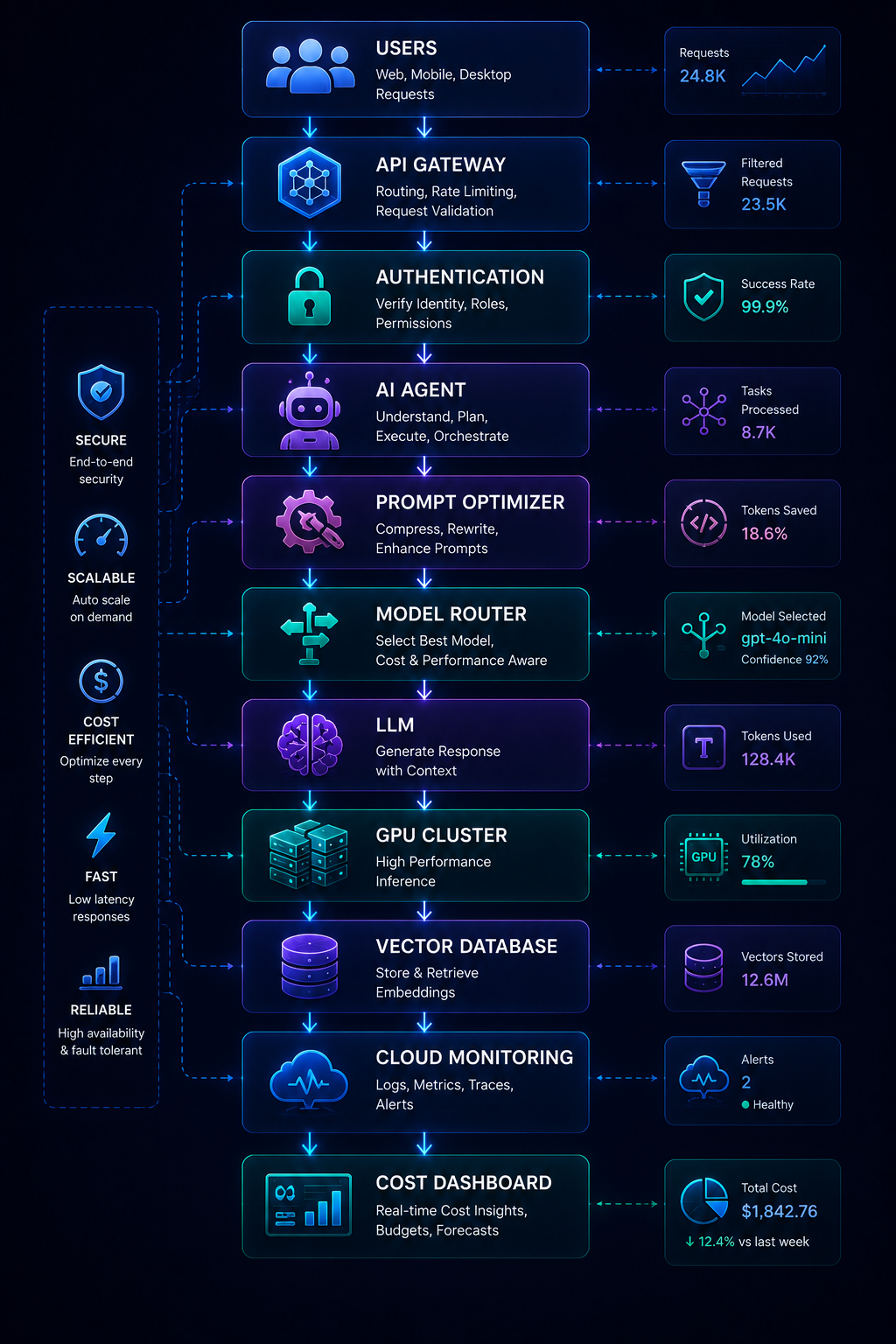
Cost Optimization Opportunities at Each Layer
| Architecture Layer | Cost Optimization Opportunity |
| Users | Apply rate limiting, quotas, and caching to reduce duplicate requests and unnecessary public cloud spend. |
| API Gateway | Validate requests, enforce throttling, and reject invalid traffic before it reaches expensive AI services. |
| Authentication | Secure access with token validation and role-based permissions to prevent unauthorized API consumption. |
| AI Agent | Limit recursive reasoning, control task depth, and minimize unnecessary tool calls to reduce generative ai cost. |
| Prompt Optimizer | Remove redundant instructions, compress context, and reuse templates to improve LLM cost optimization by lowering token consumption. |
| Model Router | Route simple requests to smaller or less expensive models and reserve premium models for complex reasoning tasks. |
| LLM | Configure appropriate context windows, batch inference requests, and enable response caching to reduce cloud computing costs. |
| GPU Cluster | Use autoscaling, reserved instances, intelligent scheduling, and effective kubernetes cost management to maximize GPU utilization. |
| Vector Database | Optimize embedding storage, compress indexes, archive inactive data, and perform regular database optimization to control storage and retrieval expenses. |
| Cloud Monitoring | Track GPU utilization, token usage, latency, and spending trends using centralized cloud cost management dashboards. |
| Cost Dashboard | Provide engineering and FinOps teams with real-time visibility into budgets, forecasting, and optimization opportunities based on the FinOps Foundation lifecycle. |
Designing infrastructure with cost awareness from the beginning allows organizations to scale agentic ai applications efficiently. Combined with effective kubernetes orchestration, serverless computing, governance policies, and continuous monitoring, this layered approach supports the goals outlined in the FinOps for AI Overview while addressing the challenges of Agentic FinOps and the AI Cost Explosion.
Developer Best Practices for Cloud Infrastructure Optimization
Controlling AI-Native Cloud Cost requires optimization throughout the software development lifecycle rather than reacting after production deployment. Developers can significantly reduce ai infrastructure costs, improve cloud infrastructure optimization, and lower public cloud spend by optimizing prompts, routing requests intelligently, monitoring infrastructure, and enforcing governance. The following practices help engineering teams build scalable AI systems while supporting the principles of the FinOps Foundation, cloud cost management, and LLM cost optimization.
Prompt Compression
Reducing prompt size lowers input token consumption without sacrificing response quality. Removing redundant instructions, limiting context, and standardizing system prompts can substantially decrease generative ai cost across millions of requests.
SYSTEM_PROMPT = """

Answer within 100 words.

Avoid repetition.

Return JSON.

"""
Intelligent Model Routing
Not every request requires the most powerful model. Routing simple tasks to lightweight models while reserving premium models for complex reasoning reduces inference expenses and improves overall cloud computing costs.
if request.simple:

   model = "gpt-4.1-mini"

else:

   model = "gpt-5"
Model Routing Workflow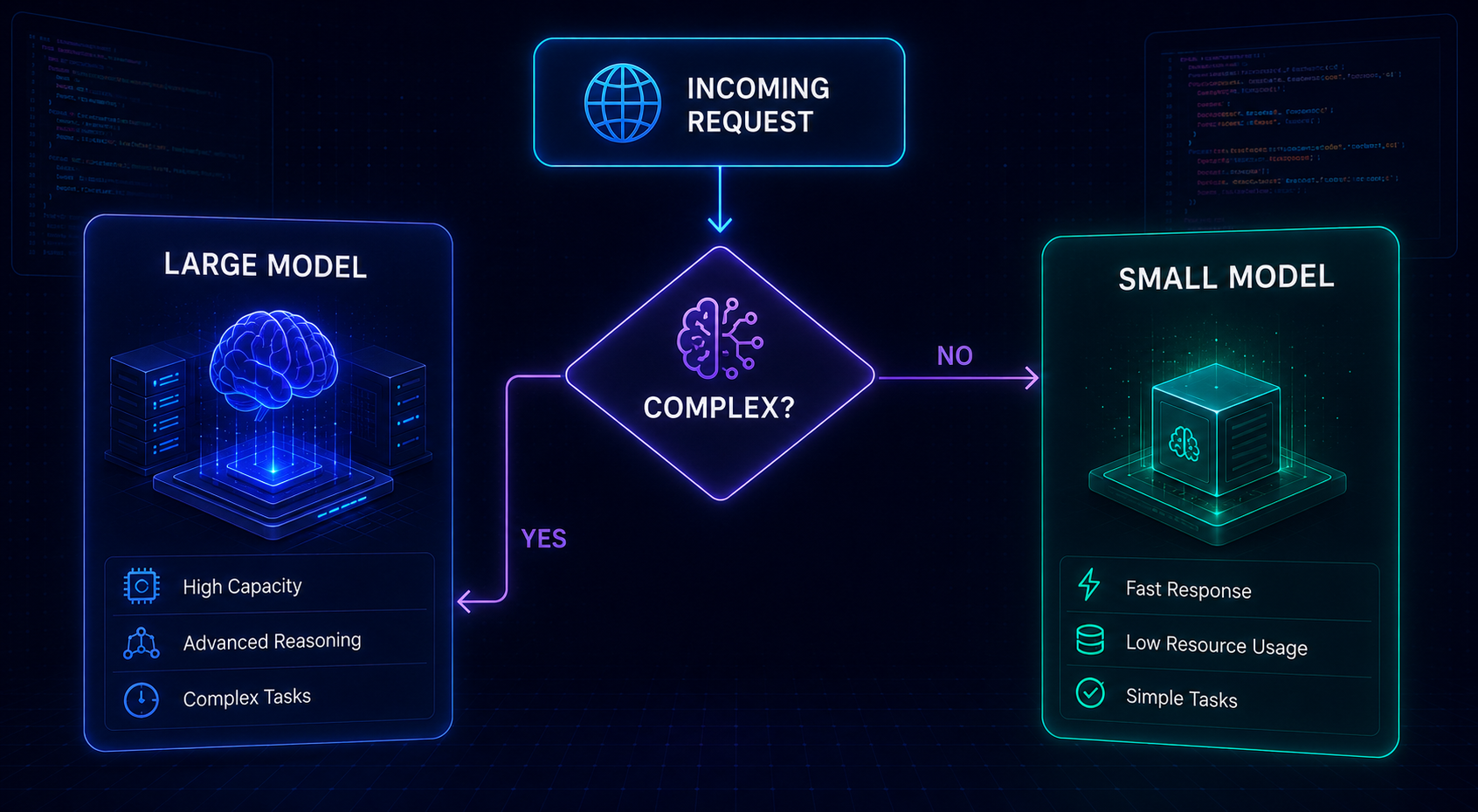
Semantic Cache
Frequently requested responses can be served directly from cache instead of invoking an LLM. A higher cache hit ratio means fewer inference requests, lower GPU utilization, and improved response times.
if cache.exists(key):

   return cache.get(key)


response = llm.generate(prompt)

cache.set(key, response)
Batch Requests
Batching multiple requests into a single API call reduces network overhead, improves throughput, and lowers processing costs for high-volume workloads.
responses = client.responses.batch(tasks)
Kubernetes Rightsizing
Regularly monitoring node and pod utilization helps identify oversized clusters, underutilized GPUs, and idle resources. Rightsizing improves kubernetes cost management and overall kubernetes orchestration efficiency.
kubectl top nodes
kubectl top pods
OpenTelemetry
Distributed tracing provides visibility into every AI request, allowing teams to identify expensive inference paths, latency bottlenecks, and inefficient workflows.
with tracer.start_as_current_span("llm"):

   response = client.responses.create(...)
Prometheus Monitoring
Continuous metrics collection enables proactive monitoring of infrastructure health, GPU utilization, request volume, and service performance for effective cloud cost management.
scrape_interval: 15s


static_configs:
 - targets:

     - ai-service:9090
Kubecost
Kubecost provides namespace-level visibility into Kubernetes spending, making it easier to identify which teams, applications, or AI services contribute most to AI-Native Cloud Cost.
helm install kubecost kubecost/cost-analyzer
Cost Allocation
Tagging workloads by team, project, or environment enables accurate chargeback, budgeting, and financial accountability across engineering organizations.
request = {
   "team": "AI Search",
   "environment": "production"

}

CI/CD
Budget Gates
Automated budget checks during deployment prevent expensive infrastructure changes from reaching production. Integrating cost validation into CI/CD pipelines strengthens governance and supports long-term cloud infrastructure optimization.
steps:
 - run: python estimate_cost.py

 - run: python budget_guard.py
By combining prompt optimization, intelligent model selection, semantic caching, batching, kubernetes cost management, observability, and automated governance, development teams can build scalable agentic ai applications while controlling serverless cost analysis, database optimization, and long-term AI-Native Cloud Cost. These engineering practices form a practical extension of the FinOps for AI Overview and help organizations address the challenges of Agentic FinOps and the AI Cost Explosion.
Monitoring AI Cloud Spend in Production
Continuous monitoring is essential for controlling AI-Native Cloud Cost in production environments. As AI applications scale, organizations must track ai infrastructure costs across GPUs, LLM APIs, storage, and serverless computing to prevent unexpected increases in public cloud spend. Modern cloud cost management combines cost dashboards, token analytics, GPU utilization metrics, cloud billing APIs, FinOps alerts, and budget thresholds to provide real-time financial visibility.
A centralized dashboard enables engineering and FinOps teams to identify the most expensive workloads, monitor spending trends, and detect unusual cost spikes before they affect production budgets.
dashboard = {
   "GPU": "$2400",
   "LLM": "$1800",
   "Storage": "$600"

}
This dashboard provides a simple visualization of spending by infrastructure category, allowing teams to compare GPU, LLM, and storage expenses, prioritize optimization efforts, and improve cloud infrastructure optimization through informed decision-making.
Cloud providers also expose billing APIs that automate cost reporting and integrate financial data into internal monitoring platforms.
client.get_cost_and_usage(…)
Using services such as AWS Cost Explorer, organizations can automatically collect usage reports, track token consumption, analyze GPU utilization, and generate scheduled cost summaries. Combined with kubernetes cost management, database optimization, proactive FinOps alerts, and budget thresholds, automated reporting helps organizations implement the principles of the FinOps Foundation, strengthen LLM cost optimization, and sustain efficient agentic ai workloads while addressing the challenges of Agentic FinOps and the AI Cost Explosion.
Measuring ROI Beyond Cloud Costs
Managing AI-Native Cloud Cost is only one part of evaluating AI success. Organizations should also measure business outcomes by tracking cost per request, cost per workflow, cost per customer, and cost per AI agent. These metrics provide a clearer picture of whether rising ai infrastructure costs are delivering measurable value. Additional indicators such as developer productivity, revenue generated, customer satisfaction, and workflow automation help determine the overall return on investment. Combining these business KPIs with cloud cost management, LLM cost optimization, and cloud infrastructure optimization enables teams to balance innovation with financial sustainability. This broader approach aligns with the FinOps Foundation principles and supports long-term success for agentic ai deployments while managing public cloud spend and cloud computing costs effectively.
AI ROI Comparison
| KPI | Traditional Apps | AI Apps |
| Cost/User | ✓ | ✓ |
| Cost/API | ✓ | ✓ |
| Cost/Workflow | Limited | Essential |
| Cost/Token | No | Yes |
| GPU Usage | No | Yes |
Common FinOps Mistakes
Many organizations invest heavily in AI but overlook the operational practices needed to control AI-Native Cloud Cost. Small inefficiencies across infrastructure and application design can quickly compound into substantial ai infrastructure costs, increasing public cloud spend and reducing the return on AI investments. Avoiding these common mistakes is a key objective of any FinOps for AI Overview.
One of the most frequent issues is using oversized prompts that include unnecessary context, increasing token consumption and generative ai cost. Keeping idle GPUs running after workloads finish, failing to configure autoscaling, and skipping semantic caching all waste compute resources. Teams also increase cloud computing costs by allowing unlimited retries during failed inference requests or routing every query to premium LLMs when smaller models are sufficient. Weak kubernetes cost management, including oversized node pools, poor GPU scheduling, and ineffective kubernetes orchestration, further reduces infrastructure efficiency. The absence of continuous monitoring, budget alerts, workload tagging, and clear cost ownership makes it difficult to detect overspending before monthly invoices arrive.
Consider a realistic enterprise scenario. A customer support platform deploys hundreds of agentic ai assistants across multiple regions. Every request is processed by a premium LLM using large prompts, while idle GPU clusters remain online around the clock. The platform has no semantic cache, allowing identical questions to trigger repeated inference calls. Kubernetes clusters are oversized, serverless functions retry failed requests indefinitely, and no team is accountable for tracking spending. Without budget thresholds or cloud cost management dashboards, monthly expenses continue to rise unnoticed. By the end of the billing cycle, inefficient infrastructure, excessive token usage, poor database optimization, and lack of cloud infrastructure optimization have doubled operational costs. Implementing the governance principles promoted by the FinOps Foundation and improving LLM cost optimization could have prevented unnecessary spending while maintaining application performance.
Future of Agentic FinOps
The future of Agentic FinOps and the AI Cost Explosion will be shaped by intelligent automation that continuously optimizes AI-Native Cloud Cost. AI-aware cloud schedulers will dynamically allocate GPU resources based on workload demand, while cost-aware LLM routing will automatically select the most economical model that meets performance requirements. Organizations will increasingly rely on autonomous FinOps agents to monitor ai infrastructure costs, enforce token budgeting, and recommend real-time cloud infrastructure optimization strategies without manual intervention.
Sustainability will also become a major priority. Green AI initiatives and carbon-aware scheduling will shift compute-intensive workloads to regions and time periods with lower carbon emissions, reducing both environmental impact and cloud computing costs. Predictive cloud billing powered by machine learning will forecast public cloud spend, identify cost anomalies, and support proactive budgeting. Combined with advances in kubernetes cost management, kubernetes orchestration, database optimization, serverless computing, cloud cost management, and LLM cost optimization, these innovations will help organizations build scalable agentic ai platforms that are financially efficient, operationally resilient, and aligned with the best practices promoted by the FinOps Foundation.
Frequently Asked Questions
What is AI-native cloud cost?
AI-Native Cloud Cost refers to the total expense of operating AI-first applications, including GPU compute, LLM inference, token usage, vector databases, storage, networking, and serverless computing. Unlike traditional applications, AI workloads have dynamic resource consumption, making ai infrastructure costs more variable and challenging to predict.
Why is Agentic AI expensive?
Agentic ai systems perform multi-step reasoning, invoke external tools, retrieve memory, query vector databases, and often make multiple LLM calls for a single task. These repeated operations increase GPU usage, token consumption, API requests, and overall cloud computing costs.
What is FinOps?
FinOps is a cloud financial management practice that brings together engineering, finance, and business teams to optimize cloud spending. The FinOps Foundation promotes continuous cloud cost management, shared accountability, and data-driven decisions that balance innovation with cost efficiency.
How does Kubernetes affect AI costs?
Kubernetes influences AI spending through cluster sizing, GPU scheduling, autoscaling, and resource allocation. Effective kubernetes cost management and kubernetes orchestration reduce idle infrastructure, improve utilization, and support better cloud infrastructure optimization.
How do vector databases impact cloud bills?
Vector databases generate costs through embedding creation, semantic retrieval, index maintenance, storage, and scaling. Regular database optimization, data compression, and lifecycle management help reduce storage growth and improve infrastructure efficiency.
What is LLM cost optimization?
LLM cost optimization focuses on reducing inference expenses by compressing prompts, limiting context windows, selecting appropriate models, caching responses, batching requests, and minimizing unnecessary API calls without compromising response quality.
How can developers reduce token usage?
Developers can lower token consumption by writing concise prompts, removing repetitive instructions, summarizing historical context, reusing prompt templates, implementing semantic caching, and routing simple requests to smaller models. These practices help reduce generative ai cost.
What tools help monitor AI infrastructure?
Teams commonly use cloud billing dashboards, OpenTelemetry, Prometheus, Grafana, Kubecost, Kubernetes metrics, and cloud provider billing APIs to monitor AI-Native Cloud Cost, GPU utilization, token usage, public cloud spend, and application performance in real time.
What is serverless cost analysis?
Serverless cost analysis evaluates spending based on function invocations, execution duration, memory allocation, and cold starts. Optimizing execution time, batching workloads, and reducing unnecessary invocations help control serverless computing expenses.
How do I measure AI ROI?
Measure AI ROI by combining financial and business metrics, including cost per request, cost per workflow, cost per AI agent, revenue generated, productivity improvements, customer satisfaction, and overall cloud cost management effectiveness instead of focusing solely on infrastructure expenses.
Conclusion
As AI adoption accelerates, AI-Native Cloud Cost has evolved from a finance-only concern into a core software engineering responsibility. Every architectural decision, from model selection and prompt engineering to GPU utilization, kubernetes orchestration, vector database design, and deployment strategy, directly influences ai infrastructure costs and long-term operational efficiency. Developers, DevOps engineers, platform teams, cloud architects, AI engineers, and FinOps practitioners must work together to embed cost awareness throughout the entire application lifecycle rather than treating optimization as an afterthought.
Adopting proven FinOps practices such as continuous monitoring, intelligent model routing, semantic caching, autoscaling, effective kubernetes cost management, observability, governance, and LLM cost optimization enables organizations to improve cloud infrastructure optimization while reducing unnecessary public cloud spend. These practices also support better serverless cost analysis, database optimization, and overall cloud cost management without limiting innovation.
Organizations that embrace Agentic FinOps and the AI Cost Explosion today will be better positioned to build scalable, resilient, and economically sustainable AI platforms. By combining engineering excellence with financial discipline, they can maximize business value, accelerate AI innovation, and confidently scale next-generation intelligent applications while keeping infrastructure costs under control.
About the Author