Durable Execution & Workflow has become a foundational concept as software evolves from standalone applications into highly distributed systems spanning cloud platforms, AI services, APIs, databases, and thousands of interconnected microservices. Marc Andreessen’s famous observation that software is eating the world has become even more relevant in this environment. Today, modern applications rarely execute a single request in one place. Instead, they coordinate complex workflows across numerous independent services where network latency, service outages, infrastructure failures, and timeouts are inevitable.
“Software is eating the world.”
Marc Andreessen
This is where Durable Execution & Workflow becomes essential. Durable workflow orchestration enables applications to survive crashes, automatically recover from failures, retry long-running operations, and maintain execution state without manual intervention. Technologies such as Temporal, Cadence, Apache Airflow, Azure Durable Functions, AWS Step Functions, Camunda, Google Cloud Workflows, and Conductor have become foundational for building reliable cloud-native systems.
“The future belongs to systems that recover automatically instead of expecting humans to fix failures.” This principle, inspired by distributed systems research and engineers like Martin Kleppmann, reflects today’s reality where resilience is designed into software rather than added later.
Around 90%+ of enterprises now operate cloud-native workloads, while modern applications commonly span 20 to more than 100 microservices, making workflow orchestration a core engineering requirement rather than an optional enhancement. Enterprise automation studies also show workflow automation can reduce operational costs by 20% to 40%, while distributed failures remain inevitable under cloud reliability engineering principles and the CAP Theorem. The rapid rise of AI agents further increases the need for durable execution because LLM requests often take seconds or minutes, require retries, human approvals, and external API coordination. From payment processing, SaaS platforms, healthcare, logistics, and fintech to enterprise automation and AI pipelines, durable workflow orchestration has become the backbone of reliable distributed applications.
What is Durable Execution & Workflow Orchestration?
Durable Execution & Workflow is a software engineering approach that ensures business processes continue reliably even when servers, containers, networks, or services fail. Unlike traditional automation that simply executes tasks in sequence, durable execution persists workflow state, supports long running workflows, replays execution after failures, and coordinates distributed services through a workflow engine. Platforms such as Temporal, Cadence, Apache Airflow, Azure Durable Functions, AWS Step Functions, Camunda, Google Cloud Workflows, and Conductor provide these capabilities for modern cloud-native applications.
A banking loan approval illustrates the difference well. After identity verification, credit scoring, fraud checks, document validation, and manager approval, a server crash should not restart the entire process. Instead, the workflow resumes from the last completed step, preserving state and ensuring consistency. Simple retries cannot guarantee this because they lack persistent execution history and often repeat completed operations, risking duplicate transactions.
What Makes Execution “Durable”?
Durability comes from persisting workflow state outside application memory. Every completed step is checkpointed so the workflow engine can automatically recover after crashes. Instead of rerunning everything, the engine uses event sourcing and workflow replay to reconstruct execution history and continue safely from the last successful checkpoint.
What is Workflow Orchestration?
Workflow orchestration coordinates multiple services, manages dependencies, schedules tasks, processes asynchronous events, supports human approvals, and applies retry and recovery policies. Rather than each microservice handling failures independently, the orchestration engine manages the complete business process from start to finish.
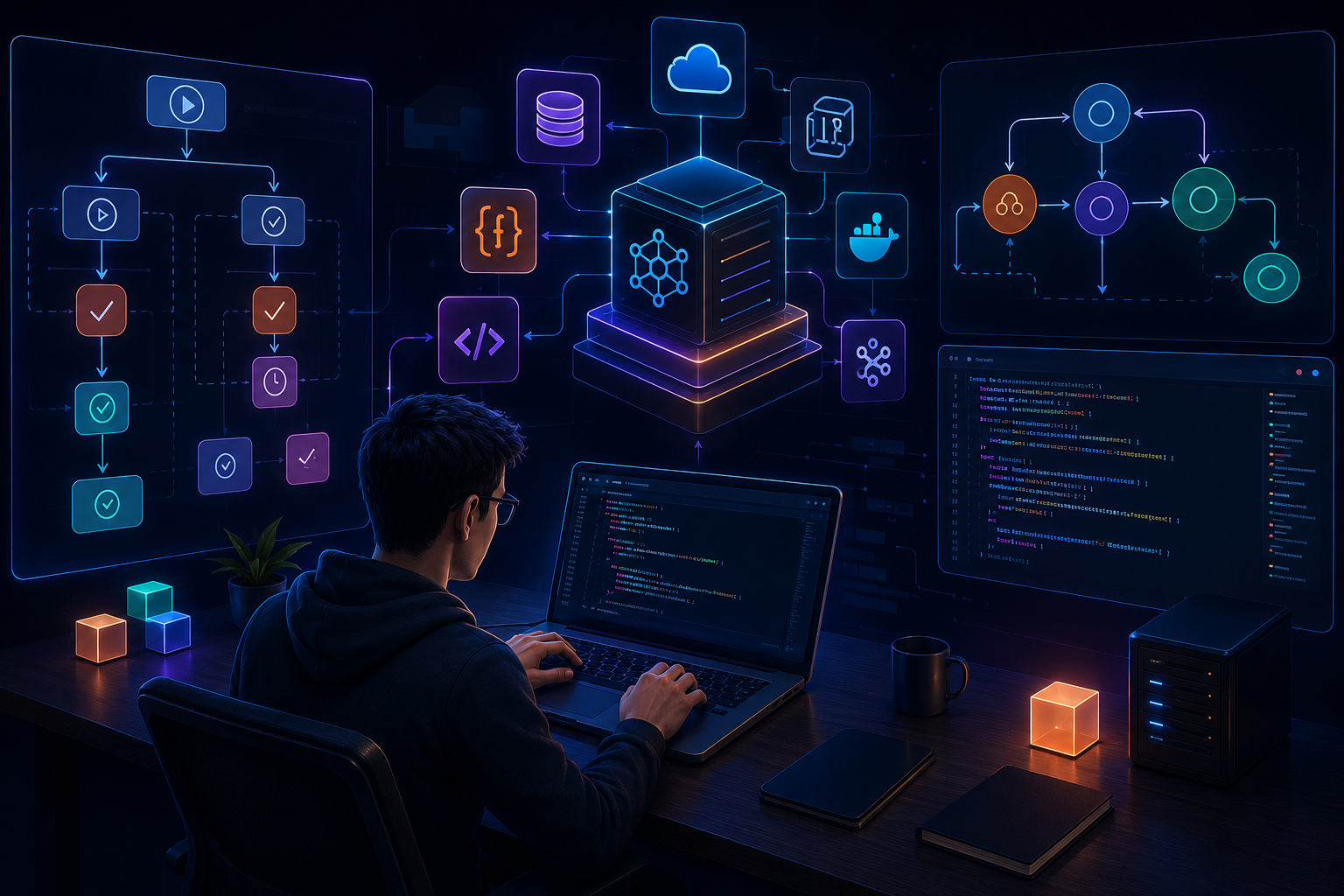
Workflow Diagram
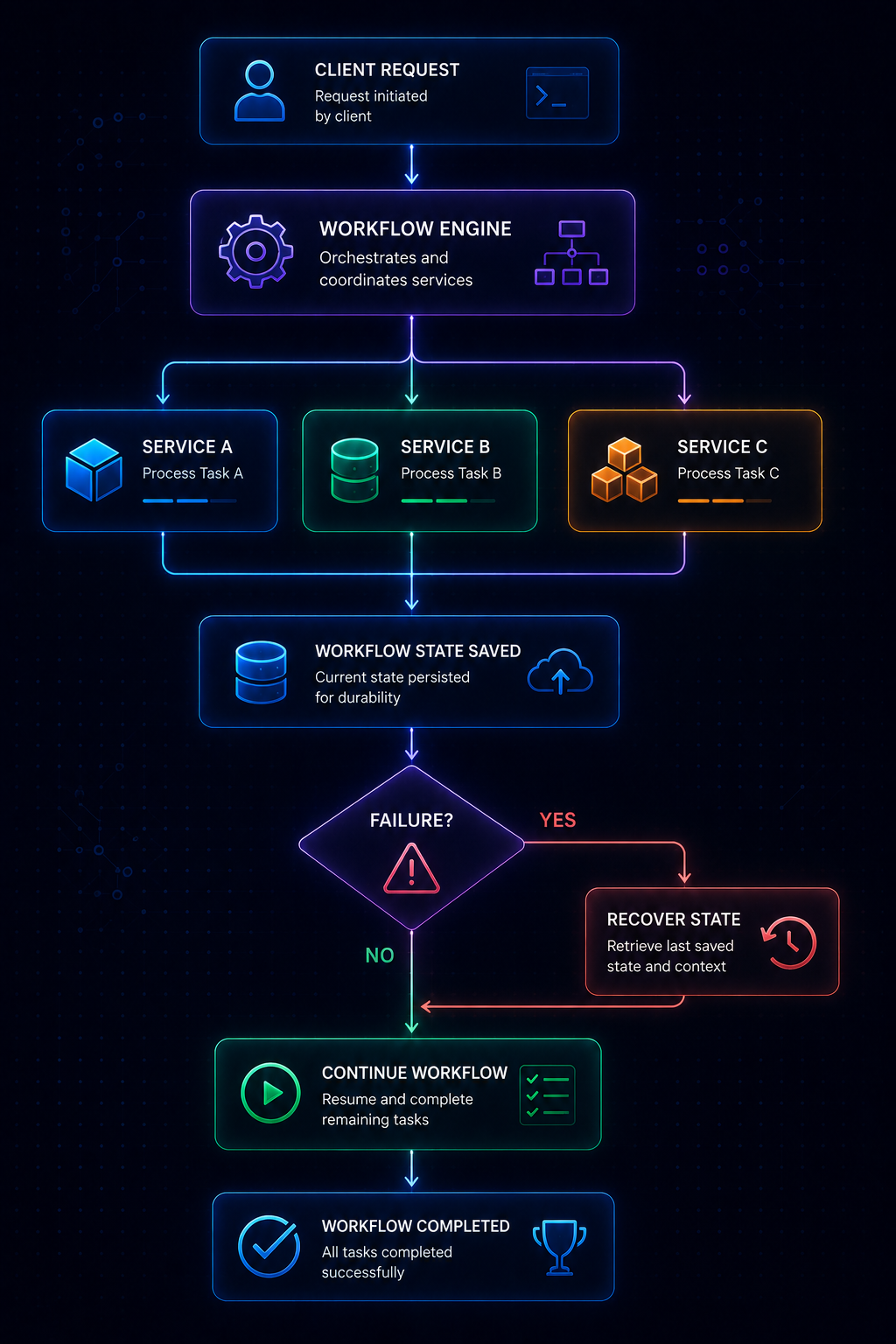
Python Pseudo Workflow
@workflow
def process_order():


    validate_payment()


    reserve_inventory()


    arrange_shipping()


    notify_customer()
| Traditional Automation | Durable Execution |
| Starts over after crash | Resumes automatically |
| Manual retries | Automatic replay |
| No state persistence | Persistent workflow state |
| Difficult debugging | Full execution history |
| Limited scalability | Highly scalable |
Why Modern Distributed Systems Need Durable Workflows
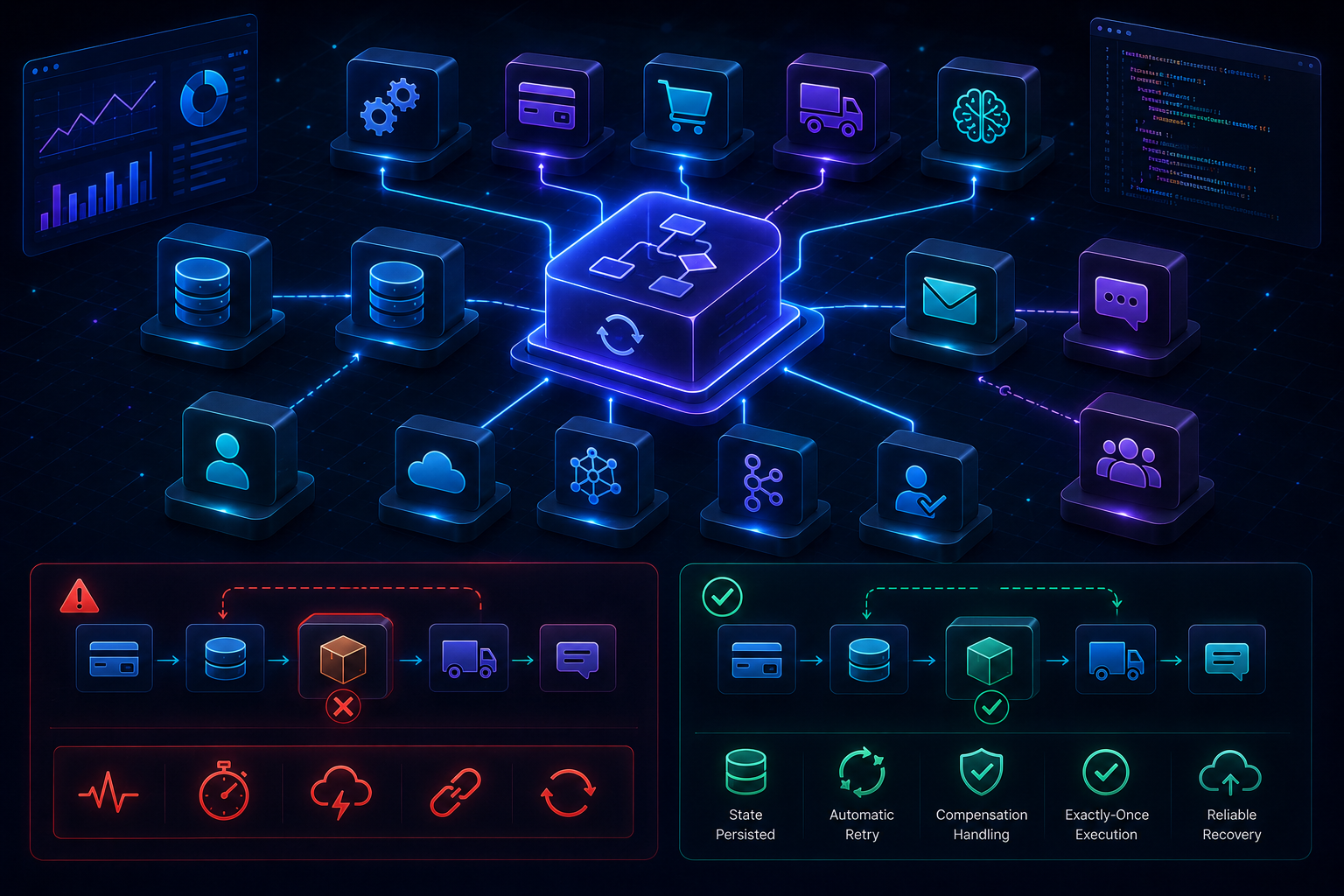
Modern cloud-native applications rarely execute a single operation in one service. Instead, they coordinate dozens of microservices, external APIs, databases, message queues, AI models, and human approvals, making Durable Execution & Workflow essential for reliability. Even well-designed distributed systems experience API failures, network interruptions, database outages, container restarts, and long-running jobs. Durable workflow platforms such as Temporal, Cadence, AWS Step Functions, Azure Durable Functions, and Camunda ensure business processes recover automatically instead of restarting from the beginning.
Industries depend on this capability every day. In fintech, payment processing must survive gateway failures without charging customers twice. Healthcare workflows coordinate patient registration, insurance verification, lab processing, and physician approvals across multiple systems. Ecommerce platforms manage payment, inventory, shipping, and customer notifications, while logistics companies orchestrate warehouse operations, route optimization, carrier updates, and delivery tracking. AI inference pipelines also benefit because LLM requests, model training, and agent workflows may run for minutes or hours and frequently require retries, asynchronous events, or human review.
Common Failure Scenarios
Common distributed failures include server crashes, request timeouts, lost API responses, duplicate requests, partial failures where one service succeeds while another fails, and deadlocks caused by competing resources. Durable workflow engines persist execution state so these failures can be recovered safely without repeating completed work.
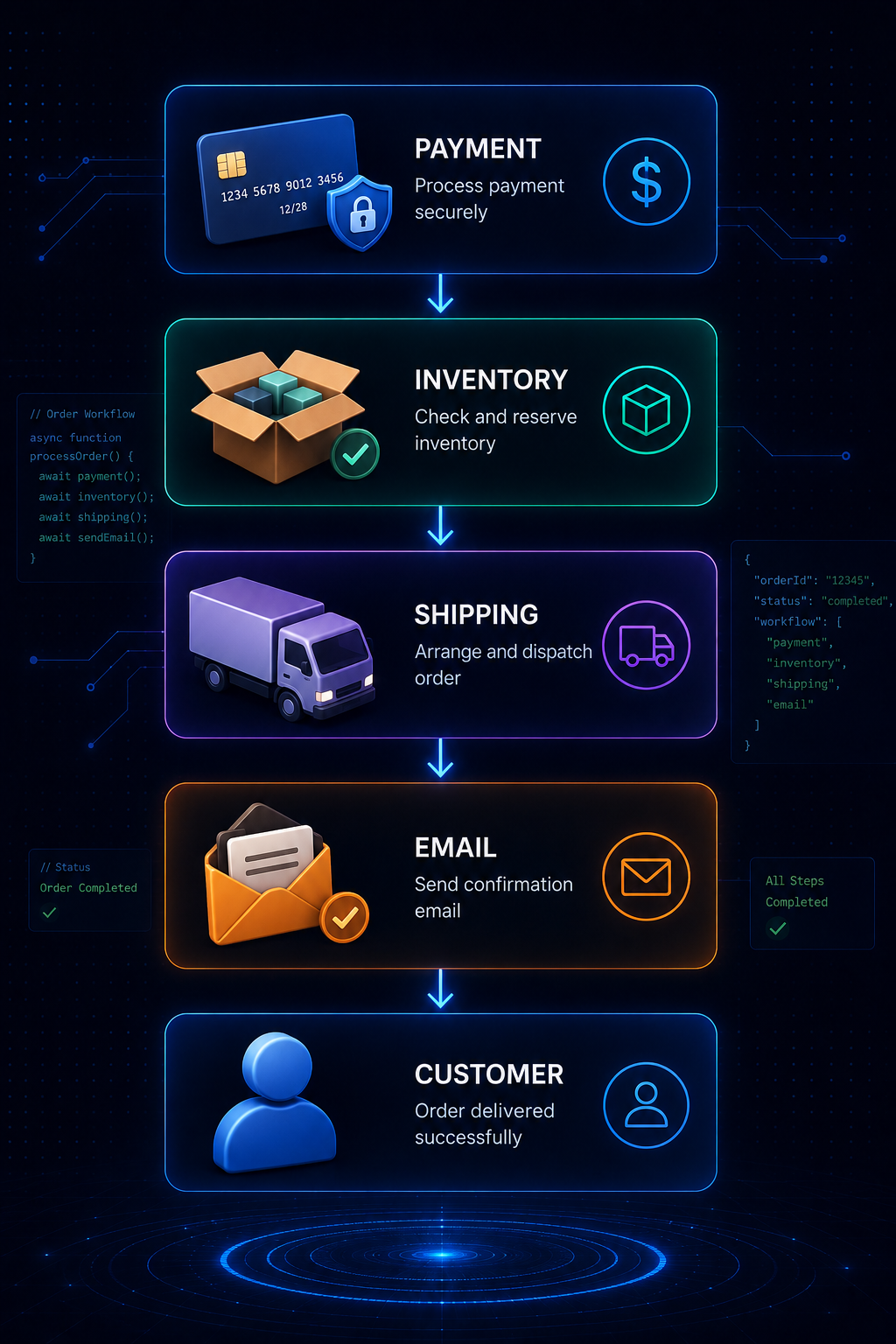
If the Inventory service fails after payment succeeds, a traditional application may restart the entire process or leave the transaction in an inconsistent state. A durable workflow instead restores the saved state, retries only the inventory step according to policy, or executes compensating actions such as issuing a refund if recovery is impossible. This prevents duplicate payments, inconsistent inventory records, and poor customer experiences.
Java Retry Example
RetryOptions retry =

    RetryOptions.newBuilder()

        .setMaximumAttempts(5)

        .build();
How Durable Execution Works Behind the Scenes
At the core of Durable Execution & Workflow is the idea that workflow progress is recorded instead of relying on application memory. Platforms such as Temporal, Cadence, AWS Step Functions, Azure Durable Functions, and Camunda maintain a complete workflow history using event sourcing. Each completed activity, signal, timer, or state transition is written to durable storage, allowing workflows to survive crashes and restarts.
Worker processes retrieve workflow tasks from task queues, execute activities such as API calls or database updates, and record the resulting events. Rather than saving the entire application state after every step, the workflow engine reconstructs state through deterministic replay. Checkpointing ensures completed activities are not executed again, while new work resumes from the latest recorded event. Workflows can also receive signals to process asynchronous events, such as user approvals or payment confirmations, and expose queries that let applications inspect workflow state without modifying execution.
Workflow History
Workflow history is an append-only event log that captures every important action during execution. Instead of storing mutable objects, the engine records events such as workflow creation, activity completion, timer expiration, or external signals. This event history becomes the single source of truth for recovering execution and debugging failures.
Example Event History
[

  {

    "event": "WorkflowStarted"

  },

  {

    "event": "PaymentCompleted"

  },

  {

    "event": "InventoryReserved"

  }

]
Deterministic Replay
Deterministic replay rebuilds workflow state by replaying the recorded event history from the beginning. During replay, previously completed activities are not executed again. Instead, their recorded results are returned, ensuring identical workflow state after recovery. When replay reaches the last completed event, execution continues with the next pending activity. This approach guarantees reliable crash recovery while preventing duplicate side effects.
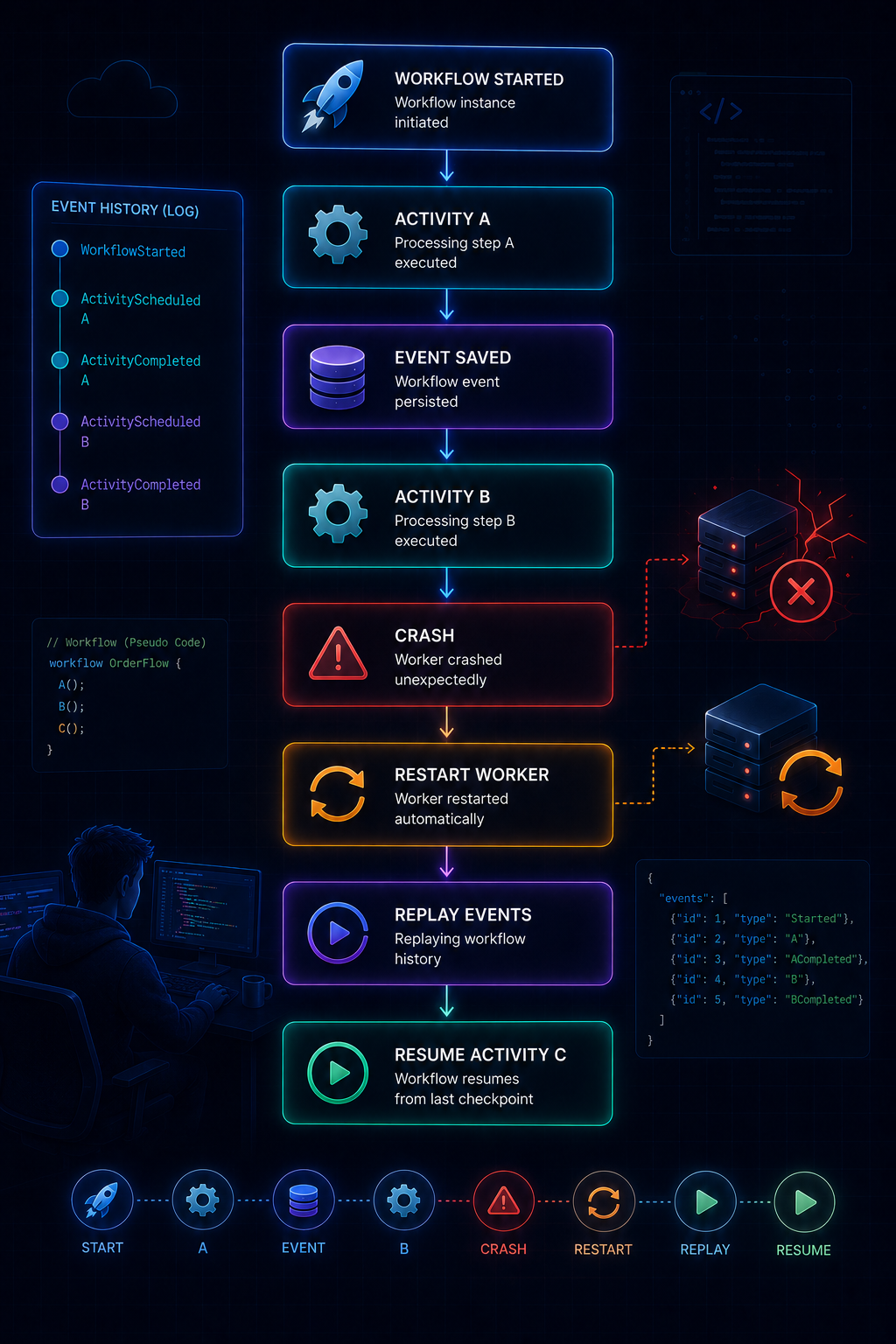
Go Example
func OrderWorkflow(ctx workflow.Context) error {


    err := workflow.ExecuteActivity(

        ctx,

        ChargeCard,

    ).Get(ctx, nil)


    return err

}
Popular Durable Workflow Platforms Compared
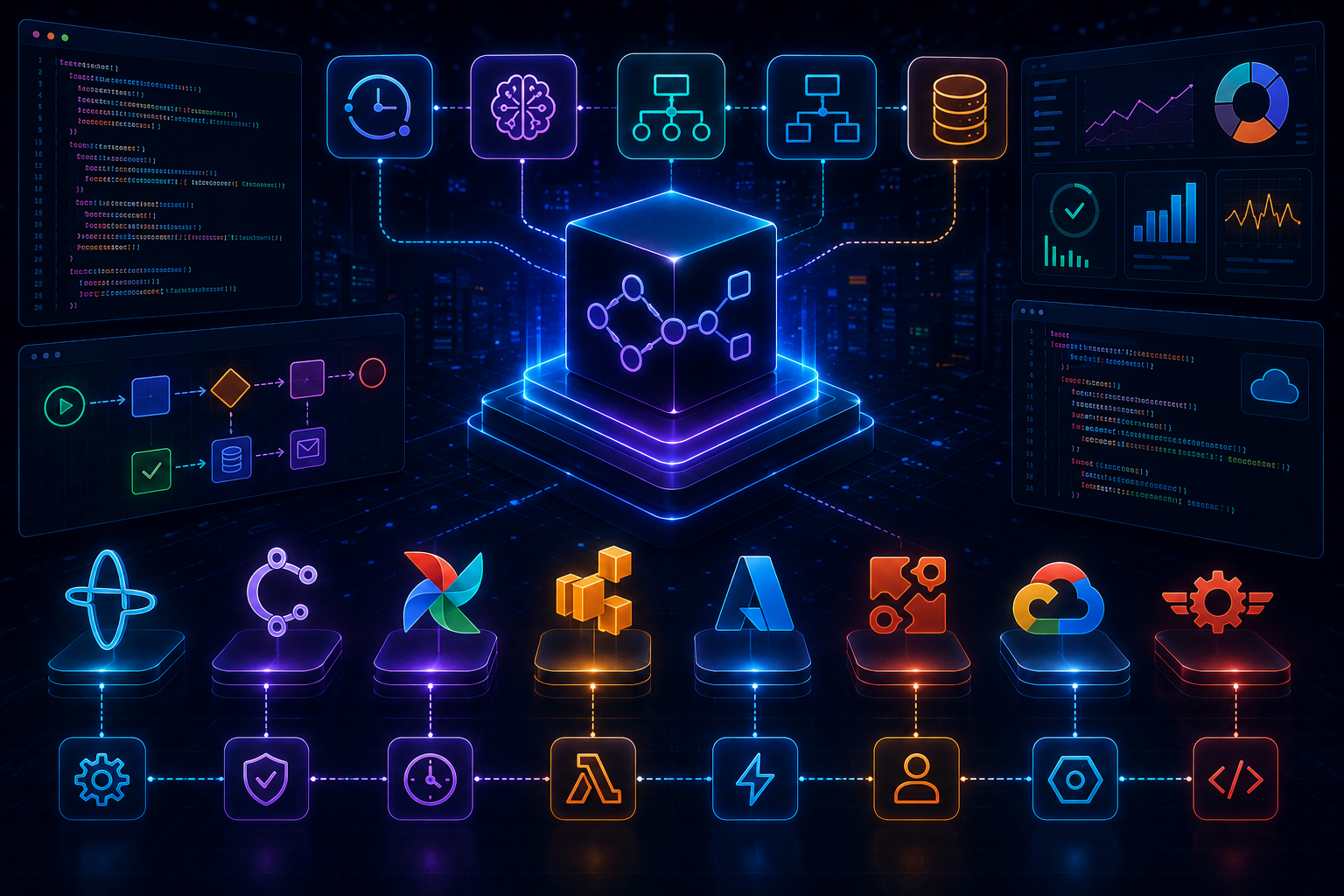
Choosing the right Durable Execution & Workflow platform depends on application architecture, scalability requirements, cloud strategy, and developer experience. Some platforms specialize in long-running distributed workflows, while others focus on scheduled data pipelines, BPMN processes, or serverless orchestration.
Temporal
Temporal provides a workflow engine, Temporal Server, language SDKs, workers, and the Temporal API to execute reliable workflows. Developers write workflows as normal code while workers execute activities and automatically recover from failures using workflow history and replay. Temporal Cloud offers a managed service, while Temporal AI enables reliable orchestration of LLM agents and AI pipelines. Temporal Data is persisted through event history for deterministic recovery. Benefits include excellent scalability and fault tolerance, though operating a self-hosted cluster adds infrastructure complexity.
WorkflowClient client =

WorkflowClient.newInstance(service);
Cadence
Originally developed at Uber, Cadence introduced durable workflow concepts later expanded by Temporal. It remains a strong open source workflow engine with mature Cadence Software, community Cadence Support, and scalable Cadence Design. Compared with Temporal, Cadence evolves more slowly and has a smaller ecosystem.
Apache Airflow 3
Apache Airflow 3 is designed primarily for scheduled data pipelines using DAGs rather than application workflows. The improved Airflow API and Airflow 3 enhancements simplify orchestration, monitoring, and deployment for ETL, analytics, and machine learning pipelines.
with DAG("daily") as dag:


    extract = PythonOperator()


    transform = PythonOperator()


    load = PythonOperator()with DAG("daily") as dag:


    extract = PythonOperator()


    transform = PythonOperator()


    load = PythonOperator()
AWS Step Functions
AWS Step Functions provides fully managed serverless workflow orchestration using JSON state machines with deep Lambda and AWS service integration.
{

  "StartAt": "Payment"

}
Azure Durable Functions
Built on Azure Functions, Azure Durable Functions supports orchestrator functions, durable entities, fan-out/fan-in execution, and event sourcing for resilient serverless workflows.
await context.CallActivityAsync(

    "ChargeCard");
Camunda
Camunda focuses on BPMN-based business process orchestration, making it well suited for enterprise workflows involving approvals, compliance, and human interaction.
Google Cloud Workflows
Google Cloud Workflows enables cloud-native orchestration across Google Cloud services, APIs, and serverless applications using managed workflow execution.
Netflix Conductor
Conductor is designed for microservice orchestration, allowing developers to coordinate distributed services, asynchronous tasks, and long-running business processes at scale.
| Feature | Temporal | Cadence | Airflow 3 | AWS Step Functions | Azure Durable Functions | Camunda | Google Cloud Workflows | Conductor |
| Durable Execution | ✓ | ✓ | Partial | ✓ | ✓ | Partial | ✓ | ✓ |
| Open Source | ✓ | ✓ | ✓ | ✕ | ✕ | Partial | ✕ | ✓ |
| Long-running Workflows | Excellent | Excellent | Moderate | Good | Excellent | Excellent | Good | Excellent |
| Event Replay | ✓ | ✓ | ✕ | Partial | ✓ | ✕ | Partial | Partial |
| State Persistence | Excellent | Excellent | Good | Excellent | Excellent | Good | Excellent | Excellent |
| Language SDKs | Many | Many | Python | AWS Services | .NET | Java | YAML | Java |
| AI Workflow Ready | Excellent | Good | Moderate | Good | Good | Moderate | Good | Excellent |
Building AI Agent Systems with Durable Execution
Modern AI agents execute far more than a single LLM request. They perform tool calling, retrieve external knowledge, invoke APIs, coordinate multiple models, wait for human approvals, and maintain memory across long-running conversations. This makes Durable Execution & Workflow a critical foundation for reliable AI systems. Platforms such as Temporal, Cadence, AWS Step Functions, and Azure Durable Functions ensure AI workflows survive crashes, recover automatically, and resume from the last completed step instead of restarting expensive model executions.
Durable workflow engines are particularly valuable for Retrieval-Augmented Generation (RAG) pipelines, multi-agent collaboration, and enterprise automation. A planner agent may generate a strategy, an executor agent performs API calls, a retrieval component searches documents, and a reviewer validates the response before it reaches the user. If an LLM call fails or a tool becomes unavailable, the workflow engine retries the failed activity, preserves workflow state, and continues execution without repeating completed tasks. Temporal AI integrations further simplify orchestrating long-running AI workflows while maintaining reliable workflow history and execution state.
AI Workflow
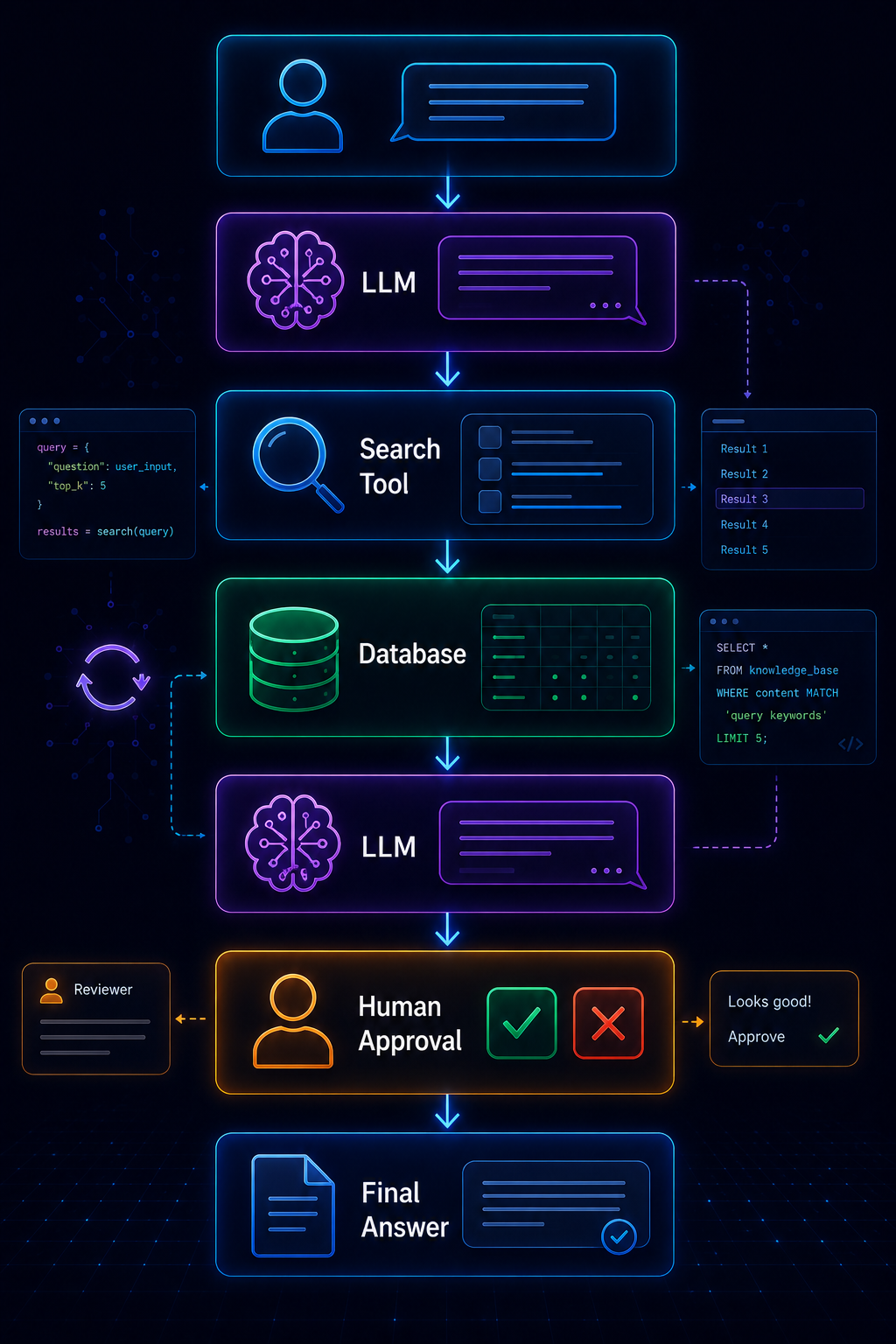
Human approval is equally important for high-risk domains such as finance, healthcare, and legal services. Durable workflows can pause for hours or days while awaiting approval, then resume automatically once a signal is received. Combined with retry strategies, checkpointing, and persistent state, this approach prevents duplicate requests and minimizes unnecessary LLM costs.
Python Example
agent.run()


search()


retry()


save_memory()
LangGraph Example
graph.add_node(“planner”)
graph.add_node(“executor”)
graph.add_edge(“planner”, “executor”)
By combining durable execution with LLM orchestration, RAG pipelines, tool calling, and multi-agent workflows, developers can build AI applications that remain reliable even when models, APIs, or infrastructure fail. This resilience is becoming a core requirement as enterprise AI systems grow in complexity and execution time.
Best Practices for Durable Workflow Development
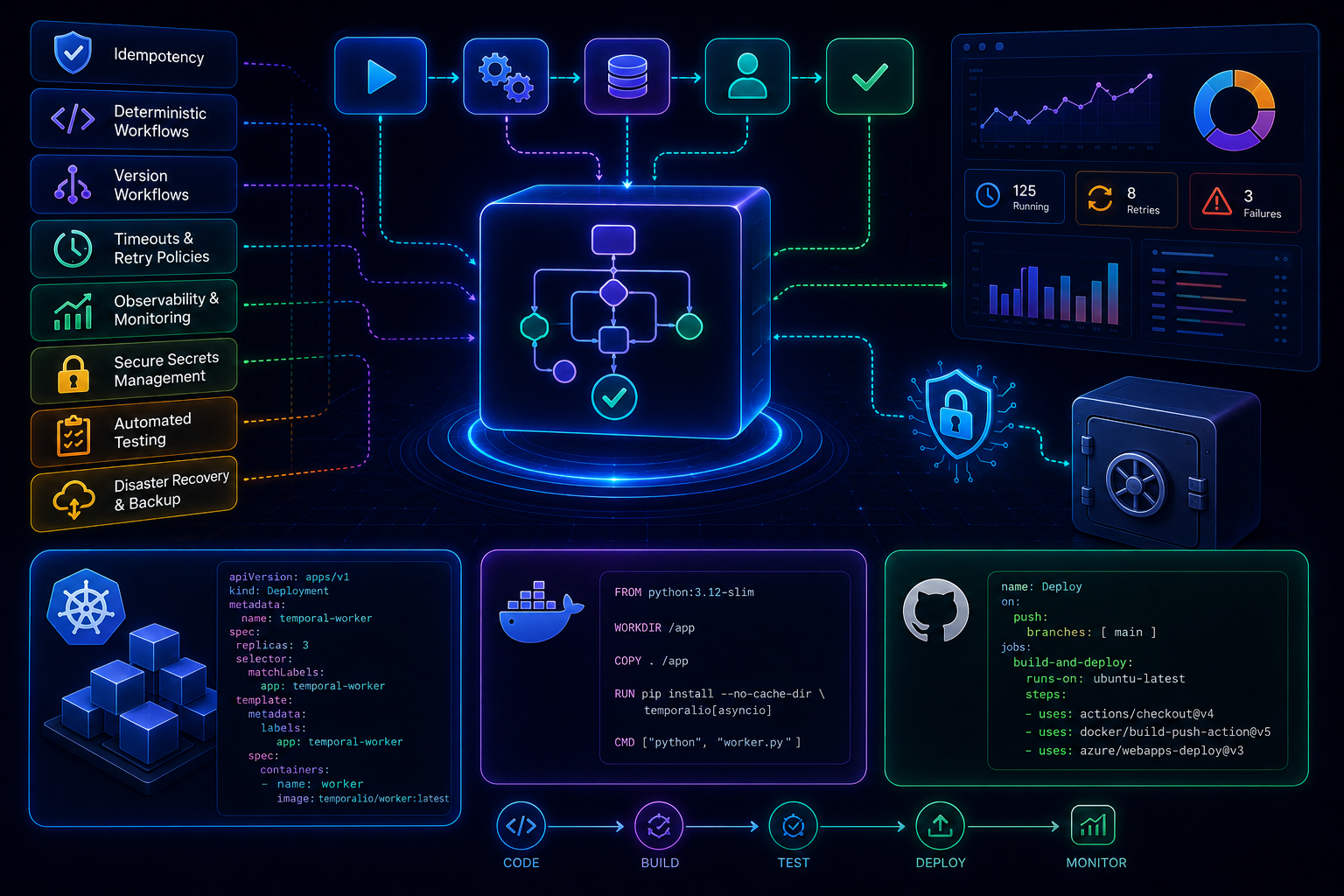
Building reliable Durable Execution & Workflow applications requires more than selecting a workflow engine. Whether using Temporal, Cadence, Apache Airflow, AWS Step Functions, Azure Durable Functions, or Camunda, developers should design workflows that remain predictable, recoverable, and secure under failure conditions.
Start with idempotency, ensuring activities can safely run multiple times without creating duplicate payments, orders, or notifications. Workflow logic should also be deterministic, producing identical results during replay by avoiding random values, direct system time calls, or non-deterministic operations inside workflow code. Use workflow versioning to introduce changes without breaking running executions. Configure sensible timeout and retry policies for external APIs while preventing endless retry loops.
Operational excellence depends on observability. Record structured logs, collect metrics, enable distributed tracing, and monitor workflow latency, queue depth, retries, and failures. Protect sensitive credentials through dedicated secrets management solutions instead of hardcoding API keys. Automated testing should cover workflow replay, activity failures, timeout handling, compensation logic, and recovery scenarios. CI/CD pipelines should validate workflows before deployment, while disaster recovery plans must include backup strategies, workflow history replication, and multi-region failover for business-critical systems.
Kubernetes Deployment
apiVersion: apps/v1

kind: Deployment

metadata:

  name: temporal-worker
Docker
FROM python:3.12


COPY .


RUN pip install temporalio
GitHub Actions
name: Deploy


on:

  push:
Following these practices helps teams build durable workflows that are easier to operate, scale, and maintain. Combined with robust monitoring, secure deployment pipelines, and resilient infrastructure, they enable distributed applications and AI workflows to recover automatically while delivering consistent and reliable execution in production.
Future Trends in Durable Execution & Workflow Orchestration
The future of Durable Execution & Workflow is closely tied to the rise of AI-native software, distributed cloud platforms, and increasingly autonomous applications. Over the next five years, workflow orchestration will evolve from coordinating microservices to managing AI agents, long-running reasoning tasks, and complex business processes that span multiple clouds and edge environments. Platforms such as Temporal, Cadence, AWS Step Functions, Azure Durable Functions, Camunda, and Google Cloud Workflows are expected to expand support for intelligent automation, while Temporal AI will simplify orchestration of LLM-powered applications.
Organizations will increasingly adopt Workflow-as-Code, allowing developers to define business processes using familiar programming languages rather than configuration-heavy tools. Event-driven architecture and serverless orchestration will continue to reduce operational overhead, while workflow observability will provide real-time visibility into execution history, latency, retries, failures, and AI decision paths.
Agentic AI will become a major driver of durable execution. Autonomous agents will coordinate tool calling, Retrieval-Augmented Generation (RAG), human approvals, and multi-agent collaboration using persistent workflow state instead of fragile scripts. Multi-cloud workflows will also become more common as enterprises distribute workloads across public and private cloud providers for resilience and regulatory compliance.
Looking ahead, durable workflow engines are likely to incorporate deeper AI-assisted debugging, predictive failure detection, automated workflow optimization, and edge-aware execution. As distributed systems become more intelligent and autonomous, durable execution will shift from being a specialized backend capability to a foundational layer for reliable software, enabling applications to recover, adapt, and operate with minimal human intervention.
FAQ
What is Durable Execution & Workflow?
Durable Execution & Workflow is a technique for building reliable distributed applications by persisting workflow state, automatically recovering from failures, replaying execution history, and resuming long-running processes without restarting completed tasks.
What is Temporal?
Temporal is an open-source workflow orchestration platform that uses durable execution, event history, workers, and SDKs to coordinate long-running workflows. It is widely used for microservices, cloud-native applications, and AI workflow orchestration.
Is Temporal better than Cadence?
It depends on your requirements. Temporal offers faster innovation, managed cloud services, and a broader ecosystem, while Cadence, originally developed at Uber, remains a mature and reliable open-source workflow engine.
What is Apache Airflow used for?
Apache Airflow is primarily used to schedule, automate, and monitor data pipelines using Directed Acyclic Graphs (DAGs). It is widely adopted for ETL, analytics, machine learning, and batch workflow automation.
When should I use AWS Step Functions?
Use AWS Step Functions when building serverless applications on AWS that coordinate Lambda functions and managed cloud services. It is ideal for event-driven workflows, business processes, and cloud-native orchestration.
What is Azure Durable Functions?
Azure Durable Functions extends Azure Functions with durable workflows, orchestrator functions, durable entities, event sourcing, and fan-out/fan-in patterns for reliable serverless application development.
Is Camunda a workflow engine?
Yes. Camunda is a workflow and business process automation platform that supports BPMN orchestration, decision automation, and human approval workflows, making it popular for enterprise applications and compliance-driven processes.
What is Google Cloud Workflows?
Google Cloud Workflows is a fully managed orchestration service that coordinates Google Cloud services, APIs, and serverless applications, simplifying long-running cloud workflows with built-in reliability and scalability.
Can Durable Execution be used for AI agents?
Yes. Developers use Durable Execution & Workflow to build reliable AI agents because it supports LLM orchestration, tool calling, retries, persistent memory, human approvals, and long-running multi-agent workflows that recover automatically from failures.
What programming languages does Temporal support?
Temporal provides official SDKs for Java, Go, TypeScript, Python, .NET, PHP, and other languages through its growing ecosystem, enabling developers to build durable workflows using familiar programming environments.
Workflow Engine Selection Guide
| Use Case | Recommended Platform |
| AI Agents | Temporal |
| ETL Pipelines | Apache Airflow 3 |
| Enterprise BPM | Camunda |
| AWS Applications | AWS Step Functions |
| Azure Applications | Azure Durable Functions |
| Google Cloud Projects | Google Cloud Workflows |
| Netflix-style Microservices | Conductor |
| Large Distributed Systems | Temporal |
| Financial Services | Temporal / Cadence |
| Healthcare Systems | Temporal |
Conclusion
Durable Execution & Workflow has evolved from a specialized distributed systems concept into a fundamental capability for building reliable cloud-native applications, AI agents, and enterprise automation. Platforms such as Temporal, Cadence, Apache Airflow 3, AWS Step Functions, Azure Durable Functions, Camunda, Google Cloud Workflows, and Conductor help developers overcome inevitable failures through state persistence, deterministic execution, workflow replay, retries, and intelligent orchestration. As modern applications become increasingly distributed and AI-driven, these technologies provide the resilience needed for long-running, business-critical workflows. Whether you are orchestrating microservices, data pipelines, or autonomous AI systems, start with a small workflow, apply best practices such as idempotency, observability, secure deployment, and comprehensive testing, then scale incrementally. By adopting durable workflow patterns early, you can build production-ready distributed systems that recover automatically, reduce operational complexity, and deliver consistent, reliable user experiences even in the face of infrastructure failures.
About the Author