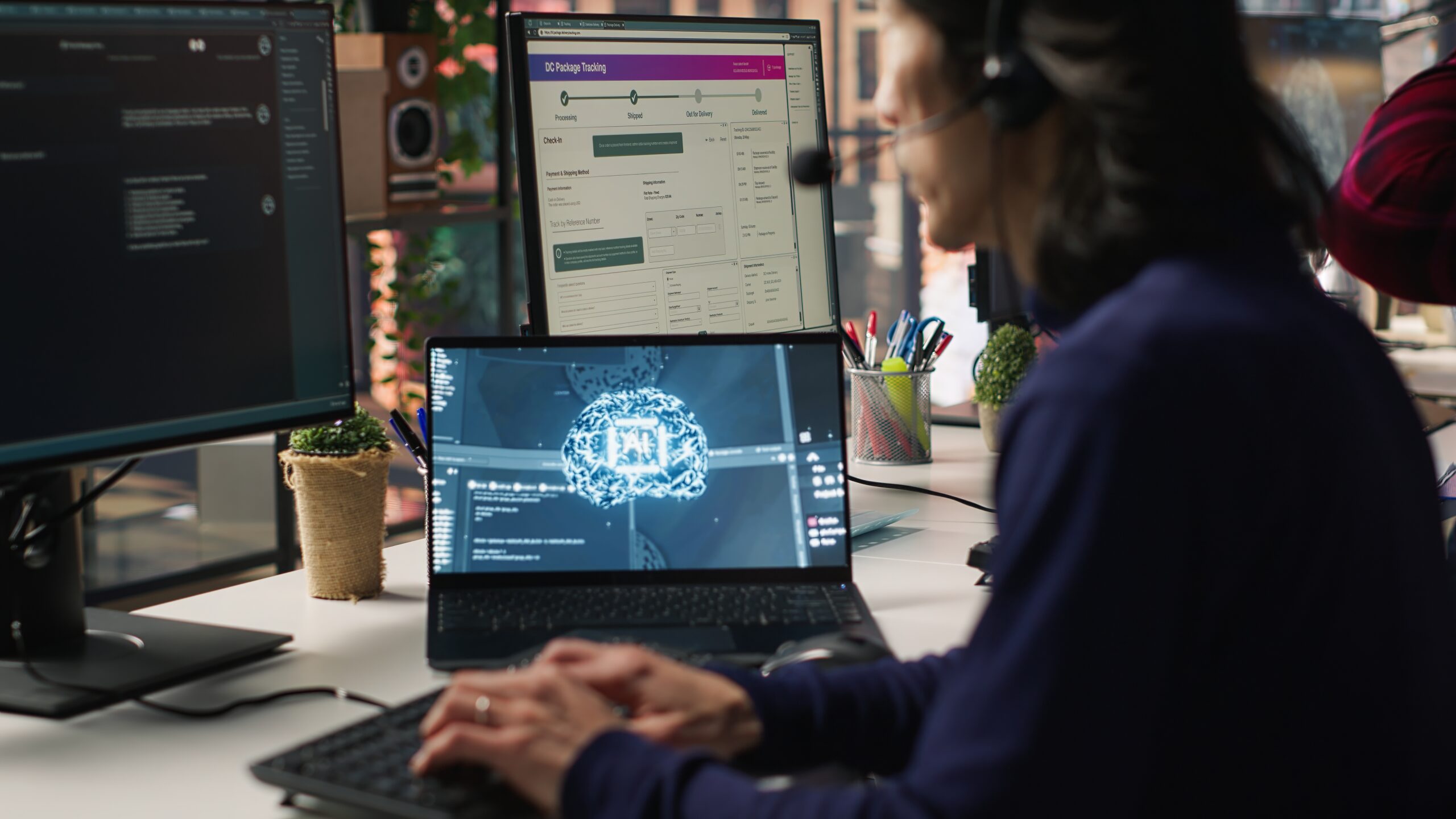
Call center agents track shipments in office using AI chatbot for help. Customer center workers use artificial intelligence assistance to locate clients packages and provide status updates, camera A
Introduction
The year 2025 has brought a new wave of innovation in software development, and at the center of it lies AI-powered testing. For decades, developers have shouldered the responsibility of ensuring software quality, but as systems become more complex—with AI integrations, cloud-native deployments, and real-time data pipelines—traditional methods alone are no longer enough. AI testing tools, equipped with machine learning and predictive analytics, are stepping in to detect errors faster, more accurately, and at scale.
For Eduonix learners eager to build thriving tech careers, this is more than just a passing trend. The ability to understand and apply AI-powered testing is becoming a core competency that employers actively seek. The question is no longer whether AI will support testing, but whether machines might actually surpass developers in finding bugs. This blog takes a closer look at why AI-powered testing matters, what risks developers face by ignoring it, the myths holding some learners back, and how you can master this skill to stay competitive.
Why AI-Powered Testing Matters in 2025
Modern applications are evolving at breakneck speed, and with that evolution comes unprecedented complexity. AI-powered testing offers a way to manage this complexity while maintaining high-quality standards. These intelligent systems analyze massive amounts of code, predict error-prone areas, and automate repetitive test cases. For developers, that means reducing manual work and increasing confidence that critical issues are being flagged early in the development cycle.
A 2024 report by Pulse Solutions revealed that organizations adopting AI-powered testing reduced manual testing effort by nearly half, freeing developers to focus on higher-value problem-solving. This trend is especially important as more companies adopt continuous integration and deployment pipelines, where fast feedback is essential. Ignoring AI tools risks slowing down releases, increasing bugs in production, and ultimately disappointing users.
Eduonix learners who embrace AI-powered testing gain the ability to deliver stronger applications—whether it’s a simple web platform or an AI-driven chatbot. This skill doesn’t just improve project outcomes, it also boosts employability. In fact, a LinkedIn study showed that nearly 80% of tech recruiters in 2024 prioritized candidates skilled in automation and AI-driven quality assurance. Clearly, mastering AI-powered testing isn’t optional; it’s becoming a prerequisite for success.
The Cost of Ignoring AI-Powered Testing
Sticking to manual testing alone in 2025 can have significant consequences. While human testers bring intuition and creativity, the process is time-consuming and vulnerable to oversights, especially when dealing with edge cases or distributed systems. Businesses end up paying the price. Gartner estimated that software downtime caused by undetected bugs costs companies an average of $7,000 per hour—a staggering loss that startups and enterprises alike can’t afford.
For learners, neglecting AI tools translates into missed opportunities. Buggy applications not only frustrate users but also hurt developer credibility. HubSpot reported that poor software quality is a major contributor to churn, with nearly a quarter of users abandoning products plagued by defects. Even more concerning, IBM’s 2024 analysis revealed that over a third of project budgets are often consumed by rework due to bugs that should have been caught earlier.
From a career perspective, the consequences are equally severe. Employers increasingly favor candidates who can integrate AI testing into modern workflows. Without these skills, developers risk falling behind peers who can deliver faster, higher-quality code. In a market where innovation moves quickly, ignoring AI-powered testing doesn’t just create software vulnerabilities—it creates career vulnerabilities.
Debunking Myths About AI-Powered Testing
Despite its clear benefits, myths about AI-powered testing still persist, holding many back from adopting it fully. One widespread belief is that AI tools will replace human developers. In reality, the opposite is true: these tools are designed to complement human expertise by automating repetitive, error-prone tasks, freeing developers to apply their creativity where it matters most. McKinsey research even found that hybrid approaches—where humans and AI collaborate—boost productivity by nearly 30%.
Another misconception is that AI-powered testing is too advanced for beginners. While it’s true that the underlying algorithms are complex, many platforms today are designed with user-friendly interfaces, making them accessible even to those just starting out. Similarly, some assume these tools are only relevant for large-scale enterprise systems, but recent studies show they perform just as effectively in smaller applications, catching significantly more bugs than manual testing alone.
Finally, there’s skepticism about the reliability of AI-generated results. Yet the very nature of machine learning means these systems improve over time, refining their accuracy as they analyze more data. Far from being unreliable, AI-powered testing often outperforms humans in detecting subtle patterns or anomalies in code that would otherwise slip through the cracks.
Ten Reasons AI-Powered Testing is Transforming Development
The real strength of AI-powered testing lies in its versatility. These tools can detect complex bugs—like race conditions in JavaScript or memory leaks in C++—with far greater accuracy than human testers. They speed up testing cycles by automating repetitive checks, cutting development time in half in many Agile environments. They scale effortlessly with projects, ensuring quality is maintained as applications grow, and they harness predictive analytics to forecast problem areas before they cause failures.
The financial benefits are equally significant. Companies adopting these systems save substantial portions of their QA budgets, freeing resources for innovation. Developer productivity improves too, as less time spent on repetitive validation means more time creating new features. The career impact is undeniable—LinkedIn surveys consistently show that candidates proficient in AI testing stand out in job markets worldwide.
For learners, these advantages are more than statistics. They represent tangible skills that can lead to better jobs, faster promotions, and greater confidence in the software they build. By understanding how AI-powered testing works and applying it in practice, Eduonix learners can future-proof their careers against obsolescence.
How Eduonix Learners Can Master AI-Powered Testing
Mastering this field doesn’t require a computer science PhD. It starts with exploring accessible tools like Testim or Mabl, experimenting with small projects to understand how AI adapts to changes in code. From there, learners can progress to advanced platforms such as Functionize or Applitools, which specialize in automating backend and visual tests. Real-world practice is key—open-source projects on GitHub or personal applications are great playgrounds for honing these skills.
Equally important is integrating AI testing into development pipelines. Using systems like Jenkins to run AI-driven tests with every code commit ensures bugs are caught early and fixed before reaching production. Collaboration also plays a big role, as AI-generated reports are designed to make cross-functional teamwork smoother by providing clear, actionable insights.
To go deeper, Eduonix’s own Data Science Mastery course provides the theoretical foundation to understand how machine learning powers these testing tools. By learning not only how to use the platforms but also why they work, learners position themselves as adaptable developers who can keep pace with future innovations.
Real-World Stories of Success
AI-powered testing isn’t just a theory; it’s already reshaping careers and companies. Developers using tools like Mabl have reported catching dozens of bugs before launch, saving their teams weeks of rework and securing high-paying roles. Engineering teams at companies like Spotify have integrated visual testing solutions to maintain consistency across platforms, dramatically reducing user complaints. Startups using Functionize have slashed release cycles while saving tens of thousands in QA costs.
These stories highlight a broader truth: mastering AI-powered testing is more than a technical upgrade—it’s a career accelerator. As tools evolve and adoption grows, those who can confidently wield them will become leaders in their teams and industries.
Conclusion
AI-powered testing is no longer optional in 2025—it is essential. For Eduonix learners, this represents a unique opportunity to stay ahead of the curve, combining technical proficiency with forward-thinking adaptability. By embracing these tools, debunking the myths, and building hands-on experience, you can deliver software that’s not only reliable but also innovative.
To complement your journey, resources like Eduonix’s How AI is Revolutionizing Software Development: Copilot vs. Human Coders blog provide deeper insights into the changing developer landscape, while CodeCondo’s guide on securing your APIs offers practical advice on building robust systems. Together with structured learning through Eduonix courses, you’ll gain the knowledge and skills needed to thrive.
The future belongs to developers who embrace change. With AI-powered testing, you won’t just keep up with 2025—you’ll lead it.
About the Author